A few days ago, the long-awaited MMO “WildStar” was finally released, and I said goodbye to reality for almost a week to achieve my sprint to the maximum level.
What I particularly enjoyed and which points stand out negatively, you will find out in this review.
As is typical for the genre, you first have to choose a faction (Dominion or Exiles), a race, and a class. Those who want to read more about the species and how they found each other should take a look at this article.
A total of six classes are available, half of which have healing abilities while the other half can act as tanks – all can deal damage, of course.
At the beginning, all classes have few abilities. By the time you reach the maximum level of 50, the number increases to 30. But beware: You can only take 8 of them into battle, but you can choose freely. This variety ensures that no Esper plays the same, and you are always faced with a torturous decision: Do I take another damage ability, or would I prefer a stun? Do I save a healing ability for emergencies? Every attack has its justification, and there are very few “must-have” abilities.
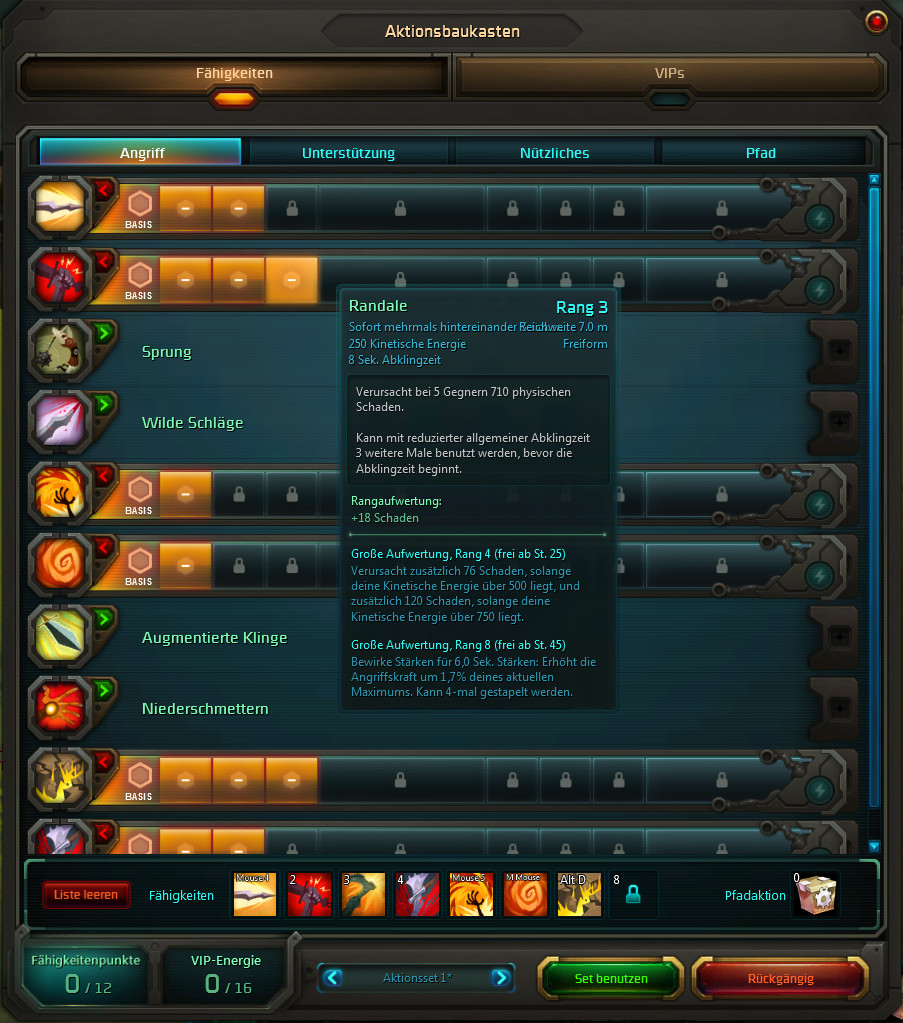
Additionally, you can improve each ability up to 8 times to enhance its damage, healing, range, or effect duration. At the 4th and 8th improvement stage, an ability may even change fundamentally. A summoned companion, for instance, may gain life steal, or a ranged attack may throw enemies back several meters.
Lastly, you gain VIP points (or AMP in English). This resembles a classic talent tree where passive abilities can be enhanced. Critical strike chance, armor penetration, or reduced spell costs await in the first ranks – and then it’s a dead end.
However, if you want to delve deeper into the VIP tree, you first have to unlock the corresponding talents for purchase and find them in the world, which can sometimes be quite laborious. But those who undertake the search will be rewarded with stronger talents that can ultimately unlock entirely new abilities – one of the game’s first calls to explore the world.
Every beginning is difficult
After clicking through the relatively extensive character editor, it takes a while to get oriented, because unlike, for example, in World of Warcraft, your character only takes up a very small part of the screen – this is incredibly important for keeping an overview of everything in the world, but it feels strange at first.
The interface is significantly better than it was during the closed beta, but some decisions remain hard to understand. Why is the character screen accessed by default using “P”? Why do some functions, such as the Codex, which contains all the important background information about the world, have no key mapping at all? I can only speculate about these decisions, and every MMO veteran might consider changing the key bindings to align with long-established gaming standards.
Background story
For a completely new world, the developers at Carbine have gone to great lengths to fill each of the races with life while staying true to their humor. Whether you take the Lopp as an example, a race of space bunnies incapable of digging themselves out of holes, the constantly drinking Granok rock people, who must make some “rocky” innuendo in every sentence, or the sisterhood of the Torine, a mysterious clan of Amazons who worship an ancient power. There is a wealth of background information available for each species – those who are not interested can simply ignore it. No one is forced to read.
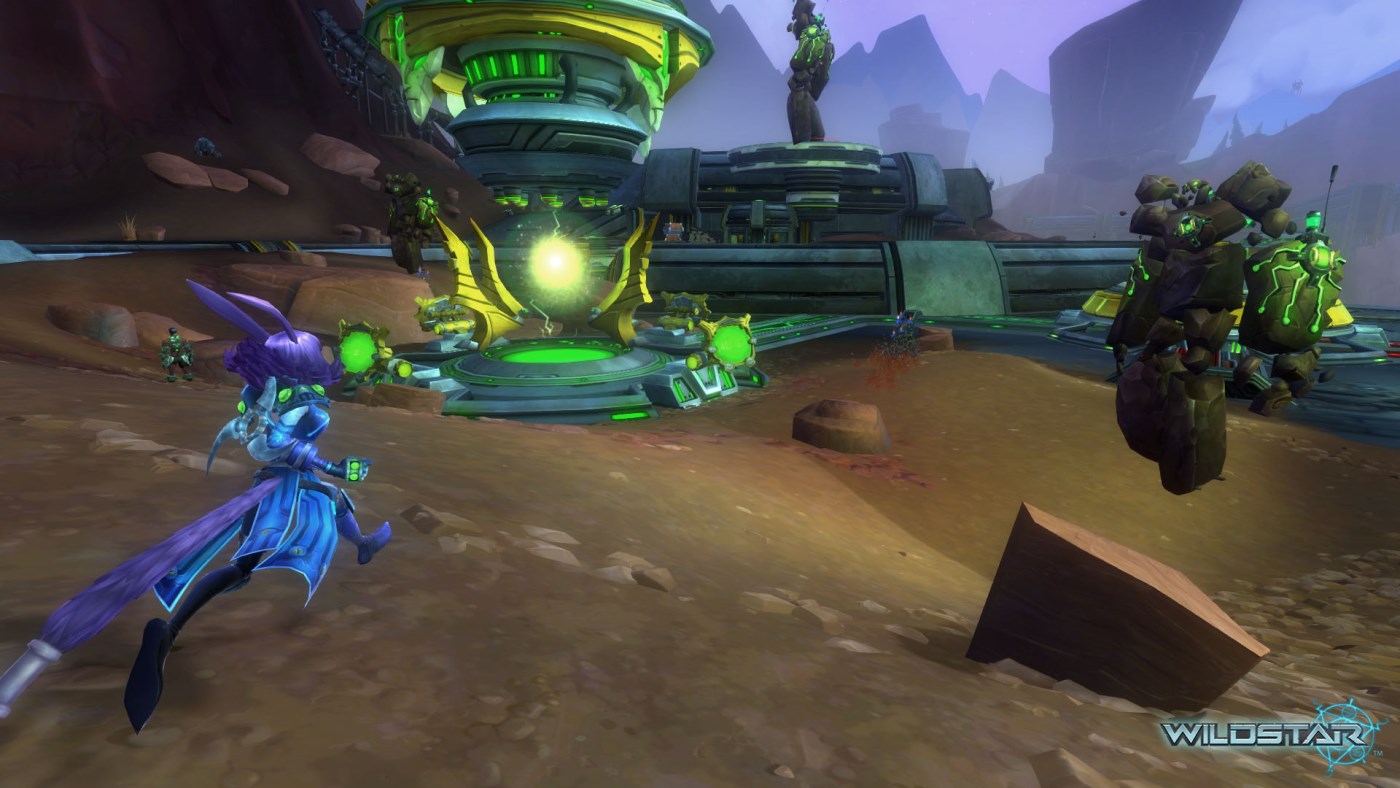
Each area tells a small story, and you repeatedly find data cubes left behind by the mysterious Eldan that provide a glimpse into their actions. If you listen carefully, you will eventually recognize what they tried to do on the planet Nexus and where they might have disappeared to… but I won’t spoil that.
Starting at level 35, the areas begin to build on one another more strongly, and you unlock solo instances that tell a slightly more epic story. Although there are only a handful of these instances, each one is relatively long and unique. They are simply beautiful, exciting, and incredibly interesting.
The only downside is that upon “completing” the main story, you are left a little hanging. You are still urgently expecting that one big resolution that is hinted at everywhere and repeatedly, but it remains absent for now. But, well, two more areas are already marked on the map that will only be made accessible in the coming weeks – and heaven help us if the main story doesn’t continue there!
Presentation of the game world: Fun is guaranteed!
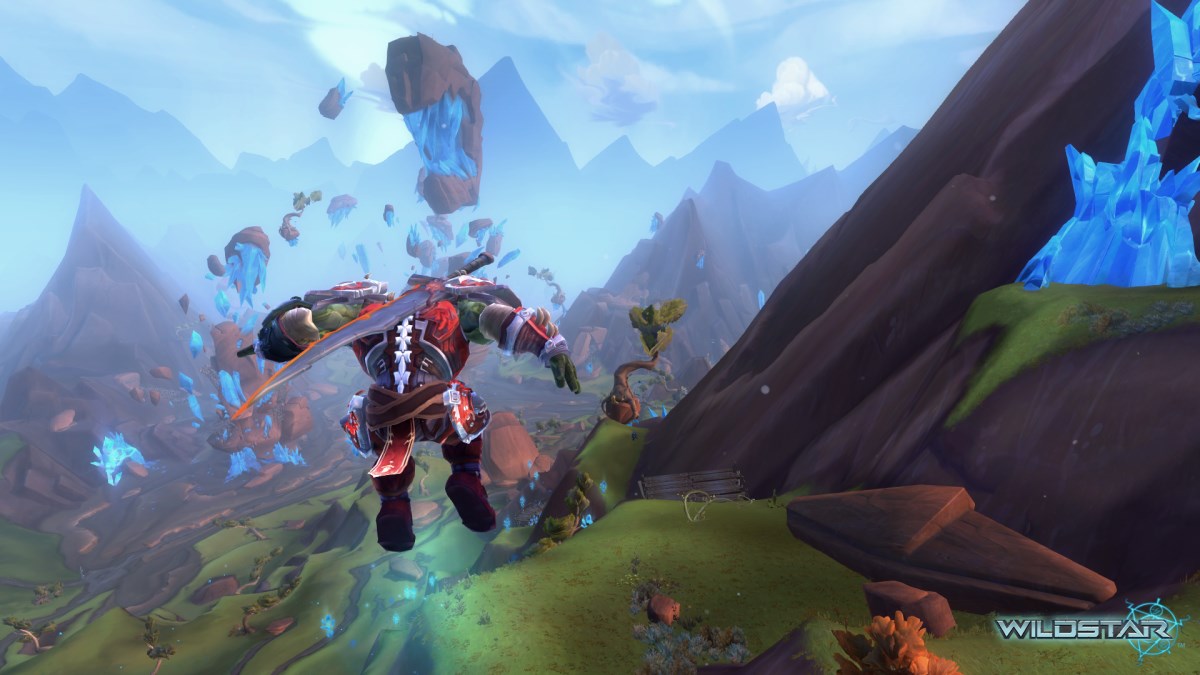
If the developers succeeded in one thing, it’s creating a cohesive game world from scratch that overflows with humor without ever really appearing ridiculous. With every level-up, the narrator yells at you, literally telling me “how awesome I am” for just reaching a new level.
However, if I die and have to revive at the next graveyard, the mocking voice of an Eldan sounds, who insults me for failing yet again, but always in a humorous manner. My favorite line so far has been: “In this world, no one stays dead forever, but I find it nice that you try so hard.”
This continues with the various races of Nexus, whose codex entries have made me laugh more than once. The Aurin, for example, are a race of “tree-huggers” and nature lovers, and clever players can receive the following lore entry – a dime novel by the Aurin:
Overwhelmed with desire and almost bursting with ripe fruit bodies, the Elder trembled as he gazed into the face of the new Matria of the village. Unseasoned and untried, she studied the bark of the tree sage as she traced her fingertips along the lines on his aged surface. “But this love must not be,” whispered Matria Wanderheartforest. “I am a Matria. But I have studied. You – you are, as I believe, a hybrid of three different tree sages. You are the ultimate tree sage.” She laughed. “Now,” she says playfully, “I believe I want to climb a tree…”
But humor is not everything. There are very serious scenes where NPCs die, or you even trigger a mass execution, after which you genuinely question whether you should have accepted that quest. Although the selection of soundtracks in WildStar seems smaller than in other MMOs, each track fits perfectly with the setting. The mysterious Eldan laboratories sometimes create a truly eerie atmosphere, and the lively music in the forests of the world makes you forget about the war for Nexus at times. The world is cohesive, and those who can warm up to the comic look will truly sink into it, only to resurface when server maintenance begins.
The combat system: No rest – for anyone!
Let’s get to the absolute heart of every MMO, the combat system. Similar to Guild Wars 2 or TERA, many abilities can be used while moving. At the same time, every attack also has an area effect: Melee attacks, for instance, have a small cone in which they take effect, while spells and ranged attacks produce a straight line of about 30 meters long and 2 meters wide.

The different hit areas are called “telegraphs” in WildStar and can be seen by both friends and foes as soon as you start an attack. Thus, the challenge in battles is to direct your blue telegraphs at as many enemies as possible while dodging the threatening red telegraphs.
Especially boss enemies have very complex telegraphs: Imagine a large circle from which you casually jump out, but at the last moment, big hooks protrude from the round area, and the whole thing starts wildly rotating. A handful of these telegraphs are only briefly displayed, and often one or two hits are enough to send your character to the next graveyard. Yet it is never frustrating: With each death, you know exactly what you did wrong and won’t make that mistake a second time.
Better yet: If you manage to interrupt an enemy during a particularly powerful attack, that enemy becomes vulnerable for 3 seconds and takes an additional 50% damage – thus tactical use of stun effects is doubly rewarded.
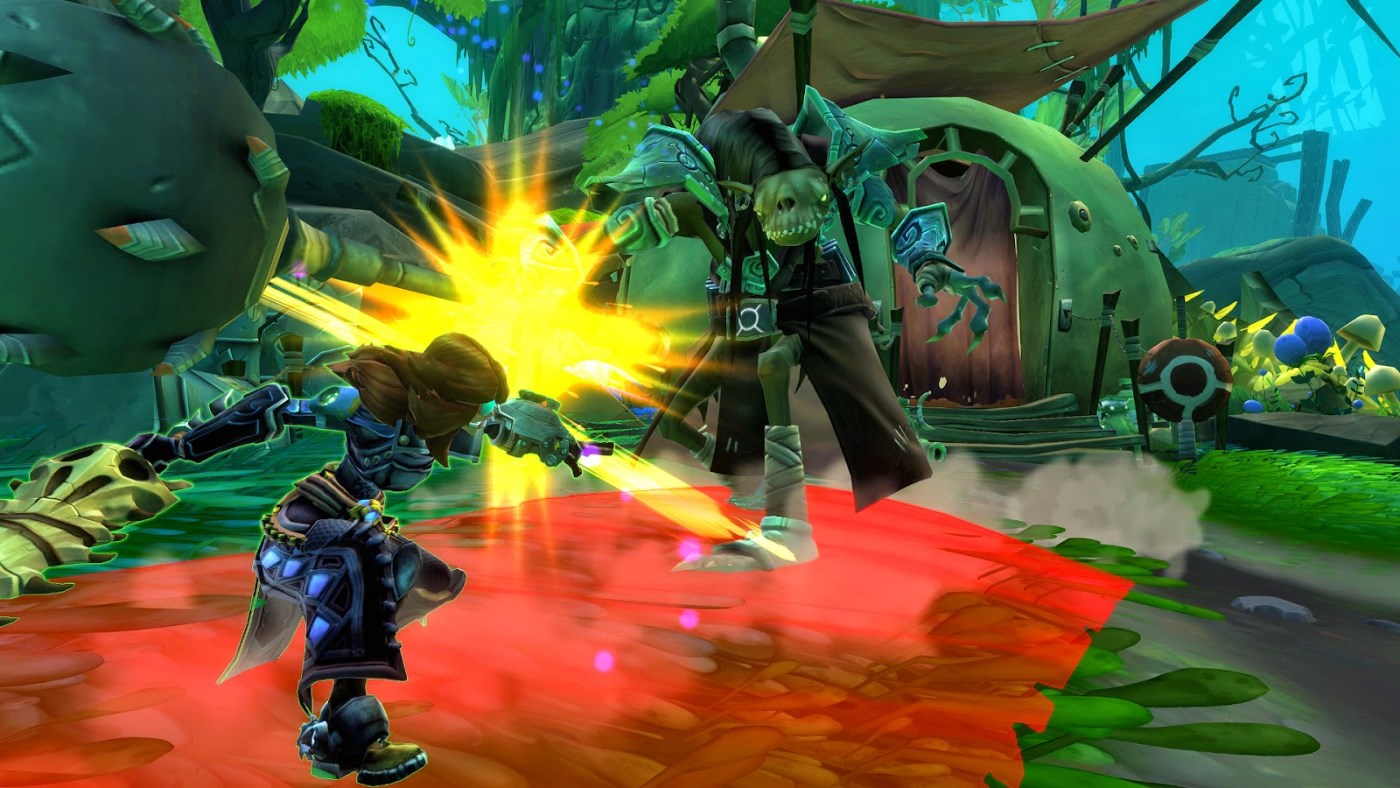
You can flip it and turn it any way you want: The combat system is incredibly fun. Never before in an MMO have I found myself so engrossed in purely hunting opponents that I forgot I had completed the quest 15 minutes ago. And this hasn’t happened just once or twice, but regularly. The fights are dynamic, and it’s easy to fall into a “flow”; or to quote a fellow player: “I feel like a damn Space Marine battling endless hordes; I don’t want to turn in the quest yet!”
Quests and Challenges
Let’s not kid anyone: The quests in WildStar are not a reinvention of the wheel. Nearly all tasks fall into the three most well-known categories “Kill!”, “Collect!” and “Deliver this from A to B!”.
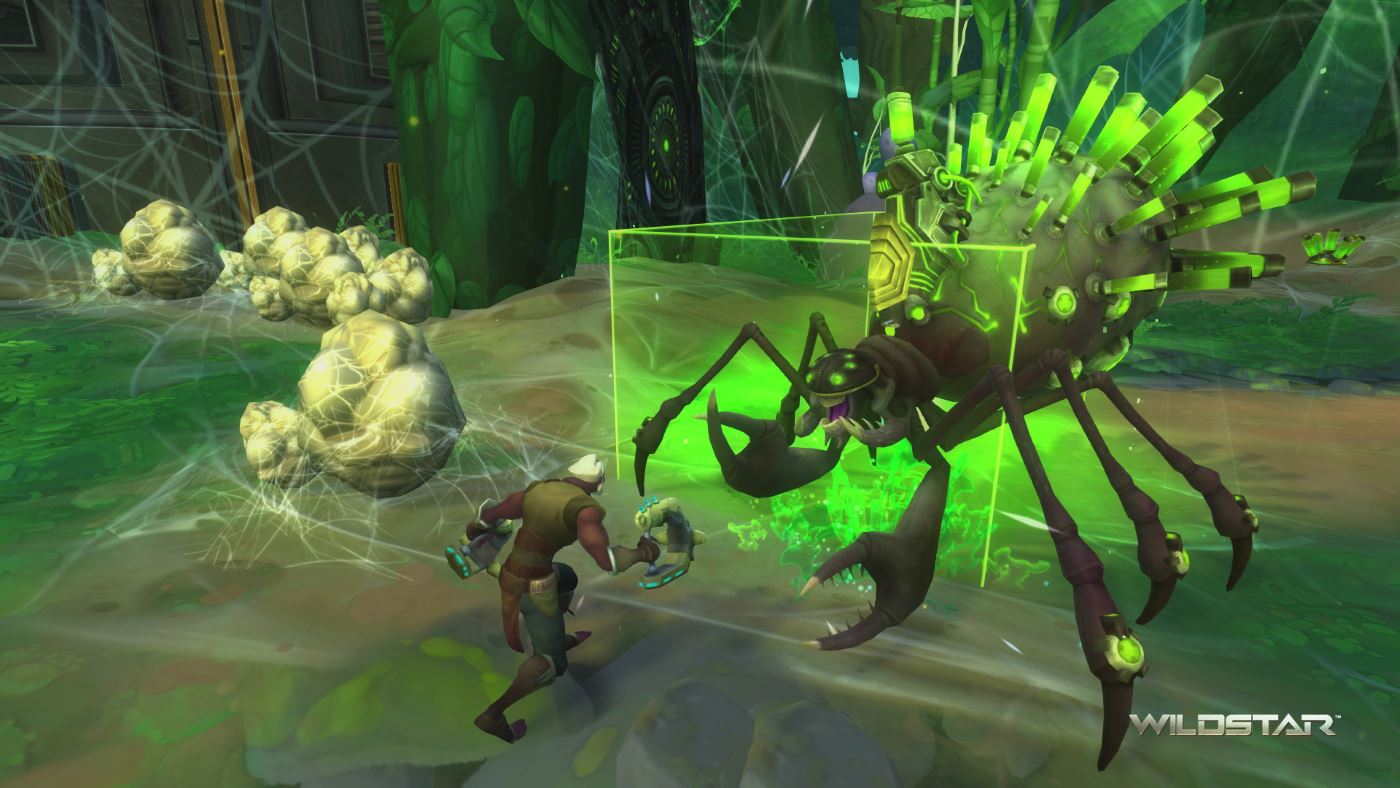
Nevertheless, I can say with a clear conscience: Killing, collecting, and delivering has never been so much fun. It’s the first game where the quest doesn’t require any other system because the combat system and the many explorable areas turn even the normally boring “Kill 30 of these because they stole my cake” task into the greatest pleasure.
When questing, WildStar completely relies on the exciting battles: A bet that the developers have won. And truly, every time the thought creeps in, “Kill again…”, you hear the narrator shout, “CHALLENGE BEGINS!” and a timer starts ticking down. These challenges are completely optional and can be best compared to “bonus goals” from other games. If you fulfill them narrowly, you receive a random item. The better you perform, the more precisely you can choose what you would like to have. And that one housing item simply looks too good…
Objectively speaking, the quests in WildStar are standard MMO fare, but there’s just one problem: With the constant adrenaline rush, you can’t be objective. It’s fun.
Furthermore, it should be noted that leveling takes relatively long and is comparatively difficult. Unlike in WoW or SW:TOR, you can never be sure that you can defeat the enemy you are currently attacking. During my sprint to level 50, I died many, many times, and what can I say? It was a refreshing experience to finally have to fight for progress!
The Paths – Kill or Explore?
Every character chooses a path upon creation, either Scientist, Soldier, Settler, or Explorer. Each path has additional missions, which are typically distributed in the usual quest areas. What makes paths particularly special?
First of all: They are completely optional, and you don’t have to worry about them if you don’t want to. However, if you do engage with them, they reward you with titles, costume equipment, and useful abilities like group summoning or a fall damage mitigator.
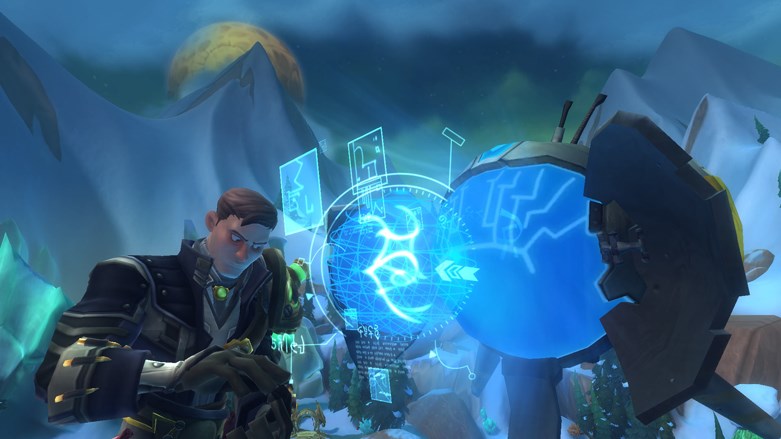
Soldiers mainly experience more kill missions; they either need to defend points against enemies or defeat particularly difficult bosses. Scientists study the world of Nexus and discover much about the background story or can analyze certain enemies to weaken them or gain useful buffs. Settlers can build multiple constructions at fixed positions in the game world that benefit all players: buff stations for additional experience points or even entirely new quest hubs. Finally, Explorers investigate every nook and cranny of the planet and must solve jumping puzzles to reach the highest peaks or the deepest caves.
The most fun comes when you wander around with a whole group and each path is represented once: Because you can help your colleagues with their path missions and gain progress in your own – practical and fun!
Dungeons and Adventures – 5 people die just as beautifully as one alone
From level 15, there are regular accesses to Adventures and Dungeons, the primary group content of WildStar. Dungeons are quite classic: a more or less tube-like area where you send the bosses off one by one.
The special twist: Each instance has a lot of challenges that you can complete for additional rewards. If you complete the instance within a certain time limit, defeat mini-bosses in the correct order, or rescue all captured NPCs, the reward in the form of loot and experience points increases. This allows even random groups to complete an instance, but those who truly want to loot everything will need to plan carefully with their group. The same system also applies to the much harder veteran dungeons, which are only accessible at level 50. Enter at your own risk.
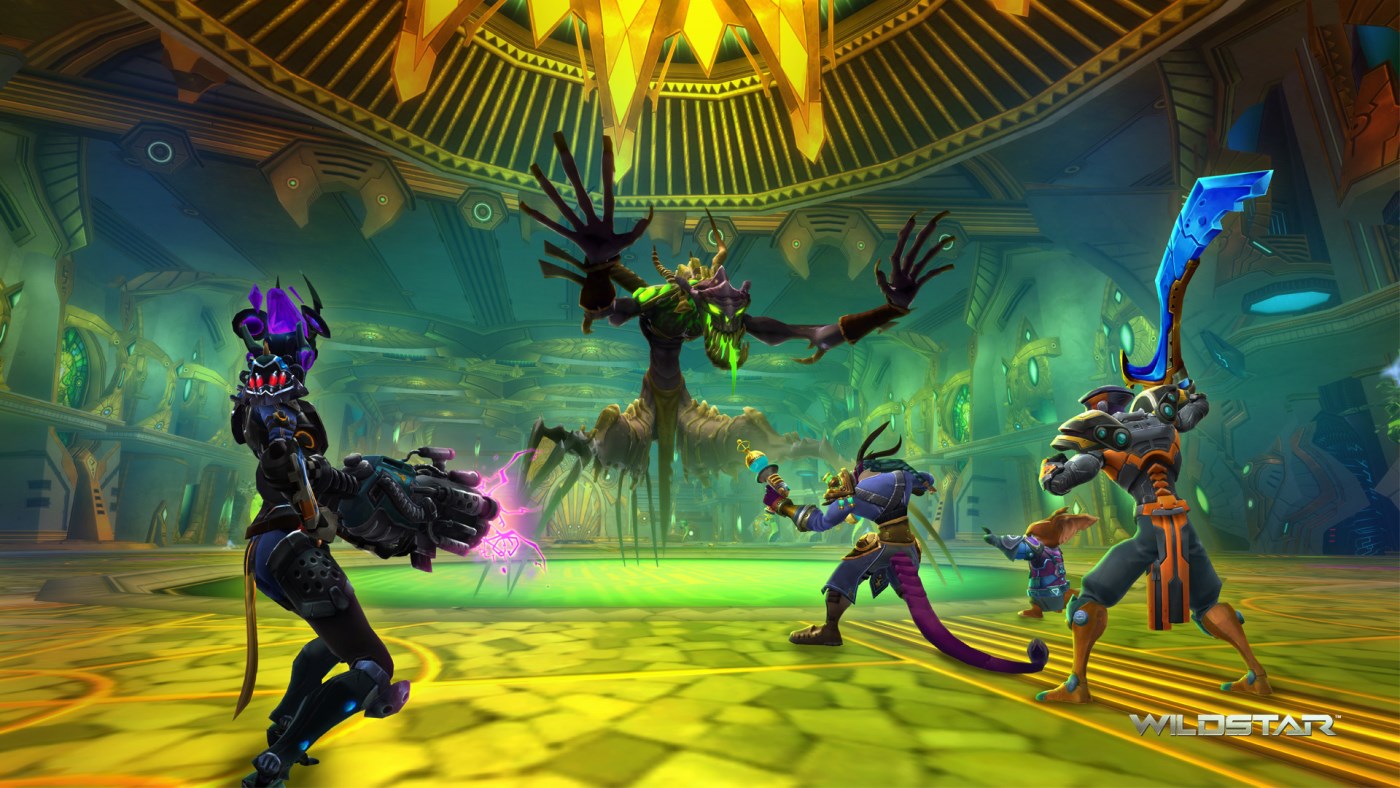
Adventures resemble small stories, where all participants can choose how they want to proceed: Should the farmers be supplied with weapons, or is it better to sabotage the enemies? Should we give the merchant his gold back or invest it in bribing a lookout?
Such decisions are made democratically, which ensures that the same adventure plays out differently every time and can lead to a different ending. Of course, there are already people who prefer the