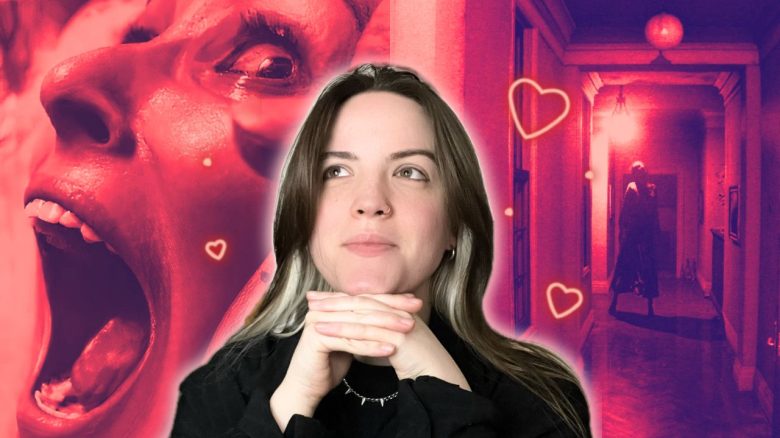
There are different types of horror, but they all share a common goal – to provoke discomfort. But why does the genre split its audience so much, and how can it, despite this uncomfortable feeling, captivate so many people? MeinMMO editor Caro also loves the genre because there is hardly another that can move her so much.
You get scared, feel creeped out, are tense and can hardly look or listen at times. You are confronted with things that definitely shouldn’t evoke a cozy feeling – and yet many horror fans regularly choose to seek out just this feeling.
Some do this with books, others watch horror movies, and others immerse themselves in games to get even closer to these horrific situations. But why is that?
Some might suspect that it’s a fondness for the morbid, that people revel in the suffering of others, and that horror fans are just masochists. Yes, perhaps some of that is true in certain cases, but there are psychological reasons why people willingly place themselves in these uncomfortable situations, and they are not as macabre as one might think.
Despite fear and disgust, fans feel particularly at home in the genre
Although horror movies and games evoke negative feelings, they are still very popular. Similar to actual threats, a horror movie activates the sympathetic nervous system, which is responsible for the involuntary control of organ activity (source: B. L. Kiss on Springer Nature): Breathing becomes shallow, you are more alert, and your heart beats faster. You are on high alert.
Behavioral researchers and professor Haiyang Yang and his colleague Kuangjie Zhang studied the reasons many people eagerly seek out such feelings voluntarily (source: carey.jhu.edu).
In addition to the physical stimulation caused by fear and coping, horror entertainment offers the opportunity for new experiences that one would hesitantly make in reality. The medium acts like a safety net, allowing viewers to satiate their curiosity about the darkest abysses of humanity while also daring to experience and cope with borderline stress situations.
Movies and games are not real, you as a viewer or player are completely safe and have control and the freedom to decide when to engage with these dangers and thrills. A controlled danger that you voluntarily confront and can overcome.
Even Lauri Nummenmaa, head of a laboratory for human emotion systems and neuroscience, supports this thesis but explains that the feeling of fear alone does not account for the popularity of horror. “Part of the pleasure of horror films comes from the relief after the tension,” Nummenmaa says (via The Scientist). The adrenaline rush following such a physical and emotional experience after a horror movie stimulates the brain’s reward center, triggering the desire to experience the thrill again. “The enjoyment often results from the fact that we can actually experience these strong emotions in a safe environment.”
More emotional than expected – why horror can resonate with me more than other genres
Warning! Mild spoiler alert for P.T. and a fairly explicit spoiler alert for the ending of The Substance.
I love horror; I can leave that as a statement, even though – or perhaps especially because – I can confront various uncomfortable contents in a self-chosen setting.
With uncomfortable contents
, I do not always mean just brutal slaughter or grotesque monsters (don’t get me wrong, both have their rightful place, and fun slashers as well as intense monster designs can also really resonate with me). It’s about unspoken taboos, societal dangers, and simply themes that evoke existential fears – and I thank all horror projects for giving me the opportunity to engage with them.
“P.T.”, the interactive teaser for the canceled but never forgotten Silent Hills, was a true boundary experience for me, which fascinated me from beginning to end. I hate jump scares; I am quite jumpy despite my love for the genre, but P.T. plays with the far worse aspect of suspense that slowly but surely emotionally and physically shredded me.

When I get scared, the moment of fear passes quickly. But as I looked at this baby and heard something moving behind me when a door opened but nothing came out, or when Lisa just stood there and we stared at each other: In those moments, I held my breath and could hardly move from suspense and fear – and I love P.T. for that.
Internally, I know: It’s a game, just a game, I can stop this uncomfortable feeling anytime if I want. But I don’t want to.
A horror film gave me the most emotional cinematic experience that still occupies me today
The aforementioned feeling of catharsis, the sense of release and relief in the horror genre, created an emotional cinema experience that could make cinephiles envious – and I felt that precisely in Coralie Fargeat’s body horror film “The Substance” from 2024.
The film roughly portrays the experiences of a 50-year-old former actress who struggles with her appearance due to the reactions of her environment, the industry, and her self-perception. To feel better, she subjects herself to an experimental substance that brings severe side effects if the rules are disregarded, which thoroughly “mixes up” the body but also one’s identity.
The protagonist, Elisabeth Sparkle (played by Demi Moore, who was nominated for an Oscar for her role in the film), suffers increasingly from the influence of the substance and the expectations and reactions of a society where the value of women is reduced to their appearance.
As she reaps the fruits of her decisions at the end of the film and is attacked during a live broadcast as an absolute body horror monstrosity in front of an assembled audience, I couldn’t look away despite the disgusting image.

The scene where “Monstro Elisasue” (the name of the mutated Elisabeth) begins to drench all viewers with a fountain of blood from a severed arm elicited – as absurd as it sounds – one of the most intense emotional reactions I have ever experienced through a film.
The adrenaline, the catharsis, the absolute escalation, mixed with all the impressions and feelings that had built up to that moment, all burst forth at that moment. You are wrapped in brutality, rage, and so much blood that one might think a red filter lay over the image. I felt like I was at the finale of a concert; it swept me away so intensely. No other film or genre has managed to evoke that yet.
(However, my girlfriend was living proof that this does not apply to all viewers, as she would have preferred to hide under her cinema seat.)
In the making-of of The Substance, you can see how this scene was created – if you start the video here, you will be directed to the relevant part without seeing other spoilers:
Even though feelings like alertness, fear, and adrenaline are not directly associated with “relaxation”, horror films and games are the type of entertainment I look forward to when I want to enjoy a nice evening. Because even though they challenge me emotionally, I feel that in the quieter moments, I can finally switch off properly.
Do you feel the same way? Or should horror be kept far away from you? Feel free to share it with us in the comments – suggestions for your favorite horror pieces are explicitly welcome!


Whether this love for horror has already developed in my childhood is hard to say, but it could be due to some films that, despite the label “family film”, disturbed way too many children: Here are 10 movies from your childhood that you saw far too early