
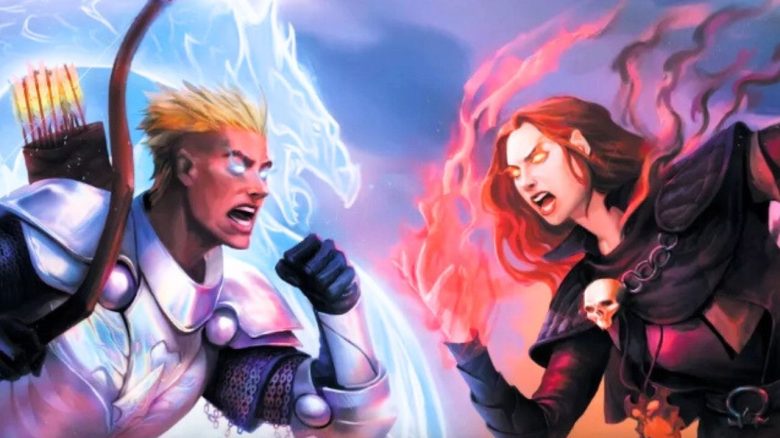
Many players strive for power in Dungeons & Dragons and are excited to become even stronger with each level up. However, many game masters say that this can hinder the fun of the game. MeinMMO editor Caro agrees with this, even though she is a player herself.
In Dungeons & Dragons, characters – whether player characters, NPCs, or enemies – gain a level up more or less regularly through accumulated experience. This makes them more powerful and capable of overcoming tougher challenges.
With increasing levels, a game master not only has to use fiercer dangers that players must confront. The characters also gain abilities that bring stronger effects. Battles bring more risk, tougher consequences, and sometimes really difficult decisions.
This is exactly what many players long for, and for good reason.
I myself, as a player currently at level 9, am also curious about what cool fights my group and I will experience at higher levels. However, I already know that in our campaign, level 16 is the limit, and that we will never experience the maximum power of a level 20 hero – but that’s okay.
Level ranges clearly show the power dynamics between levels
On the topic of a level cap, opinions are divided among players and leading figures from the community: While some players want to wield the power of a god, others strictly refrain from such an extent.
To better understand the sharp differences in power levels from levels 1 to 20, one can refer to the description from the Player’s Handbook for D&D (2024):
- Level Range 1 (Level 1–4): In level range 1, the characters are newbie adventurers, even if they already stand out from the general population due to their extraordinary abilities. […] The dangers they face are usually threats to local farms or villages.
- Level Range 2 (Level 5–10): In level range 2, the characters have become full-fledged adventurers. Spellcasters learn iconic spells such as Lightning Bolt, Fireball, and Raise Dead. Most weapon-based classes gain the ability to make multiple attacks in one round. Now the characters are faced with dangers threatening cities and kingdoms.
- Level Range 3 (Level 11–16): In level range 3, the characters have gained enough power to stand out even among adventurers. At level 11, many spellcasters learn reality-altering spells. Other characters gain traits allowing them to make more attacks or create impressive effects with their attacks. Such adventurers often banish threats that endanger entire regions.
- Level Range 4 (Level 17–20): In level range 4, the characters reach the peak of their class features and become archetypal heroes. In their adventures, the fate of the world or even the order of the multiverse is at stake.
These ranges clearly illustrate the power dynamics within the various levels. Already from level range 3, i.e. Levels 11 to 16, spellcasters are capable of altering reality, which escalates further at level 20 with world-changing abilities. With powerful spells like Wish or Word of Power: Death, maintaining balance in a fight – and, to this extent, the fate of the campaign – becomes much more challenging.
It’s all a matter of expectation – Plan a Session Zero!
Of course, this level of power is tempting for players, and the increasing risk is not a threat but rather an exciting challenge. However, this kind of thrill does not have to be the goal of every group that engages with Dungeons & Dragons.
Ultimately, one can resolve the question of a maximum level with perhaps an unsatisfying, but still best counter-question: What do you hope to gain from the shared campaign?
Whether a ban on the highest level range is an option for you depends entirely on your campaign and your expectations: What scope should your adventure take? What do you enjoy the most? Are you willing to lose characters, or would you prefer to experience a long, shared journey?
And it is precisely from these questions that we could determine for ourselves: Level 20 would ruin our campaign.
Not everyone wants to play god
At the beginning of our campaign, our DM decided in mutual agreement that we would only level up to level 16. Consequently, none of us will ever be able to cast a level 9 spell out of our own power. But that is the only right path for us.
And perhaps this limit is also sensible for your campaign, if you have similar starting points as we do:
- The backstories of the characters are more important than world-changing dangers. The scope is therefore narrower, but goes deeper.
- Different experience levels: In our group, there is an experienced player, while the other players (including me) and our DM are in their first campaign. At a lower level, the scope is kept lower so that no one becomes too strong and battles can be decided by one action (quote: “Some people shouldn’t be given too much power”).
- Smaller dangers provide more diversity than just fierce gods or entities. You also don’t want to feel superior outside of combat.
- Fights aren’t everything: Fights are fun and power feels good, but the narrative and role-playing are at least equally important.
Every player has their own reason why they play and love D&D. It can be played in various ways, which is why questions regarding the maximum level meet with different opinions.
From the absolute min-maxer to the role-playing enthusiast, everyone hopes for a different experience, which is why the relevance of a Session Zero is still highlighted: One person wants to conquer lengthy battles in every session, another wants to joke around with NPCs in a tavern – both have their place.


Since my group and I place great value on the story alongside battles, we, like many other D&D fans, step into the shoes of characters that are dear to us. I happened to take on the role of the cliché edgelord in our campaign, but my warlock doesn’t ruin anyone’s fun because I pay attention to certain things: I am the dark cliché warlock in our D&D group, but I don’t manage to annoy everyone with it

Your opinion is important to us!
Do you like the article? Then let us know!