

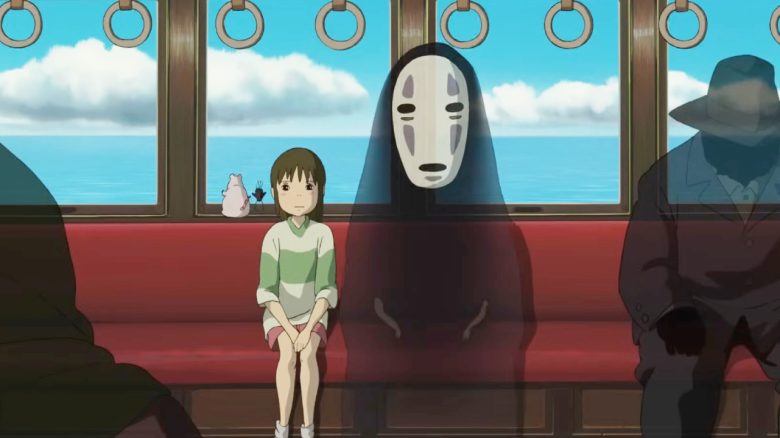
Spirited Away is one of the greatest anime classics of all time. A creature from Hayao Miyazaki’s masterpiece is known by everyone: the No-Face. But what is this monster and what does it represent?
When Spirited Away was released in 2001, the film not only snagged an Oscar at the 2003 awards (albeit a bit late): it made Studio Ghibli famous worldwide and remains one of the most well-known anime films of all time.
The film captivates mainly through the colorful world into which protagonist Chihiro travels. The various spirits are the big highlight. The most famous inhabitant of this world is probably No-Face. But what is this spirit and what does it represent?
An Original Creation by Hayao Miyazaki
What is No-Face? Even though Miyazaki often draws inspiration from Japanese folklore, No-Face is not based on any mythological figure or Yōkai. It is an original creation. It is a large black creature with a mask for a face. The mask resembles Japanese Nō masks used for a special form of theater. Whether this was the original idea for the mask remains unclear.
In Japanese, No-Face is called Kaonashi. This translates roughly to faceless
. This aligns with Miyazaki’s explanation, which was quoted by the x-account of Kinro_ntv (a special Friday TV slot on Nippon TV that regularly shows Ghibli films) in 2024. In German, Miyazaki says:
There are No-Faces everywhere. I believe there are people who want to attach themselves to someone, but who have no sense of self.
Why is this relevant for the film? In the film, No-Face, after showing that it can seemingly create gold, is besieged by the employees of the bathhouse. They praise it for its donations, which seems to please it. However, when Chihiro thanks it but does not accept its gift, it transforms into a mad monster that seemingly tries to consume everything out of greed.
When Chihiro confronts No-Face, she tells it: It would be better if you went home. […] Where is your family? Don’t you have a dad and mom?
No-Face responds: No, no, I am alone, all alone.
Afterward, she travels with No-Face by train. While all the guests slowly exit the vehicle, No-Face and Chihiro remain. In the end, No-Face stays with the witch Zeniba and helps her in the house.


How can No-Face be interpreted? Along with Miyazaki’s statement, No-Face could be an identity-less spirit wandering forever to form its identity, good or bad. This spirit only does so through other beings, which is why it wants to please everyone. Therefore, No-Face became so greedy and gluttonous in the bathhouse because it adapted to the greed of others.
If one were to project this onto the real world, the film could point to people who desperately try to please everyone, but suppress their own interests, emotions, and thoughts. They adapt, but without showing and developing their own identity. However, in Spirited Away, No-Face had a good ending. The spirit was accepted by Zeniba without having to constantly give.
But this is just one interpretation of the film and Miyazaki’s words. As often, you can see Spirited Away and its characters from different perspectives. The Ghibli legend is also not known for explaining everything in his films. How the film ranks can be seen here: All Ghibli films ranked by IMDb

Your opinion is important to us!
Do you like the article? Then let us know!