

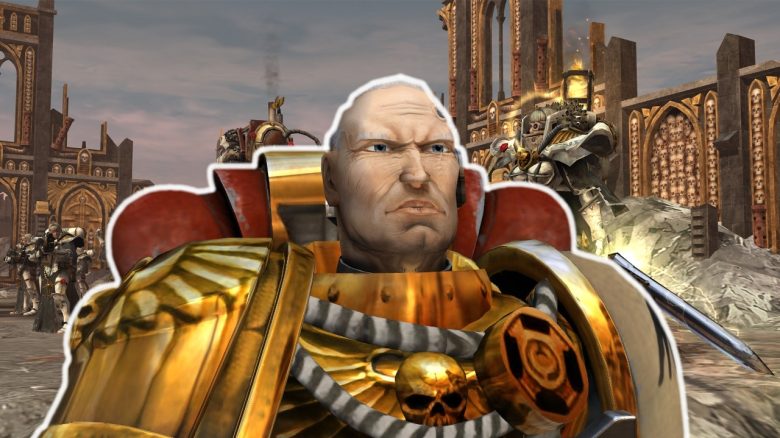
The remaster of Dawn of War is here and one question arises: How well has one of the best strategy games of Warhammer 40,000 held up after 21 years? MyMMO author Odysseas Grigoriadis has already tested the new Dawn of War – Definitive Edition and tries to answer this question.

When I first started the game, I was immediately overwhelmed by a feeling of nostalgia, even though I had never played the original Dawn of War before. Still, I felt transported back to my childhood just at the start screen: A main menu that is not divided into ugly boxes?! I can’t believe I get to experience something like this again.
The Dawn of War – Definitive Edition is old-fashioned, and that’s a good thing. The game has a charm and playfulness that we are no longer used to today due to the trend towards minimalist menus and a “clean” UI. Nevertheless, the game has held up quite well over the last 21 years – even if its age is apparent.
Dawn of War compensates for graphics with timeless gameplay
The graphics look significantly better than in the original thanks to improvements in textures, shadows, and lighting, support for resolutions up to 4K, and higher zoom levels – especially from a distance.
When you zoom in closer, you still see somewhat blurred textures. Faces not covered by a helmet also appear quite flat. While you rarely zoom in that close during regular gameplay, it becomes much more noticeable in the cutscenes of the campaigns.

In terms of gameplay, you are initially greeted with a classic real-time strategy game: You build up your base, recruit troops, and demolish your enemy’s base with them. Unlike many other RTS games, however, Dawn of War does not reward you for sitting in your base too long; on the contrary, it actually punishes you for it.
This is due to the resources in the game, of which there are only two: requisition points and energy.
- You gain requisition points by capturing control points distributed around the map. Energy is provided by plasma generators.
- Both resources are important for recruiting and upgrading units and vehicles, as well as constructing buildings.
If you don’t capture control points quickly enough, you’ll fall behind in expanding your base and military. The same goes for plasma generators – although you build them yourself, each base can only support a limited number of them. This gameplay approach and the wide selection of factions make Dawn of War still exciting today. The latter play quite differently and have various strengths and weaknesses. You can choose from Space Marines, Orks, Eldar, Dark Eldar, Chaos, Imperial Guard, Necrons, Tau, and Adeptus Sororitas.
After that, he discovered Warhammer 40,000 and played Dawn of War 2 and 3 – he could swear he also played the original (but his memory might have played a nasty trick on him). So, for him, Dawn of War is new, even if the series itself is not.
Successful entry into the dark universe of Warhammer 40,000
The main campaign of Dawn of War is still very good, both in terms of mission design and story. So far, I have played the first 6 missions of the campaign and was only truly frustrated during one mission. Sure, maybe this mission wouldn’t have been such a big deal for me if I hadn’t lost an entire Imperial army in it. Many would call it “Skill Issue,” I, however, call it “Lore-accurate gameplay.”
Speaking of lore: It isn’t thrown in your face with a shotgun but rather presented in small bites. For instance, who the Inquisitors are in the Warhammer 40,000 universe is explained when relevant – and in a way that makes sense for the characters within the world. The main campaign of Dawn of War offers a really good introduction to the world of Warhammer 40,000, especially because it doesn’t drown you in lore right away.

However, there is still plenty for fans of Warhammer 40,000: That this is indeed a game set in this universe is shown by many small details. In the very first cutscene of the first mission of the campaign, we see a Colonel of the Empire, the “good guys”, executing fleeing soldiers – Warhammer is indeed grimdark and there is no true good or evil (unless you are being interrogated by an Inquisitor).
The dirty Warhammer atmosphere is really well conveyed in Dawn of War. This is also due to the many memorable voice lines from characters and units.
Some notable examples that have burned into my brain:
- “Beware the alien, the mutant… the traitor.”
- “Innocence is not a virtue. There are only different facets of guilt.”
A dark shadow looms over the release of Dawn of War
There is a lot of positive feedback I can give about the remaster of Dawn of War. However, for me, there is a shadow over this release – and that shadow is called performance. My hardware is well above the system requirements displayed on Steam. Still, I had great difficulties getting the game to run smoothly.
- At the highest graphics settings, I play the Dawn of War – Definitive Edition with V-Sync enabled at an average of 41 FPS.
- In large battles with many units and effects, the game even falls below 30 FPS.
This might be because I have a pre-release version of the game. But I’m still worried that this might carry over to the final game. If that’s the case, it could make the release of an otherwise well-done remaster unnecessarily difficult.


Do you want to dive deeper into the lore of Warhammer 40,000? Then there is a fair number of books that tell stories from this universe. You can find out which of these works are best for beginners in this list: There are over 350 books on Warhammer 40,000 – These are the 15 best to get started in the world.

Your opinion is important to us!
Do you like the article? Then let us know!