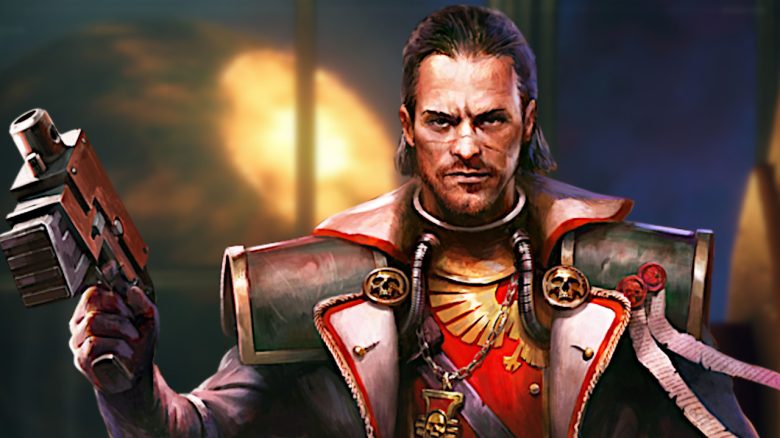
The Inquisition is considered one of the most dangerous and brutal organizations in Warhammer 40,000, but why is that actually so? Inquisitors are not just fanatics without morals. MyMMO editor and Warhammer expert Benedict Grothaus spoke with someone who has the perfect expertise on this topic: Anatoly Shestov, the Executive Producer of Dark Heresy, the upcoming role-playing game for Warhammer 40,000.
For many, people in universes where there are elves and aliens might seem boring and lame. But especially in Warhammer 40,000, the Imperium of Man is multifaceted and diverse – and has produced some of the most dangerous organizations in the universe.
The list of these organizations is undoubtedly led by the Inquisition. Anyone who gets involved with Xenos or the Chaos, even just thinks about it or gives the appearance of not being loyal to the Emperor, the God of Men, can essentially conclude their life if an Inquisitor finds out.
Inquisitors are seen as absolutely ruthless and cold. But that is not what makes them dangerous. In a one-and-a-half-hour conversation with Anatoly Shestov – in which I learned a lot about Warhammer 40,000 – this topic was among those discussed.
Anatoly is the Executive Producer of the role-playing game Dark Heresy, where you can step into the role of an Inquisitor. Owlcat, the studio behind it, works closely with Games Workshop, especially on lore questions. Hardly anyone could explain to me better what makes the Inquisition so dangerous.
“There are limits. The Inquisition sets these limits.”
The question right at the beginning of our conversation was actually quite simple: “What do you think makes the Inquisition such a dangerous organization?” Anatoly responds with a calmness as if he not only expected this question but as if he were an experienced teacher explaining the basics of his subject to a student:
There are limits. For every organization in the Imperium, there are limits. There are rules. There are conditions you must adhere to. The Inquisition, in this path or spectrum of things, is the only organization that sets these limits, conditions, and rules for everything in the Imperium.
It is not the High Council of Terra that does these things; the Inquisition does. In the end, the important question is who watches the watchers. That is one of the… let’s say, most adult sides of the universe, one of the most layered things.
Anatoly Shestov, Executive Producer for Dark Heresy at Owlcat
Specifically, this means: The Inquisition operates outside the jurisdiction of the Imperium. Whatever they declare as right or wrong is so – at least for the moment and only if the Inquisitor has the appropriate backup to enforce their rights. The Inquisition is not omnipotent; in Warhammer, one is always only “as strong as the firepower one brings with oneself and one’s army.”
Even the words of an Inquisitor are not followed if they cannot enforce their orders. And Anatoly gives another example: Even the Inquisition is dependent on others such as the Mechanicus. Because who maintains the great equipment after a mission?
Anatoly and Owlcat have previously dealt with a similar narrative in Rogue Trader: Rogue Traders are themselves somewhat like omnipotent outside of the law, only not within the Imperium, but only off its borders.
“Everyone else has strict rules, strict uniforms”
It is precisely these possibilities that also make working with the Inquisition as exciting as he further explains to me. Taking an Inquisitor as the main character for a game provides certain freedoms:
[The Inquisition] is one of the [organizations] with the greatest opportunity for freedom in how to portray such an organization. Everyone else not only has strict rules but strict uniforms and a strict mandate on things they are not allowed to use.
The Inquisition is the only one that does not have such restrictions. Only those they set for themselves. That makes them, in my opinion, the most interesting, the most dangerous, and the most appealing.
Anatoly Shestov, Executive Producer for Dark Heresy at Owlcat
The conversation then drifted for a while into the lore depths, among other things with the question of which Inquisitors Anatoly actually thinks are the coolest or which he would like to mention in a game. Several names came up, including the famous Fidus Kryptman, who once devised a “brilliant” plan against the voracious Tyranids.
Kryptman is a perfect example of the boundless power that the Inquisition possesses: despite contradictions, the Inquisitor completely annihilated a world seemingly lost to the Tyranids with an Exterminatus, something that should only happen in extreme exceptional cases. And he intended to go even further …


Not every Inquisitor is the same, thinks the same
Since I am very much looking forward to Dark Heresy and was already very impressed from the first playtest, I also asked Anatoly a bit about his upcoming game – especially with regard to the Inquisition. Because it has different orientations:
- The Ordo Xenos, which specializes in the fight against aliens and has the Deathwatch as its military arm.
- The Ordo Malleus, which fights against demons and works with the secret order of the Grey Knights.
- The Ordo Hereticus, which of course fights everything that sounds like heresy and accordingly often receives support from the fanatical Adepta Sororitas.
- Several smaller Ordos with different tasks.
Additionally, there is a division into Puritans, who strictly adhere to rules and faith, and Radicals, who use all means (with Anatoly emphasizing: “Every Inquisitor considers themselves a Puritan”). According to Anatoly, the Ordo you belong to in Dark Heresy is not fixed and also not a selection; your actions determine your orientation.
Such possibilities are also what is exciting about the Inquisition as a focal point: “There is such a thing as a ‘true’ Adeptus Mechanicus or a ‘true’ Arbites, but there is no ‘true’ Inquisitor. They are inherently different. In a role-playing game, we must keep such adaptation options open.”
This here is the second part of the conversation. Since we dived deep into the depths of nerdism for almost 90 minutes, I am processing our “interview” in several parts. So you can look forward to one or two more parts.
However, Anatoly had one request for me: during the alpha test of Dark Heresy, a user kept asking for romances for Space Marines. The persistence and dedication of this fan inspired Owlcat. Anatoly asked me to include a message: If any of you was that person, please get in touch.