

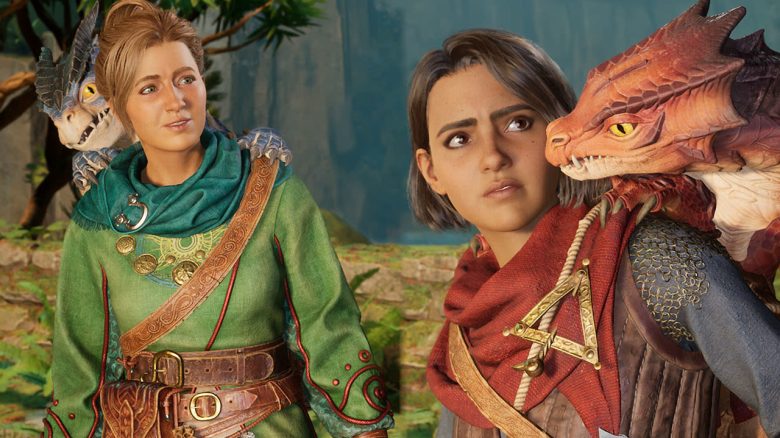
Introducing your father to video games. Can it work? MeinMMO demon Cortyn tried it out – and gained some insights.
Video games are our favorite hobby. Most of us have been playing for years, if not decades. Many of us grew up with games. When we start a new game, we usually grasp the basics within moments. Standard actions like character control, camera movement, or simple actions like “Jump” – we don’t even have to think about it. We can do this as soon as we start the game because it’s nearly identical in almost all games.
However, my father has made it clear to me that it’s not as easy as it seems. For the past few weeks, I’ve been regularly playing a game together with him on the PlayStation 5 and learned: Video games have become incredibly complicated, and basic controls are just the beginning.
We played Split Fiction. Every one of us, long-time gamers, will probably agree with me: Split Fiction is not a difficult game. That’s why it was the perfect game to play with my father and introduce him to the world of video games.
For those who don’t know the game: Split Fiction is played in “split-screen” mode, whether locally or online. You take on the role of the two authors, Zoey and Mio, and must navigate through various fantasy and sci-fi levels. Most of the time, the game is a platformer with occasional action sections and minor puzzles. The two characters must work together, as obstacles cannot be overcome otherwise.
It’s a coop game where cooperation is also mandatory. You cannot complete the game alone.
The thing with the camera
The most obvious example that ran through the entire Split Fiction experience with my father was the use of the camera.
On the console, Split Fiction uses a control scheme that is completely typical for modern action games: With the left stick, you control the character’s movement, and with the right stick, you move the camera. On PC, you control the camera with the mouse and the characters with WASD or the arrow keys. Absolute standard.
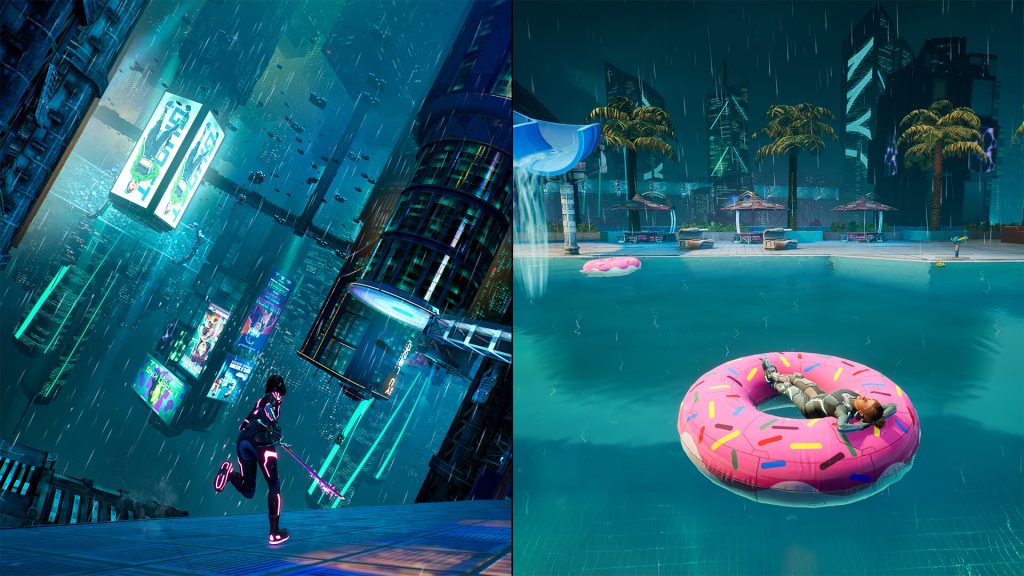
That’s super simple. Or so I thought. But it’s only simple because we’ve been doing it for years or decades.
For my father, it was incredibly difficult.
As long as there was no time limit, it was just a matter of speed. Most of the time, he adjusted the camera for the next jumping section and then controlled the character – one after the other.
But that can’t go on forever. Because eventually, there is a time limit (for example, when being chased by an angry boss), or when you have to rotate the camera during a jumping section – for instance, when moving around a large object or actively avoiding moving threats.
These were the moments when it became clear to me how much is actually demanded at once:
- The character must be moved in the correct direction.
- The camera must be simultaneously controlled, which also means the character’s movement direction must be constantly adjusted.
- The correct keys for jumping, holding, or shooting must be pressed at the right moment.
That sounds completely trivial. Just something that “we gamers” do in our sleep, with the monitor turned off and one-handed.

But for someone who doesn’t usually play video games, it was exhausting and pure stress.
It doesn’t help that my father had never properly held a PS5 controller before and couldn’t even memorize which button was the circle button or the L2 button.
This led to some amusing moments, where all buttons were pressed – including the pause button, which caused several embarrassing silences.
The only video games my father (in my memory) really played actively were the first Tomb Raider games over 20 years ago. Back then, Lara Croft didn’t move in relation to the camera, but always in relation to her own view direction. This feels totally outdated today and would probably overwhelm most of us similarly. Only we would quickly say: “What bad controls, I won’t play that.”
It was even nicer in the later sections of the game when I clearly noticed: Slowly, very slowly, he can use the controls more fluidly. He doesn’t have to look at the controller as often and is also able to align the camera while moving – at least a bit. That he then proudly exclaims after a long jump, “Ha, did you see that? You wouldn’t have thought that!” made it even better.

Games need to be more accessible – otherwise, new players won’t find their way in (Duh!)
The evenings spent in Split Fiction have made it clear to me that more modern games need simplifications.
I don’t want to take the Dark Souls difficulty away from anyone. That’s great and satisfying for us gamers. I also loved completing Expedition 33 on expert and enjoy tough raid bosses in World of Warcraft.
However, I believe that games have become so complex in recent years that they would do well to work more on their accessibility. Basically, every developer should ask themselves: How can my game help someone find access to gaming who has had nothing to do with it so far? Especially complexity monsters like World of Warcraft are simply too hard for newcomers.
This also explains to me why all these “dumb” mobile games are so popular among the older generation. I believe it’s largely due to the simple controls without time pressure. Essentially, very little motor skill needs to be learned, and things like hand-eye coordination are not needed at all. This is different with PC and console games that have action elements.
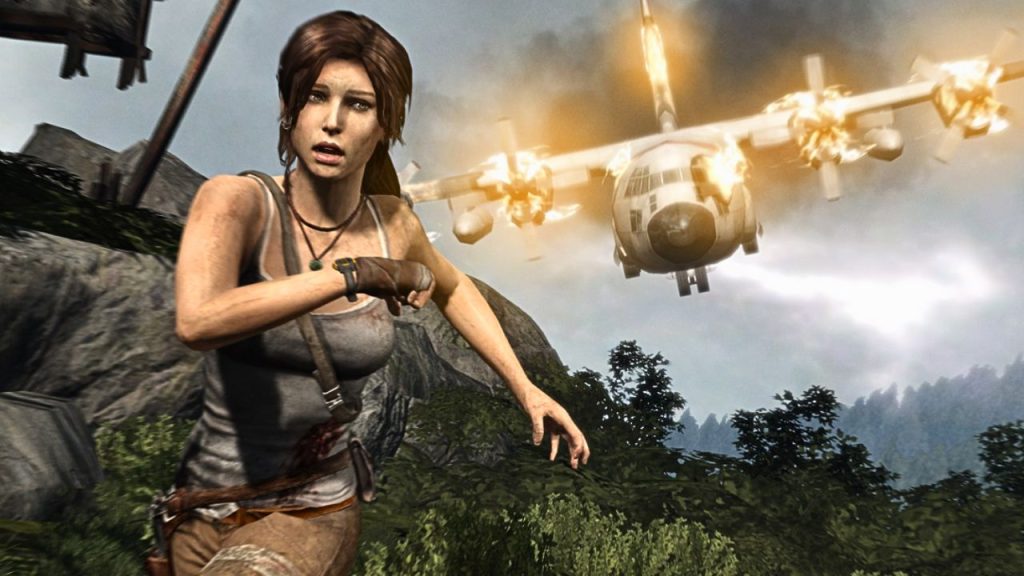
Playing with my father also showed me how trained my eyes have become for what most of us would see as “obvious” – but it simply isn’t for non-gamers.
The level design in modern games is designed with lighting and coloring so that at first glance you can see: Ah, that’s the path we’re supposed to take. Whether it’s little lanterns by the roadside, brighter colors, or simply the layout of the environment. I typically needed only two to three seconds to grasp which direction “the game wants from me.”
When my father then murmurs, “Well, something would be hidden here in Tomb Raider,” while he tries to glitch through a for me incredibly painfully obviously completely unimportant vase, I sometimes had to suppress my sympathetic “Now Grandpa is going to tell us how it was in the war” look.


We managed to get about double the playtime out of the game, as the occasional “simple jump” turned out to be quite a test of patience. But hey – in the end, we made it and had a lot of laughs. Because Split Fiction was simply a nice and entertaining game and perhaps one of the best overall to introduce someone to modern gaming.
Now the only question is, which game I will force him to play next. Do you have any good suggestions? Otherwise, I will probably force him to play The Last of Us or Detroit: Become Human.

Your opinion is important to us!
Do you like the article? Then let us know!