
The character has been created and is ready to be unleashed into the role-playing world? But… you don’t quite know how to behave in role-playing to even connect with others or be taken seriously? Don’t worry, with this handful of tips and guidelines, we will give you the necessary tools to find your way around.
As mentioned last time, it should also be said here: These rules are not set in stone, and different role-playing groups may tighten or completely omit them, yet they are still considered “general averages” to which one can always refer.
But let’s go back to the individual points in detail:
1. Player Knowledge and Character Knowledge
Once you dive into your role-playing adventure, you must clearly distinguish between the knowledge you have as a player and the knowledge your character has. That may sound trivial, but especially newcomers often tend to let their player knowledge flow into the role-playing – much to the detriment of their fellow players. This can be best illustrated by a few examples:
As a player, you know that the character in front of you is named “Remson” because the game displays his name above the avatar’s head. However, your character does not know this until someone tells him his name. Your interface may also reveal that your counterpart has the class “Jedi Scholar,” but if the corresponding character has nothing with him that clearly identifies him (such as a lightsaber), then your character cannot recognize it.
Moreover, the class being played does not necessarily have to correspond to the character portrayed in the role-play. You might be playing a mage while leveling and questing, but in the role-play, you simply embody a baker’s apprentice without any special gifts.
The short rule for this paragraph would be: Use knowledge that you derive from the game interface, not for the role-play.
2. “Hello, I am a Sorceress!” – What to Better Keep Under Wraps
Every player strives to give their character story life, and a common beginner mistake is to share this with others at all costs. We want to warn against this strictly, as depending on the circumstances it can have severe consequences. The worst-case scenario could be that other players ignore you or treat your character as if they were invisible. Why is that?

There is hardly a worse idea than standing at a bar in a world where magic is strictly monitored and saying “I had a funny story with my succubus today. Oh, by the way, I am a sorceress.” Just as questionable would be to announce to everyone that you are an agent of the imperial secret service – because those who do so are not doing their job very well.
But here too, there is the perfect solution for all dilemmas: the lie.
Many role-players (not just newcomers!) do not simply expect that their character would be blatantly lied to. That requires a bit of practice, but if you are a member of a secret sorceress society, then you should have a good lie ready about what you actually do in your spare time.
3. Emotes, Abbreviations, and Spelling
In short: Emotes and abbreviations have no place in role-play, the following example should clarify this:
“I greet you, Sorceress. 🙂 How were your studies on Arcanophysiology? ^^ Would you like to go have a drink together or maybe take a walk? :D”
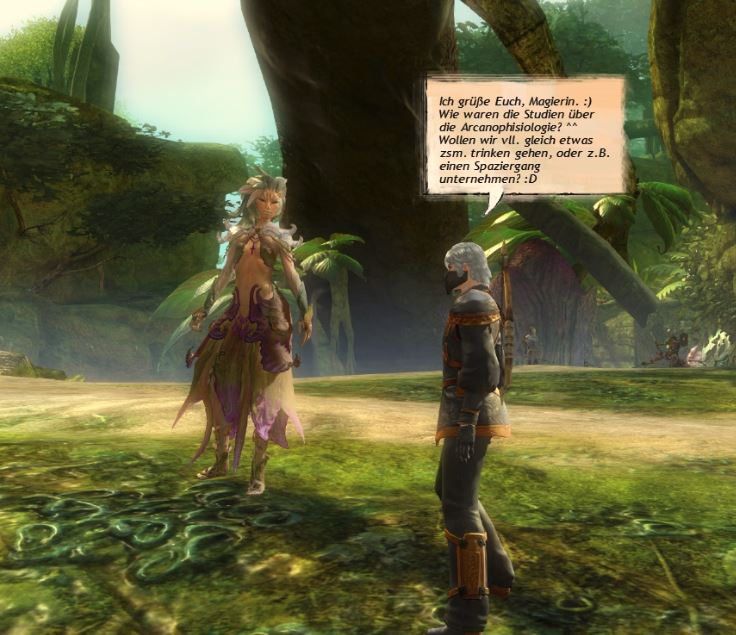
Role-players could read the following from this sentence in the worst case:
“I greet you, Sorceress. Colon Parenthesis Close. How were your studies on Arcanophysiology? Circumflex Circumflex. Would you like to vee el el go have a zet es em drink together or zet Point be Point take a walk? Colon D
This example is intentionally exaggerated – most role-players will overlook a smiley, but they drastically disturb the atmosphere when they appear too often. Just avoid them, and there should be no problems.
Spelling must also be mentioned, as unfortunate as this topic is on the internet. Role-playing consists largely of written texts. Hardly any person would be able to read an entire book where every word is written in lowercase, no commas are placed, and every third word turns into a guessing game because of misspellings. Role-playing is more laborious, and each sentence requires more effort than a “lfm 2 mages 4 strat, then go.” It is not about being perfect in any way, but one can make an effort to make one’s texts more attractive to fellow players – they will thank you for it.
4. Logical Perception
Basically, two to three chat channels are used in RP: /say, /whisper, and, if available, /emote (or /me). However, depending on which MMO you are currently in, the say channel may have an absurd range of 40 meters or more. In such cases, try to incorporate the surrounding environment of your character into his perception. In a crowded cantina with a hundred or more people, it would be nonsensical to be able to hear exactly what the young lady is currently saying to the doorman standing several dozen meters away: Just because you can read it as a player does not mean your character can hear it! I refer again to the point “Player Knowledge and Character Knowledge,” as it also applies here.
5. OOC – Out of Character
From time to time, it may be necessary to speak in role-play not as a character but as a player to regulate the RP and clarify ambiguities. In such a case, it is an unwritten rule to set what is said in “double parentheses,” such as in this example: “((I just had a disconnect, can you repeat your last sentence?)). This enables communication among players without completely breaking character. However, this should be kept to a minimum – if possible, it should not be used at all or only resorted to in emergencies, as it can significantly disturb the atmosphere.