

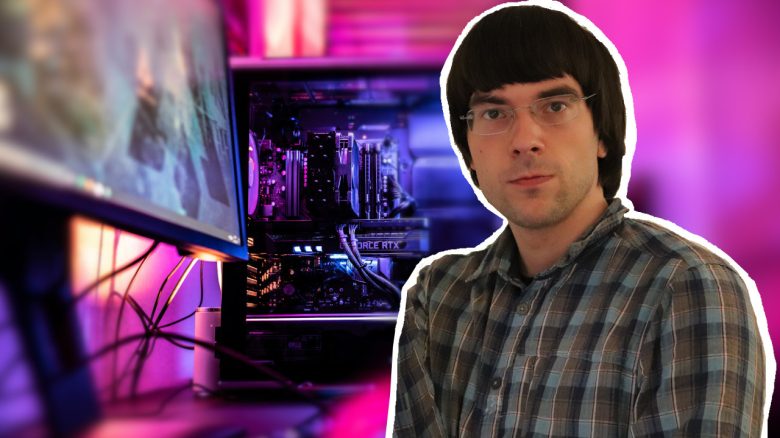
A gaming PC, according to MeinMMO editor Benedikt Schlotmann, can never achieve a state of perfection. And there are several reasons for that.
I myself am an absolute perfectionist when it comes to my PC, which leads to my system being a constant construction site. I am always considering what improvements or adjustments I could still make. Anyone who asks me about my gaming PC in six months will find a different device than today’s – because there is (almost) always something to optimize.
Here are some examples of my recent upgrades:
- At the end of 2024, I switched from a midi tower to an ITX system and got myself a new PC case.
- In spring 2025, I replaced my RX 6700 XT with an RX 9070 – looking back, one of the best decisions of the year.
- In summer 2025, I tested a dozen different case fans to find the ideal set for my system.
Currently, I am considering replacing the still quite loud CPU cooler and am looking for better dust filters that can more effectively catch cat hair. The cable management is also not optimal; a power supply change would bring significant improvements here and simplify many things. Because I could only fit the current power supply in the case with great difficulty.
Hardware is constantly evolving
Not only from my subjective view is a perfect gaming PC an illusion; this is partly due to the constant development of hardware. Components like CPUs, GPUs, RAM, SSDs, and cooling systems are constantly evolving, making the currently “perfect” state quickly outdated. My Ryzen 7 7800x3D was long considered the best gaming CPU, but the successor is already on the market.
This does not mean that I need a new graphics card every year, as I know my needs and my budget. Therefore, my Ryzen 7 7800x3D and my RX 9070 should continue to serve me well for a few more years.
Benefits of continuous optimization
Nevertheless, continuous optimization offers a clear advantage from an objective point of view: The costs for new hardware are spread over several years. It is more economical to replace individual components like graphics cards or fans than to have to renew the entire system at once. If I replace a few parts every few months – even if it’s just a case fan – I don’t have to limit myself to just the essentials while shopping for weeks.
And this continuous optimization has another advantage: If I eventually do replace components like the processor or graphics card, the retired hardware usually finds its way into my wife’s PC or those of other family members. The components still work perfectly.



The dilemma of perfection
Critics might argue that a once-configured and balanced system can also deliver good performance over many years, even if one does not necessarily want to play in the high-end range.
However, I am convinced that a gaming PC will always remain a compromise – between technical currency, personal demands, and the available budget. Therefore, it is never “perfect”, but always adjustable and optimizable.
This is also one reason why I have never warmed up to consoles like the Xbox or PlayStation: The hardware is already outdated as soon as you buy a console.
Many gamers wonder whether to buy a gaming PC or a console. But what do PS5 and Xbox do better than a real gaming PC? MeinMMO presents the advantages of consoles: 6 things where PS5 and Xbox are simply better than a gaming PC

Your opinion is important to us!
Do you like the article? Then let us know!