

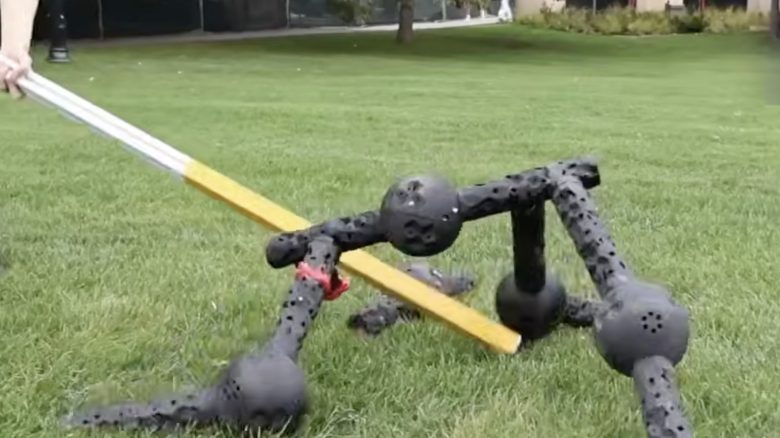
Researchers are developing a fresh generation of modular robots that can not only walk but also survive damage and reassemble themselves.
Where are indestructible robots being developed? A research team from Northwestern University in the USA has developed a completely new type of robot. These machines consist of several small modules that can assemble into larger robots (MCCormick).
The entire model is based on an evolutionary algorithm that mimics natural selection. The results of this research area have directly flowed into the development of the latest model.
The researchers call these constructions “legged metamachines” – machines consisting of several small, leg-like modules.
Each individual module is already a complete mini-robot with:
- its own battery
- its own motor
- a small computer
“Inside the sphere, the robot has everything it needs to survive: a ‘nervous system’, a ‘metabolism’, and ‘muscles’,” said Kriegman, an expert in biorobotics and AI, assistant professor of computer science, mechanical engineering, as well as chemical and biomedical engineering, in the press release.
On their own, a module can already roll or turn. When multiple of these units are connected, a significantly more powerful robot is created that can even “walk” or at least move steadily. The published study mentions a so-called “morphological adaptation gift” (PNAS).
Immortal Robots
What makes these robots so special? The big difference from many previous robots lies in their adaptability. Classic robots are often built to be very specialized. If a single component fails, the entire system often stops working.
Sam Kriegman explains in the video that the robots currently do not perceive their environment nor have orientation. However, each element of a combined robot can recognize when something goes “wrong”, meaning when they are upside down.
The new metamachines are constructed to be significantly more flexible. Because they consist of many individual modules, they can change their structure or be reassembled. Even if individual parts are damaged, the robot can continue functioning. This makes the machines almost resemble small, artificial organisms that adapt to their surroundings.
Do the new robots defy all obstacles? To test their constructions, Kriegman and his team selected the best three-legged, four-legged, and five-legged models that previous development had produced. In outdoor tests, the models moved over various surfaces – such as gravel, grass, tree roots, leaves, sand, mud, and uneven bricks.
They could hop, turn, and right themselves after tipping over – without special preparation or retraining.
In contrast to conventional robots, which often completely fail when there is a defect, these machines remain operational (in the video, a leg is even explicitly severed). They can adapt and continue to work. Even if a leg breaks off, the metamachine remains stable: the remaining modules compensate for the loss and continue to move.
The severed leg can even roll back and reconnect with the machine.



The new walking robots from Northwestern University show how rapidly robotics is changing. While machines are becoming more robust and adaptable, other projects are trying to build robots that are as human-like as possible: The tech company DroidUp has introduced its new robot. It is supposed to serve primarily as a social partner.

Your opinion is important to us!
Do you like the article? Then let us know!