

MeinMMO editor Benedict Grothaus has been a huge fan of Dragon Age since Origins. He was able to get an early look at The Veilguard and has spent over 90 hours in the game. He likes it a lot, but as a fan of the series, he also has some criticisms.

Since the first Dragon Age title 15 years ago, I have invested well over 300 hours into the series. To this day, Dragon Age is the best role-playing series of all time for me with all its facets. I was even more excited about the Netflix series than about Arcane.
It has now been 10 years since the third part, Inquisition, was released, during which I have been eagerly waiting for the sequel. For years, BioWare has dangled a new story in front of me. Now it’s finally here.
And I was already thrilled right at the start of The Veilguard.
Only during my journey through Thedas did a few points arise that I stumbled upon, which have caused quite a bit of discussion in our editorial offices. What I noticed is that especially I and other veterans were bothered by content such as character developments. Colleagues for whom The Veilguard is their first Dragon Age show significantly more enthusiasm.
Accessible gameplay with depth but without a plethora of spells
Beforehand, BioWare has shown trailers for The Veilguard with very colorful graphics and action-packed gameplay. This has caused rather subdued joy among fans, and in some cases even skepticism. And yes, some fears are indeed confirmed with The Veilguard.
The gameplay is significantly different from before and more geared towards action. Even in the direct predecessor Inquisition, there were more options to act during tactical pauses. In earlier parts, for example, it was important:
- to select and place the right spells and abilities
- to trigger the corresponding combos with them
- if necessary, to change positions to escape from dangerous areas
Also, each character was controlled individually. In the latest Dragon Age, it is primarily about using your own character and looking as cool as possible. Companions are generally immortal and, depending on the build, merely buff-bots or combo partners. The tactical pause is now just a tool for selecting a few abilities and the corresponding target.
This very action gameplay ensures, however, that new players have much quicker access without it being too easy. Just like the motto: Easy to learn, hard to master. Your own character Rook starts with one of three classes and a talent tree, at the end of which one of three additional specializations is possible.

Enormous advantage: The fighting gets better and better
As you level up, new abilities and mechanics gradually come into play, which interact with each other and provide depth but are not as complex as, for example, the vast spell pools from Origins. Mine worked out somewhat like this:
- I started directly as a warrior because I find the Reaper specialization very cool.
- While leveling, I gradually learned what my class can do exactly and what the deal is with light, heavy, agile, and charged attacks.
- Later, skills get keywords like “projectile”, “duration”, or “area”, and from here it gets interesting.
- Over time, more equipment comes in, and real builds become possible. Right now, I’m playing on “Necroses”, i.e., poison and life drain, while sacrificing my own health to become stronger.
My companions are pure buff machines for me, strengthening me and preparing combos. From what I have seen so far, builds are also possible where you become the support for your companions. Either way, even the highest difficulty is manageable for veterans.
For me, the gameplay is a huge plus point. The combat system combines components from all the old parts and is still something of its own. I’ve never had so much fun hitting enemies in Dragon Age.


The story is okay, but the characters are absolutely amazing
However, an action RPG also includes the second part: the role-playing aspect. Here, The Veilguard is somewhat weak in the most important aspect, the story. Contributing to this is the constant backtracking to the areas. Many side quests interrupt the narrative of the actual danger. The hated and beloved Solas still plays a large role but serves only as a supporting character.
Instead, a new conflict against the gods is in the foreground, especially the development of the “Veilguard”, i.e., the heroes you gather around you. And here The Veilguard does a masterful job.
From the trailers, we already know that two old elf gods have escaped from the Veil – a kind of intermediary world that protects Thedas from the “nothing” and thus from all sorts of evil things. Our task now is to prevent the gods from destroying our world. Along the way, everyone gets their personal journey.
The only game that has been able to convince in recent years with the development of its characters is Baldur’s Gate 3. In The Veilguard, while there are fewer conversations with the companions, they frequently have quests that further their development.
And suddenly, I am the romance…
Every companion is a potential romance, and although I wanted Harding as my partner from the start, I now find myself after 70 hours choosing from three people – including the old necromancer Emmrich.
The companions have developed so well over time that I have fallen for several of them. In one case, it seems that I am even the target of an NPC’s romance, which I have never experienced before. And, as much as I hate to admit it: He succeeded, we are now a couple.
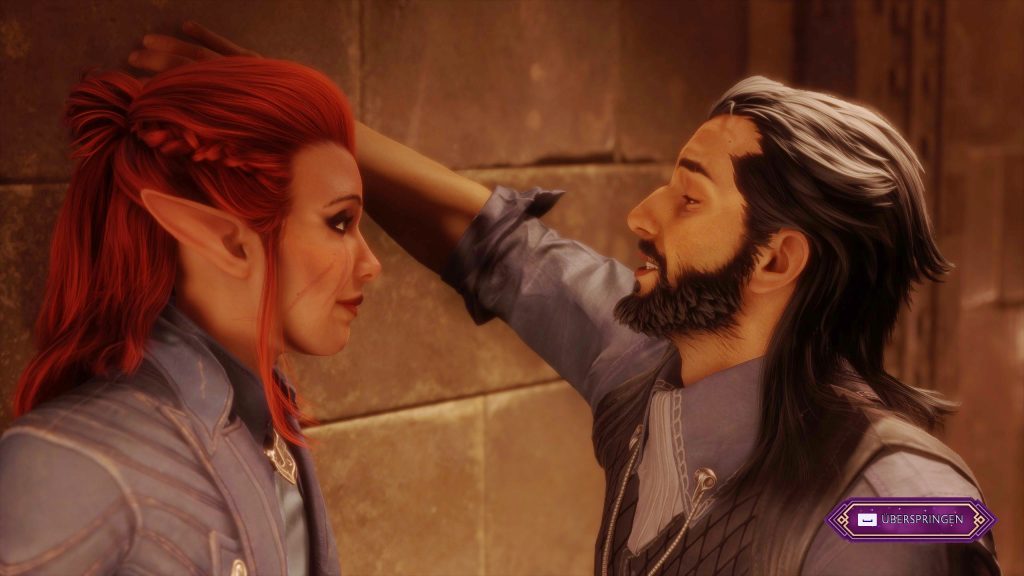
Nice detail: The “title” in the character descriptions changes depending on how well you get along with them.
I don’t want to spoil any content but can say: If you explore the sometimes tragic stories of the companions, you will often be amazed. Even the characters I initially found boring surprised me. Only two stand out from the crowd.
As a fan, I see a few things critically
One is the character Rook herself.
BioWare somehow failed to give me the opportunity to decide who I am. This is particularly noticeable in direct comparison to the role-playing hit Baldur’s Gate 3, where my character plays a real main role and can be as good or evil as I like.
My Rook often says things that I wouldn’t support for her role, especially since the dialogue choice implies something entirely different. Even small details, like that she wants chocolate in times of war, seem inappropriate for an assassin.
A real immersion-breaker for me, however, is one of the companions.
Where other companions have personal quests that deal with their origin or where you explore their abilities and defeat enemies, this companion merely defines themselves by the existence as a non-binary character.
The first companion “quests” are even just cutscenes where the companion repeatedly complains about how uncomfortable they feel and even gets insulting towards my female Rook. Especially in comparison to other companions, this one comes off as one-dimensional.
I would have wished for more complexity and depth here. Any other trait that the character brings and even significant experiences constantly recede into the background. The potential of a strong character feels wasted.
The elephant in the room
Let’s get to a point that has already been hotly discussed on the internet: The gendering. All texts are gendered. In English, this feels much more organic than in German.
Especially in German, Dragon Age: The Veilguard uses a new and unfamiliar form: neopronouns. Pronouns like “hen/hem” are still quite rare in everyday language. What particularly bothers me about this in the game is: There is no explanation for it and it feels like a linguistic foreign body in the world.
This is mainly due to the lack of description regarding what the pronouns stand for and the fact that all NPCs already know how other characters want to be addressed before the first encounter. This is particularly confusing at the beginning and pulls me right out of immersion every time.
The Veilguard is the first Dragon Age I have ever played in English because of this.
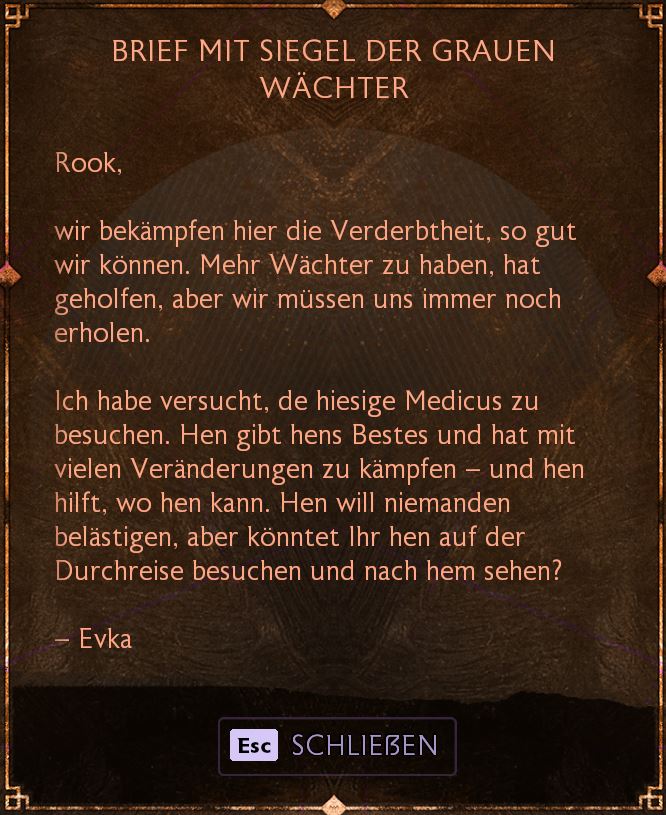
We asked EA why they chose this method of gendering for The Veilguard. This is the response:
Since non-binary language is neither universally established nor officially recognized in grammar and dictionaries, we have collaborated with linguists to integrate grammatical elements and pronunciations that aim for a respectful representation of non-binary characters in our game.
Ideal for beginners, a matter of attitude for veterans
Decisions like the chosen graphic style as well as the implementation of the story and the combat system are especially a question of whether veterans can adapt to the changes and new elements or not.
As for the gendering, that is a purely personal attitude. I am bothered by the sometimes difficult-to-read texts in German. Other testers have told me that they hardly noticed it.
However, where everyone agrees and what is also my biggest plus point are the characters. The development of (most) companions is excellent, and I have enjoyed following (almost) every story.
Overall, The Veilguard is not like its predecessors.
Anyone expecting a second Origins, Dragon Age 2, or Inquisition will be disappointed. But every Dragon Age so far has always been significantly different from its predecessors. And that has always been part of Dragon Age.
You have to want to immerse yourself in the game and not expect to play an Origins 2. Accordingly, new players who approach the matter completely unprejudiced have a great advantage over old hands like me.
However, where I can reassure you is the matter of graphics. No, The Veilguard is not in tone a Fortnite – I also don’t know how one could come to that conclusion. The world is grim as ever, maybe with a bit more sunshine, but with the same amount of rough manners and crude jokes as always. After all, we are not hunting dinner with chicken here, but evil elf gods.
My colleagues, however, also have a few things to say about The Veilguard.
Short conclusion on The Veilguard: Pros and Cons
Voices from the editorial team
In addition to me, three other MeinMMO editors have tried out The Veilguard:
- Karsten Scholz, our MMORPG expert and the only one with experience in Dragon Age besides me
- Sophia Weiss, huge fan of Baldur’s Gate 3 and Final Fantasy, but an absolute Dragon Age newbie
- Editor-in-chief Leya Jankowski, who has also never touched a Dragon Age and is happy to go along with The Veilguard
Karsten is the counterexample to Benedict’s thesis
Let me introduce myself briefly: I am the perfect counterexample to Benedict’s thesis. I know the entire Dragon Age series and have played especially parts 1 and 3 with great enthusiasm. And yet, The Veilguard seems to be the ideal Dragon Age for me. At least in the approximately 20 hours I have spent so far, I have had a lot of fun with the role-playing game.
What I particularly like is the story focus of all quests. Generic busywork, like what was found in The Inquisition at Ubisoft-esque levels, is hardly present in the new part. Everything revolves around the main story, the companions, or the factions.
I also enjoy the action-packed battles, which flow smoothly but also require quick reflexes and smart use of skills on the higher difficulty levels.
Additional plus points for me are the stylish graphics and the largely dark atmosphere, some of the companions (Lucanis and skeleton assistant Manfred, for example), and the somewhat more compressed structure of the game world; exploration is worthwhile, but it doesn’t seem like there is a Hinterlands 2.0 this time.
Minor inconsistencies, like the use of unfamiliar gender terms, a cringeworthy dialogue here and there, or dialogues between companions repeating too quickly have not yet managed to torpedo my very positive first impression.
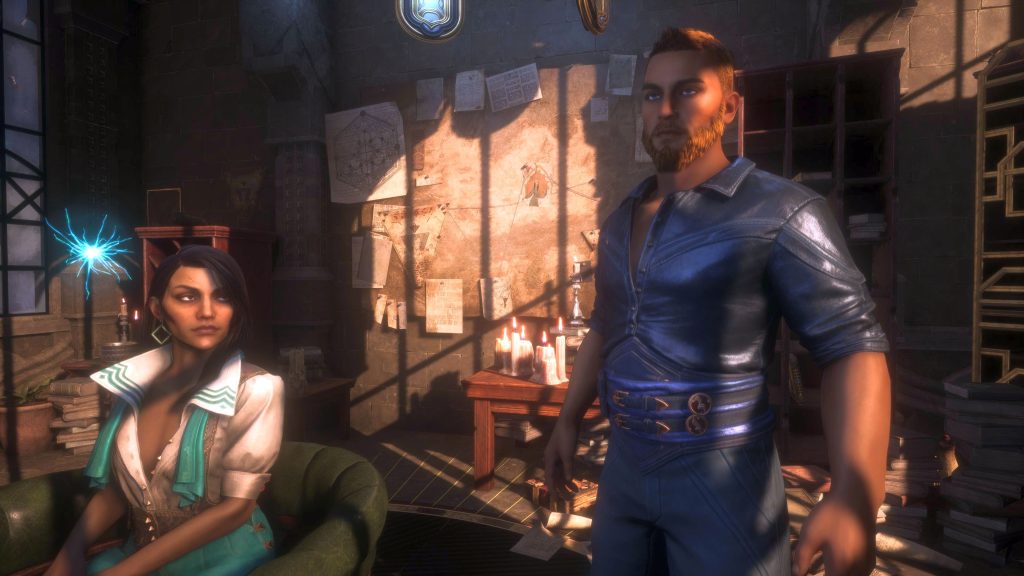
Sophia loves melee combat with her mage
Dragon Age: The Veilguard is my first Dragon Age. I play many open-world RPGs and have been spoiled with Baldur’s Gate 3. My entry into Veilguard was therefore somewhat unusual.
This was mainly due to the initially linear level design and the linear main story. The quests send you deliberately from A to B. I do not like it when games put me on fixed rails. I want to be able to make at least a little free decisions.
However, starting from level 5, more side quests come in, and new areas open up that make the levels worlds more exciting. By the way, everything looks absolutely beautiful.
But what I like best are the characters of the companions. It’s hard for me to settle for quests focusing on just two of them – I would like to have them all with me. Just for the funny group conversations.
I like that I can only partially control them in combat: This way, I can concentrate better and use the NPCs for combos and burst damage. The combat system is also completely successful – as a mage with a spellblade focus, I have an incredible amount of fun with the melee chaos.
If you like RPGs, you should definitely take a look at Dragon Age: The Veilguard from my perspective. Especially for newcomers, the game is a good entry point into the series. So if you feel like a really nice fantasy RPG? Then The Veilguard is just right for you.
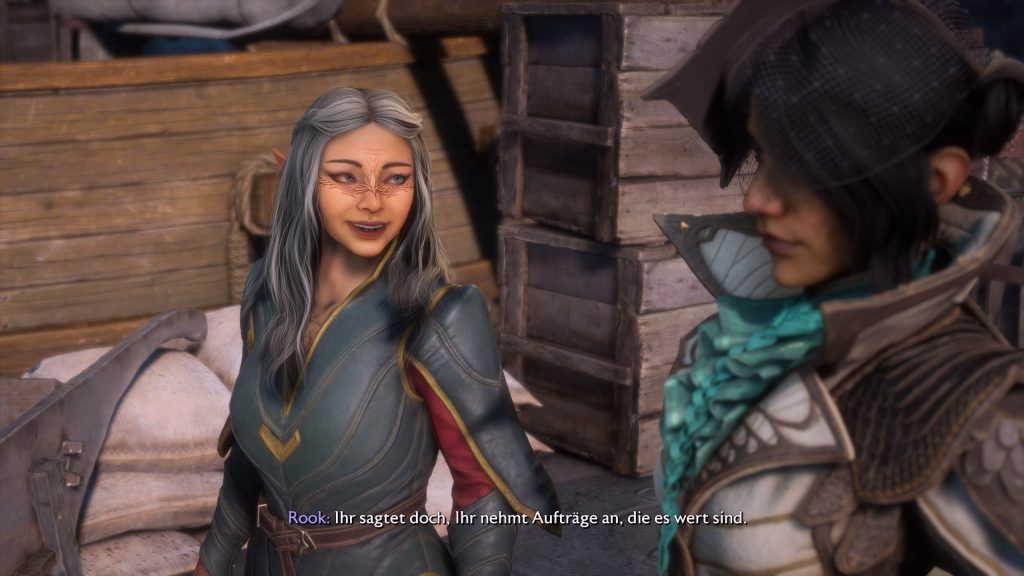
Leya enjoys the popcorn cinema
If there were a term for popcorn cinema for games, I would give it to Dragon Age: The Veilguard. And I mean this in the most positive sense!
Here is why: Until now, I have never touched Dragon Age. Even with BioWare itself, I have had little contact. I only played their MMO loot shooter Anthem with full dedication.
However, I enjoy role-playing games and love to fall into fantastic worlds. And exactly that I can do in The Veilguard: let myself fall completely and be carried away by the story. If I want, I can switch off my brain a bit and just follow the quest markers in a linear system while listening to the dialogues. The game always holds my hand and only gradually unfolds its complexity, especially in the combat system.
If you are really into optimizing the smallest percentages in your build, you can do that. But you can also quite easily follow a path in the skill tree and still progress wonderfully.
As someone who is new to the franchise, I really like that. I can focus on the beautifully crafted world that offers much love for detail at every corner. This makes me extremely happy as a fan of a decent photomode – because The Veilguard has that. Here, however, I would have wished for a few more sliders!
I agree with Benedict that the companions initially seem quite boring, but they also unfold over the story, so it is worth taking on each companion quest to get to know my crew better.
The Veilguard is a perfect introduction to the world of Dragon Age. I would even go a step further and claim: The Veilguard is a great entry point into the world of role-playing games in general.
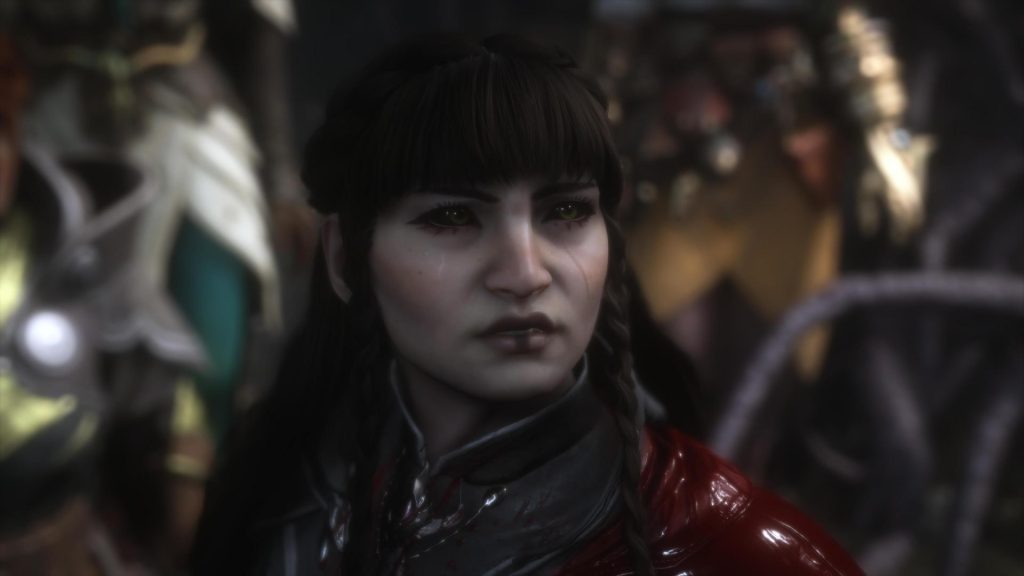
As you can see, we have all played The Veilguard in quite different ways – not just regarding our knowledge but also in terms of play style. Mages, rogues, and warriors are represented. And each of us had (and still has) fun with the game, despite a few quirks here and there. I particularly appreciate Karsten’s Rook because besides me, he is the only raven from Antiva – in my opinion, the best faction in the game, even if you think differently: The most popular factions in the new Dragon Age: The Veilguard ranked – From unpopular to popular

Your opinion is important to us!
Do you like the article? Then let us know!