

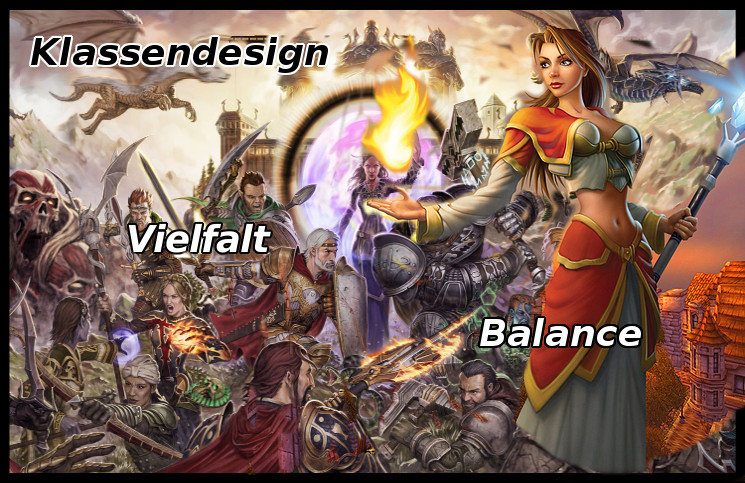
“WTF Blizzard? Why am I paying 12 euros a month when my class is the only one that keeps getting nerfed!” This is a legendary quote from Uncle Barlow, which has been circulating on the internet for years.
In our article, we address the sensitive topic of class balance using the genre leader World of Warcraft and the classic Dark Age of Camelot. We also take a look at what awaits us in this challenging area.
Seething Chaos in Dark Age of Camelot
My first MMORPG was Dark Age of Camelot many years ago. Today it feels a bit like the ghost of Christmas past.
In retrospect, it was a time for game design like the 1960s for society. Suddenly, different rules applied; everything seemed to be in chaos and change, every idea was initially implemented, and game developers were searching for a new path.
Dark Age of Camelot, for example, started with 30 different classes.
If you’re used to the manageable number of classes in WoW today, you might raise an eyebrow at that, but for us newcomers back then – having no other reference – it was completely normal.
The trick with DAOC: Each of the three warring realms had different classes to choose from, but the basics were covered. Each of the three realms had, for example, an archer available. However, the details differed among the classes.
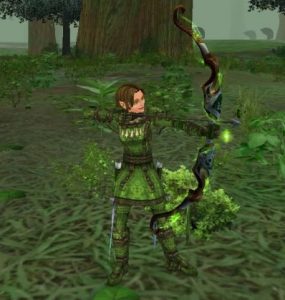
In the realm of Albion, inspired by Arthurian legend, there was a scout, a military archer, who could also wield a shield. The northern realm of Midgard had a hunter who functioned very much like the later hunter in WoW: with a pet, a bow, and a spear for close combat. The realm of Hibernia, rooted in Celtic mythology, had a ranger whose strength was self-buffs.
Fun Fact: Since Hibernia also had elves and “The Lord of the Rings” was incredibly popular, variations of the name Legolas were found everywhere in Hibernia at release.
Was everything worse back then?
From today’s perspective, it sounds like a utopia: Three hunter classes in one game? How would they be balanced? Wasn’t it logical that the hunter with the pet was stronger than the one without? So why didn’t everyone play the one with the pet?
And that was not all. There were the craziest classes back then in Dark Age of Camelot. The Shadowblade was highly sought after. He was an assassin but could wield huge two-handed swords and with the first strike from stealth, he could send numerous opponents to Odin. From our current balance perspective, a true nightmare!
Did you know that the upcoming PvP MMORPG Camelot Unchained is essentially the successor to Dark Age of Camelot and that the former producer, Matt Frior, now has significant influence on the development of The Elder Scrolls Online as Game Director? The parallels in game design are definitely unmistakable.
Another example of class design in DAOC: There was a skill back then that doesn’t exist in contemporary game design and it was simply called “Bubble”. It was a buff that could completely absorb the first physical damage and renewed every 6 seconds. This ability was distributed across all three realms – but in a creative way. In Hibernia, it was given to a chain-wearing supporter, in Albion to a caster who could summon elementals, and in Midgard to a typical pet-caster class, the Spirit Summoner.
So was everything better back then?
The good thing about the system: Each realm required a different strategy and developed completely differently over time. The classes were highly specialized, and the different distribution and orientation of the skills created a completely different gameplay experience, depending on which realm you played.
The disadvantage of the system: It was unbearably unfair. Each realm envied the opponents for certain traits and advantages. Constantly, grand conspiracy theories were devised, claiming that the operator favored one realm, and especially that a particular class was much better than its equivalent.
DAOC reached its peak or its low point when new classes were introduced with expansions that appeared much too strong to players. Then the operator was accused of only introducing such strong classes to boost sales of the new add-on. The term “FotM” started to circulate, standing for “Flavor of the Month”, referring to the class that was currently in vogue.
Peace and Order in WoW
Now, leaving this chaos, which had a lot to it but could not establish itself, let’s look at the classes in WoW (the spirit of the present Christmas, so to speak). Here, there were only two realms from the beginning that had access to the same classes. Only two classes were initially reserved for one faction, but that was quickly changed. With The Burning Crusade, there were also paladins for the Horde and shamans for the Alliance.
What stands out sharply in WoW: Blizzard is extremely cautious when it comes to introducing new classes into the game. In the many years that WoW has existed, only two new classes have entered the stage, the Death Knight and the Monk. When the Death Knight was introduced, it came with the promise of only being the first of many new prestige classes available to players reaching a certain level. However, as it turned out, the Death Knight was also the last prestige class.
The Death Knight as a Sinful Fall
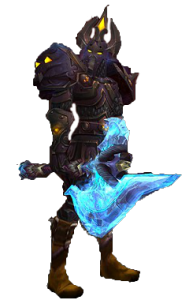
His appearance was met by the community with the same reaction as the emergence of strong new classes in DAOC many years earlier. He was perceived as much too strong, overpowered and imbalanced. A year and a half ago, when Mists of Pandaria was released, the Monk was viewed exactly the opposite. He was considered much too weak and people wondered what purpose he even served.
The gameplay principle that Blizzard maintains above all others is comparability and fairness among classes. Every player should have the same chances for first kills and achievements, no matter which realm they play in. The differences between the Alliance and Horde in WoW are negligible compared to the differences among the three realms in DAOC at its peak. However, that doesn’t stop players from constantly discussing the unfairness of classes and races. In WoW, it is even the case that the Alliance has what are perceived to be the stronger PvP races and the Horde has the better PvE races.
Envy can also occur within one’s own ranks
Furthermore, in WoW, it is not the realms competing against each other anymore, but different classes eye each other with suspicion and mistrust. Even in WoW, there is always a class that seems superior in every patch cycle. Either the mages are at the top of the damage meters or rogues benefit particularly from a strong scaling.
It is clear: Even if the mathematical advantages are only a few percent or even mere fractions, the game has become so professionalized that the differences are perceived as unfair and lead to loud protests.
Blizzard has also reacted to this: With the new expansion, the same race was simply unlocked for both factions. Interestingly, a similar reaction was also seen back in DAOC in response to the inequality among the factions. In the last expansion, all three realms were given the same race and the same class.
Where diversity exists, there is also envy and anger
The interesting and overarching insight that can certainly be drawn from the two case studies of WoW and DAOC is the understanding that there is immediate dissatisfaction and discord when more than one class or race is in the game and intended for the same task, regardless of how large the actual difference is in reality.
As soon as there is a difference, it is perceived as unjust.
This should reassure everyone who is concerned about the class distribution in the next generation MMORPGs. These will not only have 10 or 30 classes, but rather 40 or even an unlimited number of options. That is the spirit of the future Christmas!
New Impulses on the Horizon
Because modern role-playing systems and game designs are moving away from the equalization of a system like World of Warcraft and encouraging players to take new paths in character creation. Many systems are intended to have classes that are not as highly specialized and narrowly defined as they were in DAOC. Instead, developers want to give players opportunities to express themselves creatively and to develop their character independently of predetermined categories.
We at mmo.de believe:
That has also been necessary for a long time. We look forward to new impulses in the class system! And we will keep you updated!

Your opinion is important to us!
Do you like the article? Then let us know!