

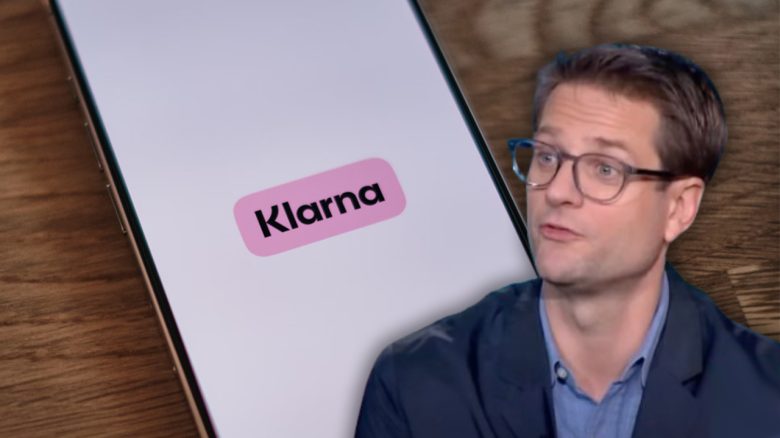
Sebastian Siemiatkowski, CEO of Klarna, believes that artificial intelligence (AI) can take on not only simple tasks but also complex leadership roles, like his own.
What did the Klarna CEO say? In December 2024, Sebastian Siemiatkowski commented in an interview with Bloomberg TV (via Bloomberg) about the role of artificial intelligence (AI) in his company Klarna. He explained that the company had ceased actively hiring new employees about a year ago because “AI can already take over all tasks.”.
Klarna is a Swedish fintech company that offers “Buy Now, Pay Later” services and is criticized for its business model, as it could lead young consumers into debt through easy lending (via derStandard).
On January 6, 2025, Siemiatkowski then published a post on the platform X (formerly Twitter), where he clarified his previous statements: “I am aware that my statement ‘AI can already take over all our jobs’ has caused a stir. Let me clarify: ‘Let me explain and elaborate what I mean’.”.
He further argued that the decisive breakthrough in AI is the ability to reason. This enables machines to handle simple logical tasks almost flawlessly, which forms the basis of complex problem-solving:
“Complex problems can be solved through advanced reasoning and stored knowledge. This advanced reasoning is merely a combination of simpler, fundamental tasks.”.
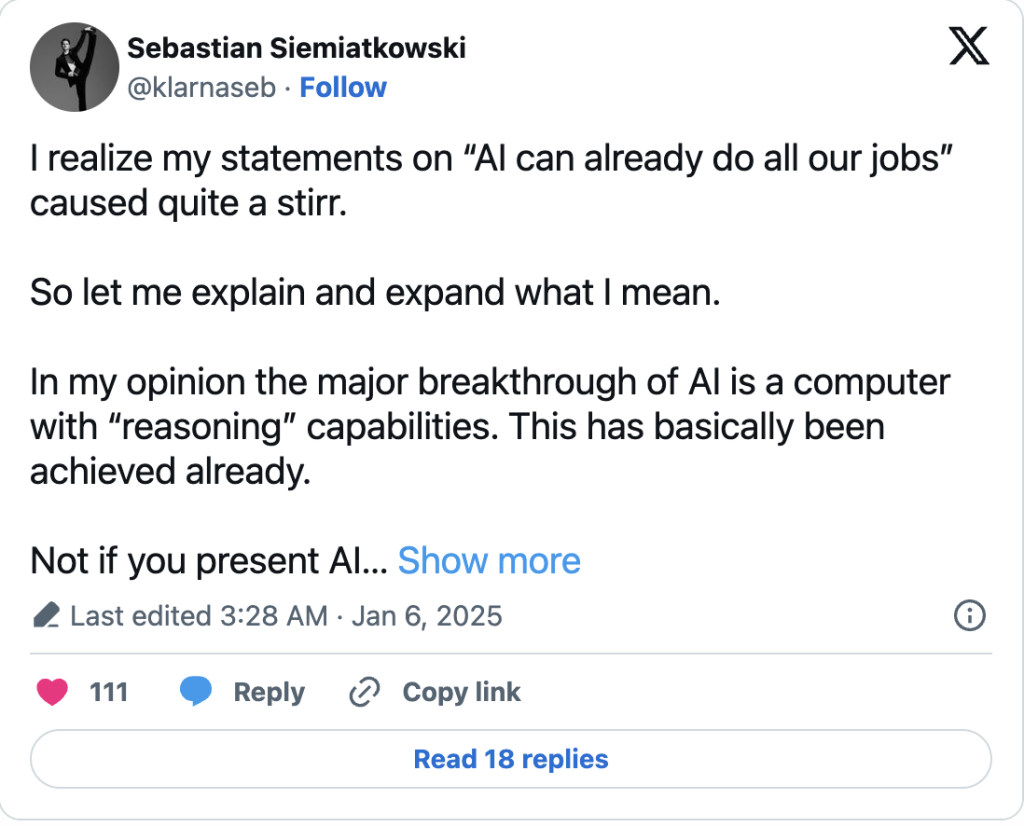
He drew a historical comparison: In 1700, humans would theoretically have been able to build cars or rockets, but did not yet have the necessary knowledge. Similarly, AI could theoretically take on all tasks today, but the exact process of implementation is still not fully resolved. However, he does not provide concrete evidence for his statements, which should therefore be viewed with caution.
Incidentally, Siemiatkowski is not the first CEO of a major tech company to comment on the future of AI implications. Recently, Nvidia CEO Jensen Huang stated that we cannot yet trust AI. Opinions on the current status of the technology are thus partly divided.
How does Klarna use AI? Klarna has already integrated AI deeply into its workflows. Last year, the company reduced its workforce by 22% to about 3,500 employees. According to Bloomberg, about 200 employees now share core tasks with AI solutions that were previously handled by hundreds of staff (via Bloomberg).
Klarna aims to directly pass on the efficiency gains from AI to its employees. CEO Siemiatkowski recently stated in the Bloomberg interview: We will pass on some of the efficiency gains that AI brings by increasing our employees’ salaries.
The community reacts annoyed
What does the Reddit community say about it? In the Technology thread on Reddit, Siemiatkowski’s statements are already being hotly debated, with the community particularly critical of the motives behind the Klarna CEO’s remarks.
Here are the main criticisms summarized:
- User thepostmanpat writes in the Reddit thread: “As the Financial Times recently highlighted in one of its articles, he says this only to praise AI, as Klarna is in a difficult financial situation despite some investments in AI and the dismissal of numerous employees.”.
- User jus-de-orange writes in the Reddit thread:
And one of Klarna’s venture capitalists is a major shareholder in the profit-driven branch of OpenAI. OpenAI powers Klarna’s AI-driven internal solutions.
- User KikoSoujirou writes in the Reddit thread:
Yes, I really believe they are lying through their teeth and using it as an excuse to fire people to try to stay financially stable, but realistically, they are not producing the same amount of work/output and their product/feature timelines have gone down the drain.
From the Reddit thread, it becomes clear that such statements have become almost everyday occurrences. Many users are annoyed by the constant exaggerations with which companies seek attention. This is a classic example of polarization:
In marketing, polarization means intentionally using provocative or controversial statements to gain attention and highlight the brand more strongly. This strategy often generates a lot of buzz – similar to political polarization, where similar tactics are used (via NIM).
Is the CEO right?
Can AI really take over leadership positions? The question of whether AI is capable of taking on the complex tasks of a CEO is being controversially discussed. Siemiatkowski sees great potential in the reasoning capabilities of technology: AI could make decisions, develop strategies, and implement company policies in a fraction of the time that humans would need.
The industry magazine Fortune has asked experts whether AI is actually capable of replacing CEOs. Imad Riachi, CEO of the consulting company Honu, believes that AI could soon work faster and more effectively than humans. According to Riachi, AI could soon evaluate business performance, analyze millions of scenarios, and develop strategies – and do so in a fraction of the time that humans would need.
He told Fortune: “The unprecedented scope of AI’s decision-making authority requires executives to better understand their capabilities.”


Other experts, such as Akash Nigam, CEO of the AI company Genies, are more skeptical. He explained that while AI has made impressive progress, it still lacks key traits such as emotional intelligence, adaptability, and real leadership skills (yet). The extent to which complex (i.e., human) and especially emotionally intelligent thinking can be executed by artificial intelligences is unclear.
The debate about AI and its possibilities is heated – but what happens when AI is also to take over creative processes? A YouTuber tried to create content with AI, and the result was more embarrassing than impressive. You can read the article here: YouTube supports content creators with AI, but it only makes them look like stupid narcissists

Your opinion is important to us!
Do you like the article? Then let us know!