

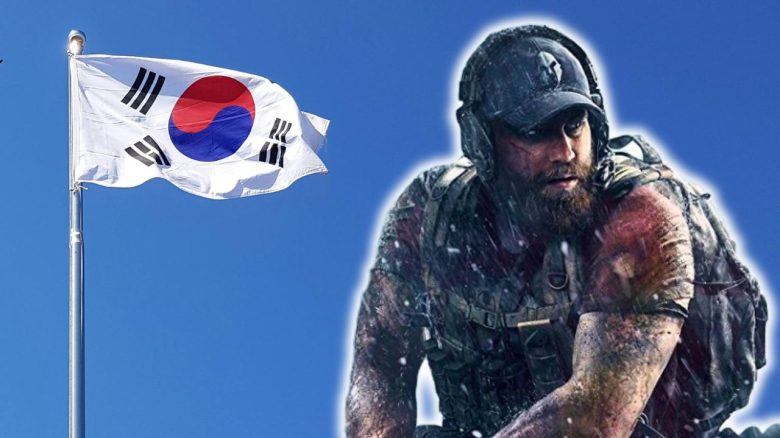
During the Cold War, a Russian enemy image was established in Hollywood, but after the fall of the Soviet Union, the state eventually became obsolete as an arch-enemy even in video games. In search of a new main adversary, the gaming industry in the mid-2000s turned its attention to another nation with threat potential.
Who should become the new villain? After fighting against the Soviets in many video games in the early 2000s and before, this enemy image gradually melted away with the end of the Cold War. Developers needed to find a new villain who posed a threat to the world and had to be defeated in heroic missions.
During this time, Ubisoft and Lucas Arts chose North Korea, then still controlled by ruler Kim Jong-il. With the isolated communist government in the north and the opposing capitalist government in the south, North Korea provided a perfect backdrop for the video game industry, but the outcome went too far even for South Korea.
Here you can see what a modern installment of the Ghost Recon series looks like today:
Reconciliation instead of a new enemy image
Why did South Korea have a problem with this? While North Korea is currently in a tense relationship with South Korea, things were different in the early to mid-2000s. The relationship between the two states was at a high point at that time, which was due to the effects of the so-called Sunshine Policy of South Korea under President Kim Dae-jung (via Wikipedia).
When Ubisoft released both Ghost Recon 2 and Tom Clancy’s Splinter Cell: Chaos Theory with North Koreans as enemies, it did not go well in South Korea at that time.
The Korea Media Rating Board, which is roughly equivalent to the German entertainment software self-regulation (USK), banned the games along with the title Mercenaries: Playground of Destruction from Lucas Arts, because they portrayed North Koreans as enemies – they were seen in South Korea more as “willful cousins”.
Comments from that time show how the citizens of South Korea viewed the games. The then 21-year-old college student Im Boo Gil said in an interview with the New York Times: “In South Korea, such games are no longer well-received these days [2005] – North Korea is no longer our main enemy.”
“The most popular film in Korea at the moment is ‘Welcome to DongMakGol’, a story about how North and South Koreans come together and annoy the great powers,” said Lim Sung Ae, then 21 and a student at Yonsei University.
At a time of rapprochement with North Korea, people in the southern part of the peninsula did not want their neighbors to replace the USSR as a new enemy – even if it was just fictional scenarios.

How did North Korea respond? A North Korean newspaper criticized the game Ghost Recon 2 and warned American gamers: “To them, it may just be a game now, but later it will be no game anymore. In war, they will only suffer miserable defeats and cruel deaths.”
One of the members responsible for the rating board later explained that the topic of war on the Korean Peninsula was a sensitive one and that this led to the ban. Regarding Ghost Recon 2, he said: “North Korea’s criticism of the game had nothing to do with our rating.”
Did the ban remain in place? The ban on the games was later lifted in 2007 in South Korea, as Gamespot.com reports. According to Kim Key-man, head of the rating board, this happened after a “careful review of the content” and to “enable freedom of expression”.
Even after the bans, North Korea continued to frequently serve as an enemy image, for instance in “Homefront” from 2011, which was also banned. Even today, political decisions lead to bans on games – albeit for different reasons. In Germany, a law led to many titles being removed from Steam’s catalog: Chaos on Steam: A German law is to blame for suddenly disappearing games

Your opinion is important to us!
Do you like the article? Then let us know!