The selective multiplayer RPG Shroud of the Avatar is competing for the favor of sandbox players and story fans. However, there are significant issues, particularly in the quest area.
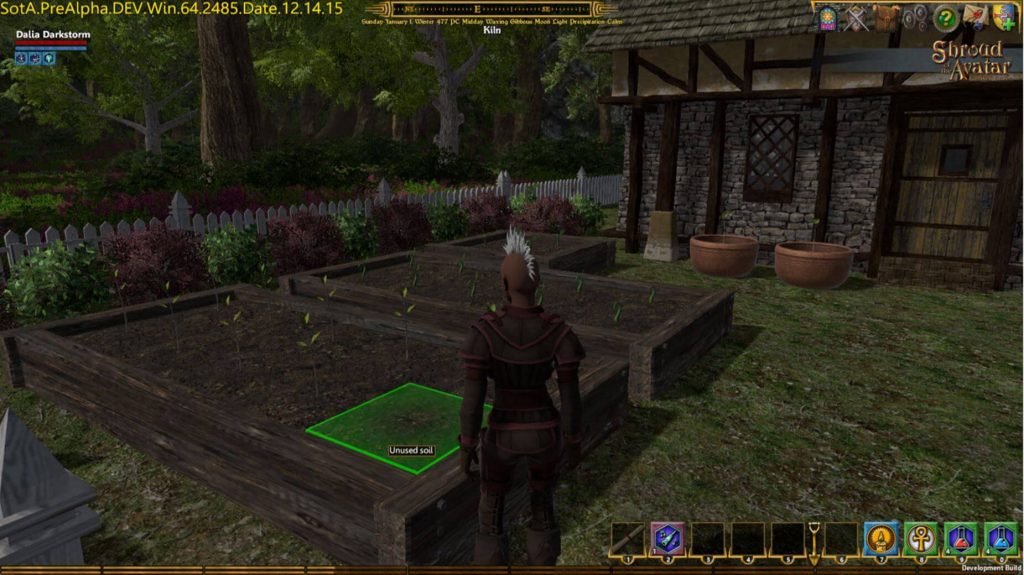
Combining a sandbox with many freedoms and an as-open-as-possible housing system with a story-driven game is not easy. Both can clash with each other. A good example of this is Shroud of the Avatar. After the truly successful introduction, where an army of the undead attacks an outpost, the story-driven game unravels massively due to the sandbox effect. The player reaches the first village and sees the houses of other players. Here, Viking houses line up alongside treehouses, and players decorate their front yards with snowmen, stacked furniture, and write messages with fruit on the lawns.
Sandbox versus Story
After narrowly escaping an army of the undead and expecting a refugee camp, this completely ruins the atmosphere. Moreover, there is no possibility of creating instances in housing zones (every town in the game) to show changes to the area, for instance. A murderer will never end up in prison. No NPC can die. Houses cannot burn down. Although the developers want to bypass this by giving NPCs different names, creating the impression that NPC A is in prison after his atrocities and has been replaced by NPC B. However, this does not provide an immersive solution.
Shroud of the Avatar has another problem. The game wants to be a “story-driven RPG,” suggesting that considerable emphasis is placed on good, profound quests with many twists and surprises. Some of the missions appear quite interesting, even if the implementation almost fits into the “frustrating” category. To unmask an arsonist, you talk to every NPC and search every house for clues. You scour the entire area, trying to find the right keywords in conversations with NPCs, and get hardly any hints on how to continue this quest. It’s simply frustrating.
This is just hardly fun…
Another example: A resident of the village of Soltown is missing a necklace. So, you ask everyone who knows anything about it. From one NPC, you learn that a grave robber is on the loose. You discover him in the cemetery. However, you cannot talk to him about the situation. A bug? No. You either leave it alone or you attack the man and return the necklace to the villager. This is not only illogical but also completely devoid of fun. Why aren’t there multiple ways to solve this quest – which, by the way, takes place in the “Love” questline.
So, love means just attacking a suspicious person in a cemetery? Such situations can be found everywhere in the game. In the large city of Ardoris, you are sent from NPC A to NPC B, who in turn asks you to find NPC C. Or you are constantly delivering some letters. RPG fans who appreciate a good story are simply used to much better by now.
Richard Garriott explained that he is currently playing through the story and has approved the quests up to the city of Ardoris. What can be played up to that point already corresponds to “final” quality… And it makes one fear that the story of Shroud of the Avatar cannot meet the expectations of players due to these quests. Quests should be fun, amaze, evoke emotions, and not frustrate or bore. Shroud of the Avatar still has a long way to go to become a “finished” product, but whether the quests can ultimately be enjoyable remains unfortunately questionable.