

The game has already been selected in which you want to try your hand at role-playing, but you lack access or are afraid of making a bad impression during your first attempts? We will remedy that now! Thematically, today we will focus on creating your first role-playing character, but we must say in advance: These tips are not set in stone, but they will greatly facilitate your entry.
Character creation is the foundation of your role-playing experience; much is already decided for the future, so one should proceed very carefully to avoid putting obstacles in one’s own way right from the start. The creation process doesn’t have to be time-consuming, but it’s essential to take some notes, and at its core, you need to be able to answer five questions for the character to dive into the game.
But let’s detail each point:
1. What has my character experienced so far? (Family, friends, background)
To answer this question, it is essential to already know a little about the background story of the game world. Usually, this information can be obtained for free from the internet; otherwise, ask in forums about details you consider important – or ask that one “lore nerd” we all have in our friend list. You should never fill your own gaps in knowledge with assumptions, as this generally leads to complications.
Need an example? You might consider playing a Draenei who was raised among humans in WoW. Experienced players will weep and cover their faces with their hands, because the Draenei have only had contact with humans for a few years.
Another important point in the story: Stay grounded! Nothing is more boring than a background story that explains why your character is an absolute superhero. It may be true that you have defeated 19 dragons and 254 undead in a raid instance – but that has no place in role-playing.
The role of a simple baker, a somewhat clumsy mercenary, or a humble farm boy has much more potential and does not frighten other players. No one is perfect in real life, and no one should be in role-playing, because that only leads to one thing: loneliness.
But the other extreme is incredibly boring as well: Newcomers often tend to develop a background story that is dripping with drama. The character’s father was murdered by your personal arch-nemesis, the mother died at birth, and now the broken, helpless, and naive girl has to beg in the streets, where she keeps falling for bad men and their promises.
It’s very tempting to want to play something very special in a fantasy world, but unfortunately, thousands before you have come up with the same idea and flooded the role-playing servers. It’s boring and only leads to frustration for your fellow players.
The historical entry is especially easy if you work it out together with a friend. Your two characters could be brothers or good friends – work out some shared memories that connect your characters, and you’re good to go.
2. Where are my character’s strengths? (Skills, “soft skills”)
As mentioned before, it’s incredibly monotonous if your character is the best at everything they do. No one can simultaneously be the legendary dragon slayer, the world’s greatest blacksmith, the most successful charmer, the most elegant artist, and the sturdiest fighter. It’s best to choose one or two things that your character is really good at; it doesn’t have to be anything world-shattering. Small things like “He is good with children” or “She always stays calm, even in the hottest arguments” make a character much more interesting than “He is unbeatable and kills every enemy in two seconds.”
When selecting strengths, you should also pay attention to another detail: only choose strengths that you can portray as a player! It’s simply not very convincing if your character is a “very good blacksmith” but you, as a player, have no idea what a forge is, for example. This makes your character unbelievable and leads to frustrating moments for you. The golden rule that can be derived from LARP here is: Play only what you can portray.
3. What are my character’s weaknesses? (Bad habits, deficiencies)
Just as important as the strengths are the weaknesses of your avatar. Basically, the same rules apply as with strengths: Choose a few things that your character simply cannot do well. These don’t have to be anything practical; social disadvantages are also possible. To give a few examples again: a burly blacksmith who is afraid of dogs of any size, or a spice merchant who cannot help but grant overly generous discounts to handsome Twi’lek men.
Maybe a noble lady who has horrifically bad taste in fashion? Anything is possible, and every strength can be mirrored as a weakness – the palette is nearly limitless. Additionally, your character may not even be aware of their own weakness yet because it hasn’t shown itself in any situation – it may only reveal itself during the RP.
4. What are my character’s goals? (Especially long-term)
This point is especially important to ensure your own enjoyment of the game. It’s not necessary to write a whole essay about what your character wants to achieve or how they plan to achieve it – a single keyword may suffice. For this purpose, we differentiate between long-term and short-term goals. The long-term goal is the most important, as it helps you, as a player, to pick up the “red thread” of your own story in difficult situations and offers you a decision-making aid.
Of course, your character does not have to pursue this goal non-stop; it is, however, extremely important for their life plan. And a great advantage is: Goals don’t have to be realistic. Your apprentice blacksmith can very well have the goal of eventually being allowed to forge the king’s armor or to become the best blacksmith in the world – even if you, as a player, know he can never achieve that. A broader term like “a free life” would also be a legitimate goal that a character can strive for.
Short-term goals are, as the name suggests, more spontaneous in nature. They usually arise simply from the role-play and require little further explanation. For the off-duty city guard, a goal could be to flirt a little with the cute waitress over there and perhaps find out where she lives, while the waitress might try to squeeze as much tip out of this obvious lecher as possible.
Finally, it should be noted that goals can change; they are not fixed or irreplaceable. Role-playing itself continuously shapes your character, and even if your mercenary has always dreamed of a free, unbound life, it may turn out after a few weeks that this one pretty magician has turned his head so much that he might prefer to marry and settle down.
5. What does my character look like? (Muscular, skinny, scarred)
For the appearance of your character, all previous points must be considered and intertwined. If your character is a blacksmith, then it’s only logical for him to have a muscular physique; likewise, the mage apprentice is likely to be skinny, as he may never have had to lift anything heavier than his schoolbooks.
Make sure that your background story, strengths, weaknesses, and (not always) goals reflect your character’s appearance. Appearance is the first thing other players will see of your avatar – it should roughly reflect what defines them. No one will believe you if you want to portray a battle-hardened mercenary but have such flawless and scar-free skin that one might think your only effort so far has been to bathe in milk every evening.
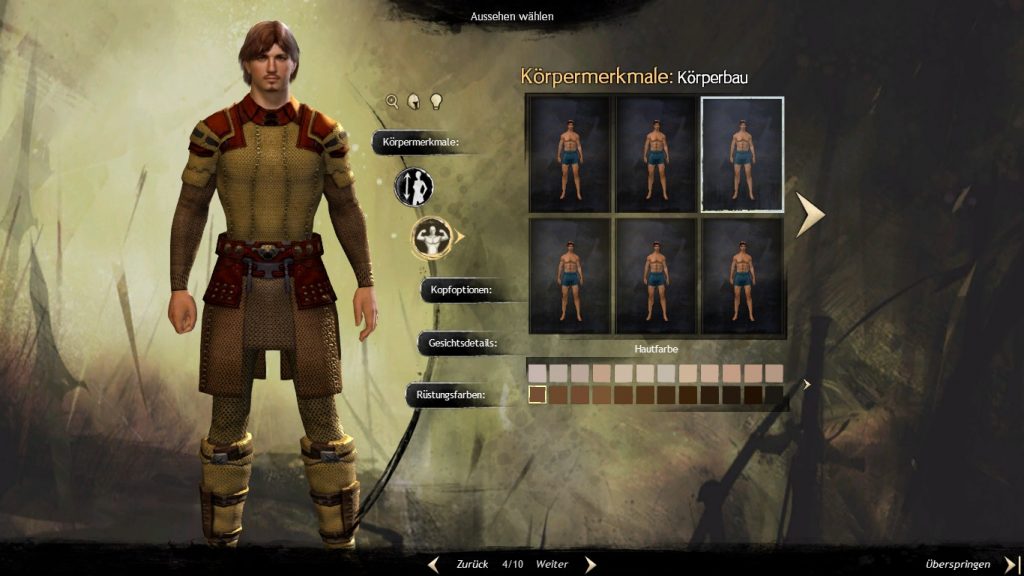
Many games make it relatively difficult for us role-players, as character customization options are limited. Often, each race and gender has exactly one body model, so anyone wanting to portray a somewhat plump elf or a tall human woman runs into a problem initially. However, you shouldn’t be discouraged by having a limited selection of customization options or abandon your character concept – the appearance does not have to perfectly match the actual appearance – small details like being overweight/underweight or scars can also be easily mentioned in role-play.
Of course, there are also online role-playing games, such as Aion or Guild Wars 2 (image above), that come with a fairly extensive character creation and offer you a wide range of possibilities.
Conclusion
If you can adequately answer these five questions, then you should discuss your concept with someone else – preferably with a role-player who knows the setting well. If you don’t have anyone in your friend circle who fits that description, you can also simply ask for opinions and help in the appropriate forums – as a newcomer, you have nothing to lose, and people will usually give you good advice on what you should change or reconsider.
Just remember: you will soon be playing with these people, so it’s also important to them that you are well prepared and do not represent a burden, but rather an enhancement to the game world.

Your opinion is important to us!
Do you like the article? Then let us know!