

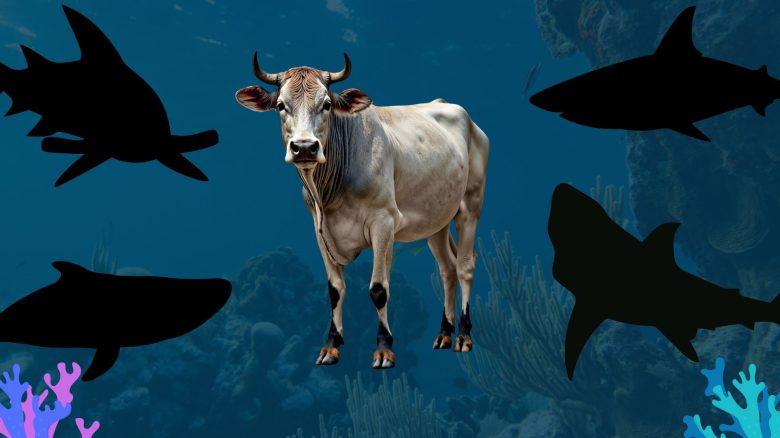
Scientists throw a cow deep into the Chinese sea and discover unexpected guests. What begins as a simple research experiment turns into a discovery that challenges the understanding of sharks, deep sea, and climate change.
This experiment is about: As reported by IGN Brasil, researchers sank a dead cow 1,600 meters deep in the South China Sea. The aim of the experiment was to simulate the natural decay of a whale body – a so-called “Whale Fall”, where a carcass becomes the center of an entire deep-sea ecosystem over the years.
Instead of a whale, a dead cow served as a substitute in this case. It was sunk at a continental slope off the island of Hainan at a depth of 1,629 meters. Because it is relatively close in size and tissue to a whale and much easier to obtain. According to a study published on June 1, 2025, in the journal Ocean-Land-Atmosphere Research, the researchers wanted to observe which animals would be attracted by it.
The depth is not only full of mysteries in reality – in games like Subnautica, the unknown beneath the ocean surface is encountered in impressive ways. Watch the video about the game here.
What lies dormant in the deep
What was attracted by the experiment? Particularly surprising was the appearance of eight Pacific sleeper sharks – a species of shark that has only been documented in the cold North Pacific before. This is the first confirmed sighting of this species in the South China Sea. All identified specimens were female. It was previously assumed that these sharks only lived in the North Pacific, from Japan to Baja California. The new sighting challenges this picture.
The sighting marks the southernmost known point of their occurrence in the entire Pacific basin. Biologists are now examining whether their habitat has shifted due to environmental changes or if an undiscovered population lives here, possibly even a refuge for females or juveniles.
What was special about the behavior of the animals? The underwater cameras documented an almost polite behavior: the sharks arranged themselves in a sort of rotation to feed one after the other. Larger animals were more targeted and aggressive, while smaller ones held back initially. Instead of a chaotic fight, there was an orderly system, an indication of social feeding hierarchies that have been little known in predatory fish.
The sharks also retracted their eyes while feeding. Since they lack a nictitating membrane – a protective third eyelid – researchers interpret this as a natural self-protection mechanism. Similar mechanisms are known only from a few species. Additionally, several animals showed conspicuous parasites in their eyes, presumably copepods. Such parasitic infestations typically only occur in Greenland sharks, a close relative.
What other species also appeared? In addition to the sharks, snailfishes and numerous amphipods were also documented. Small, shrimp-like crustaceans that usually only settle on carcasses after a longer time. This suggests that tropical deep-sea ecosystems may be more productive than previously thought.
What does this mean for research? The discovery raises important questions. Have habitats shifted due to climate change? Or is the South China Sea simply still under-researched? The frequent occurrence of sharks in this region could indicate both. The high activity of the sharks might suggest that there are more food sources at this depth than previously suspected. Future comparative studies from other marine regions should help learn more about energy flows, breeding grounds, and behavioral patterns of large deep-sea species.


Whether in the deep sea or at the surface: extreme conditions often demand unusual adaptations. While sharks react with rotational behavior at 1,600 meters depth, humans often reach for the wrong solutions in heat. Why you should prefer tea over cold water in hot weather shows how surprisingly effective the body functions.

Your opinion is important to us!
Do you like the article? Then let us know!