

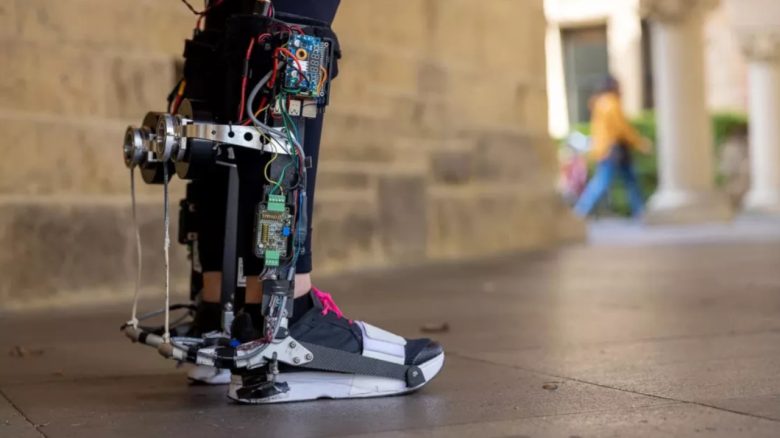
A man invests a lot of money in an exoskeleton to be able to walk again. However, after a defect, the manufacturer refuses to repair the model. Only after a lot of media attention is his device finally repaired.
Former jockey Doug Straight was paralyzed from the waist down after an accident at a horse race and could no longer walk. For this reason, he invested around $100,000 in an exoskeleton to be able to walk again.
But after 10 years and over 300,000 steps, the device is defective, and the manufacturer refuses to repair it. Allegedly, it is only about 18 euros.
Defective battery for 18 euros in a device worth 90,000 euros
What exactly is the issue? After he had taken more than 371,000 steps, however, the suit suddenly gave up. The English magazine Techspot talks about a “cable in the watch,” but the man himself refers to a battery in the watch and not a cable. He cites the cost of $20 (about 18 euros) for the battery replacement.
What does the affected person say? The affected person explained on Facebook:
The reasons why it has stopped are a pathetic excuse for a bad company trying to make more money. The reason it doesn’t work anymore is a battery in the watch that I wear to operate the device.
I called and thought it was no big deal, but I was told that they no longer work on machines that are 5 years or older. After I paid almost $100,000 for the machine and the training, it is very hard for me to believe that a $20 battery for the watch is the reason I can no longer walk.
How did it end? Doug Straight eventually got his robotic legs repaired at the end of the day. But only after he raised a stir on social media and got the local television to report on his struggle.
Without this media attention, he probably would not have received support from the company and would not have had his exoskeleton repaired.


In Europe, “Right to Repair” is coming
What about us? In the European Union (EU), there has been a long fight for a “Right to Repair.” This is meant to ensure that devices can be repaired even after the warranty has expired, thereby reducing waste. In July 2024, a corresponding EU directive came into force, which must be implemented into national law by 2026 (via bundesregierung.de).
Manufacturers are to be obliged to ensure that products are repair-friendly so that devices can be opened with simple tools. Additionally, they want to prevent barriers for individuals from being built in, such as soldered components or software locks.
More exciting developments: The Raspberry Pi is one of the most popular computers in the world. Now researchers at Stanford University have developed an exoskeleton with such a system. In the future, the system should also be available for purchase: Popular computer could improve the lives of thousands of people – Makes walking faster and easier

Your opinion is important to us!
Do you like the article? Then let us know!