A man loses a game of elephant chess. In pouring rain and hail, he later reflects on his game.
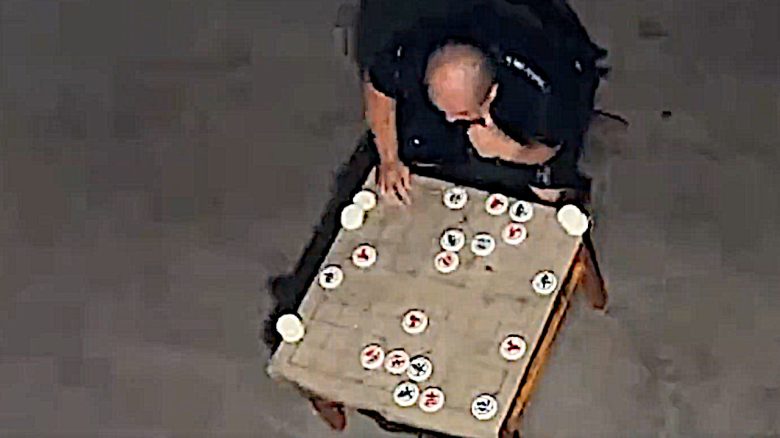
A man from the Hebei province in northern China has gone viral for losing a game of Xiangqi. Xiangqi is often referred to as Chinese chess. However, what made this event special was not the match itself, but what the Xiangqi player did after the match: he began to reflect on his game. This was reported by the English-language magazine Dexerto.com.
What exactly did the person do? After losing his match, in a video by the South China Morning Post the man was seen asking his opponent to return to the table after the game.
The footage shows how he sat there for four hours, with the table looking almost exactly the same as before. He moved the pieces step by step and set them back up as he had lost them. He was not even disturbed by the storm brewing around him.
In hail, wind, and pouring rain, he sits bareheaded in the video at the table and thinks about his game. Even his wife, who wants to get him at some point, has no chance of getting him to stand up. He is too preoccupied with the lost game.
Xiangqi and Chess: Similar, but Different Games
What is the man playing? Xiangqi is one of the most popular board games in China and Vietnam, and has been played for centuries. Xiangqi is often called Chinese chess or elephant chess because it has similarities with the chess version we play, and because both games are said to have originated from the same Indian game (Chaturanga). Nevertheless, there are significant differences in addition to similarities:
Similarities:
- Both games aim to checkmate the king (Western) or the general (Xiangqi).
- They use similar piece concepts: king/general, rook/chariot, knight/horse, and pawns/soldiers.
- The game requires strategic thinking and is usually designed for two players.
- Pieces are moved according to defined rules and capturing pieces is a central part.
General Differences:
- Chess is played on a field of 8 × 8 squares of white and black, where pieces stand on squares. In Xiangqi, players play on a 9 × 10 line grid and pieces are placed on intersections (points).
- In the center of the Xiangqi board, there is a river that certain pieces, like the elephant, cannot cross.
- In Xiangqi, there is the eponymous piece Xiangqi, for which there is no counterpart in Western chess.
- Additionally, no pieces become promoted in the Chinese variant upon reaching the opponent’s side.
Can you play this in Germany? Yes, you can also play Xiangqi in Germany. Championships are organized by the German Xiangqi Association (DXB). The association also offers online meetings approximately once a month where you can watch and even learn the game.



Those who have joined the chess hype in recent years may have come across the site chess.com. Here, chess enthusiasts can play, train, and interact with each other. However, for the well-known chess site, the hype seems to currently be a bit too much: After a big hype due to Twitch, Netflix & Co., it seems everyone wants to play chess – Popular site buckles under the onslaught