

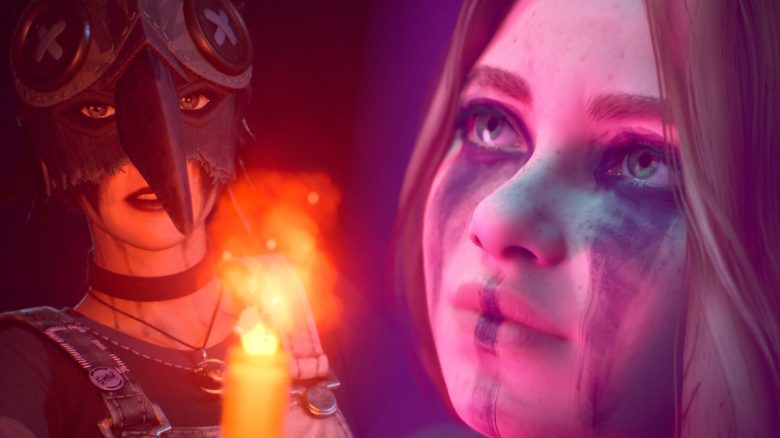
MeinMMO demon Cortyn played Lost Records: Bloom & Rage. We reveal what the game is worth in this article, without spoiling too much.
After I finally had enough of Clair Obscur Expedition 33, it was time for another game. Something calmer. Something that had been on my list since its announcement, but that I had avoided because it was not “finished”.
However, a few weeks ago, the second “episode” of Lost Records: Bloom & Rage was released, making the game now complete. So I dove in, and I have to say: Man, I missed that.
What is Lost Records? Lost Records is a new franchise from Don’t Nod. You have probably heard the name, as they are the original creative minds behind the first “Life is Strange” titles until it was taken over by Deck Nine Games.
Bloom & Rage is the first game in this franchise, but the developers want to create a whole new world that tells a story over several games.
I knew relatively little about Bloom & Rage beforehand. Aside from an initial teaser trailer, I hadn’t engaged with the game at all and want to make it clear:
Not knowing anything about the game is definitely a good thing. The less you know, the more the game can surprise you.
If that doesn’t scare you off (I know you!), I will now go into more detail about why I enjoyed my time with Bloom & Rage so much.

From Insignificance to Horror Thriller
The story of Bloom & Rage starts very gently and slowly.
You are Swann, a middle-aged woman returning to her hometown after 27 years. An old friend has reached out. She received a package addressed to their friend group from back then – and that is concerning. She doesn’t dare to open the package alone because she wanted to forget the events of that time. So she gathers all the friends again to meet and process the experiences of the past.
Then you take on the role of 16-year-old Swann in 1995. Swann is not like the other girls. She feels out of place and is not particularly social. She also has weight issues, which affect her self-esteem.
However, what Swann loves is her camera. She basically always has it with her and films everything that comes in front of her lens. Whether it’s graffiti, animals in the wild, or simply beautiful panoramas that she discovers in her daily life.

This camera is a central gameplay element. Because you can record small clips of around 10 seconds at almost any opportunity and save them, while you control the camera yourself, rotating, zooming in, and determining the recording. Multiple clips can then be combined into a short video in which Swann shares her thoughts – about her cat, her place of residence, or her room.
As a little bonus: Those who actively experienced 1995 will find here a time travel experience that is simply nostalgic. From Tamagotchis to edible sugar bracelets or “Grow your crystals” sets in children’s rooms. The attention to detail is splendid, and anyone over 30 is likely to feel younger during that exact timeframe.
Swann is about to move away from her hometown, which is why she is collecting memories once more. But when she is taking shots of the video rental store (video rental stores, who remembers them?), she is confronted. A young woman thinks Swann is a stalker secretly filming her. This, in turn, brings her boyfriend into play, who wants to drive away the “perverse stalker” (us!).

One thing leads to another, and from this situation, Swann becomes part of a friendly group. By the side of Autumn, Kat, and Nora, she spends her last days in her hometown and wants to capture as many memories as possible.
But something is not right. In the first hours, you notice that your camera sometimes behaves strangely. Some subjects just can’t be filmed properly, and there are disturbances. And then there is this old mineworker’s cabin in the woods that seems abandoned for years and yet would be the perfect secret hideout for the girls…
Without going into too much spoiler-filled detail: Something mystical is occurring in this forest. The boundaries between illusion, imagination, and actual magic seem to blur as the girls form a pact in the woods that will determine the further course of the game’s story. Along with a song that determines the girls’ future:
Gameplay that doesn’t feel like a game
Bloom & Rage does not rely on quick reactions. Bloom & Rage focuses on emotional gameplay that I have never seen in this form in any other game.
And yes: you can run around with the camera and try to photograph every silly graffiti, every bird, and every creepy toy to satisfy your collecting instinct. But that is not what it is about. That is even the weakest part of the game.
In Bloom & Rage, it’s about emotions, friendship. About personal and foreign needs, empathy, and attention. About uncomfortable topics such as dissatisfaction with one’s body, unrequited love, racism, loss, and the search for one’s place in the world.
That sounds so “woke” to some that they might vomit – but hey, close the article and have a nice day. This game is not for you.

Because while we guide Swann through her everyday life with her new friends, not only the dialogues are in the foreground but also the gestures and facial expressions. The small objects in the game that you can take a close look at. The little movements, little sounds of dissatisfaction or agreement.
As the girls talk, you repeatedly get choices on how you want to intervene in the conversation. Do you want to heartily laugh at Nora’s joke? Or would you rather stay silent because the joke embarrassed Autumn somehow?
No matter what you choose, the conversations continue. As the conversations progress, your response options change. The conversation develops, whether you intervene or not. Even silence is an option because you don’t have to say something to everything. But if you are constantly silent, the other girls will find that strange as well. Who wouldn’t find it odd if a friend silently stands next to her with a camera all day?
But do you prefer to be honest and reveal that you have no idea what music groups the others are talking about? Or do you try to adapt and pretend to be a fan to fit into the group?
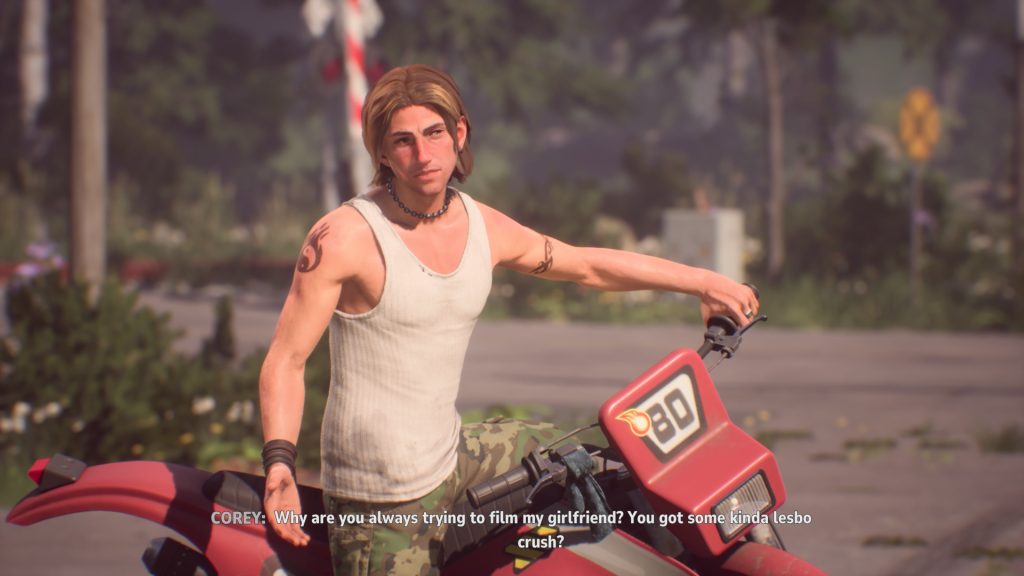
All these little conversations and interactions have significance and are important. Not on a level involving world-changing events but on an emotional, interpersonal level.
A few examples.
Nora asks: ‘Can you pass me my notebook?’}
So we stroll over to the pile of magazines and stand in front of 7 different issues. If we were attentive, if we watched the cutscenes closely, then we know which of the magazines should be hers. If we give her the wrong one, she will be disappointed. She thought one would know her well enough by now to realize that she is into punk rock and not video games.

At another point, Kat stands before us and is crying. She needs comfort. But how do we best comfort her? Do we just hold her and stay silent? Do we talk to her to distract her? Do we keep our distance and let her be alone because she just needs time?
These are questions we can answer only if we know Kat well. And we only do so if we were attentive. If we considered the small details. Small details that do not appear as glowing objects with a “important!” marking in the game.
Such moments are constant. Do you find the right solution to give the girls in your group what they want? And are you ready to put your own desires behind for that? Or would it even be good to set red lines and say what you want? Maybe this honesty is exactly what the others wish for?

Fantastic details in a thoughtful world
Especially want to emphasize how well thought out and detailed the world is. There is one scene in particular that has stayed in my memory.
After a dramatic incident, Swann is back in her room and is compelled by her mother to finally pack her boxes for the move.
On the bed lies Swann’s phone, and next to it are listed some numbers, including those of her friends and the veterinarian for her cat.
What the game wants to convey is relatively clear: Call one of these numbers. Decide whom you want to talk to.
But it’s so much more. In the hours of gameplay before, you could explore several areas, such as the video rental store. Naturally, it also had a phone number on the door. Did you remember it? Then you can call there too.
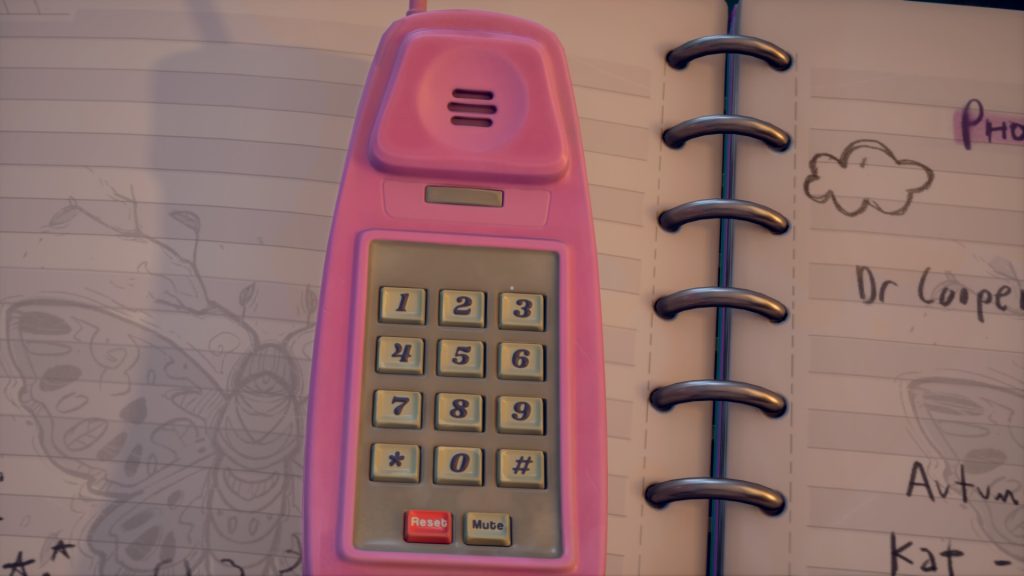
Or did you take recordings of all the graffiti in town that sometimes had a phone number? Do you remember those? Then you can manually enter them too. Or just call 911 to reach the police?
Actually, really crazy things are possible that you won’t even think of during your first playthrough.
These possibilities with the phone call are just one detail that has stayed in my memory. Bloom & Rage is full of them, and you often only see them on the second or third look.
Bloom & Rage is so feminine that it sometimes hurts
Bloom & Rage is feminine. Not only because it’s about the relationships of a group of young (and later adult) women but also because the themes of the characters have a distinctly feminine focus, which can sometimes be slightly uncomfortable.
When Nora draws a picture during the secret sleepover in the woods, of the cartoonish caricature of a blood-soaked tampon with a face that “will haunt you all in your sleep”, I thought to myself: Okay, other games probably wouldn’t have done that. And that makes it pretty cool.
There were certainly a few moments when I cursed that. When it was too feminine for me. Because at the meeting of the women, 27 years later, everyone sits around the ominous package for several hours debating whether to open it or not. They discuss it so thoroughly that I wished multiple times: Ladies, enough is enough. Just open the package or put it away. But if you keep talking it to death, I’ll reach through the screen and open it myself.

Bloom & Rage fails at the start, and that’s a shame
Lost Records: Bloom & Rage is not perfect.
If I look at the trophies of the game on PlayStation 5, it becomes quite clear where Lost Records loses players. Right at the beginning.
While 85% of accounts at least reach the first decision, not even half of them experienced the end of the first chapter – just 40.8%.
This means that Bloom & Rage loses a large part of the player base within the first hours of gameplay.
And I understand that.
Because the beginning drags on. In the first few hours, Lost Records takes so much momentum that one can lose interest multiple times.
In the first hours you stumble awkwardly through Swann’s room, pursuing absolute trivialities and feel like you are trapped in a very peculiar collection game where the only goal is to capture as many subjects with the camera as possible.

Many of these supposed trivialities and unimportant details later turn out to have significant meaning, but you do not see it at that time. You can’t see it. And without this context, the beginning is primarily one thing: really boring.
I understand anyone who put down Bloom & Rage after an hour and never started it again. But that’s a mistake. Because after the first “night” sequence, the game picks up significantly and goes into a flow that is fun and above all makes you curious.



Despite these negative points, Lost Records: Bloom & Rage receives a clear recommendation from me. Those who can endure the sluggish start will find themselves in a game whose characters feel alive and relatable like in very few other games before.
Completely overwhelmed me was the level of detail that you don’t realize when playing for the first time. Even the first hours are so full of hints that you don’t recognize as such. During the second playthrough, I thought multiple times “Holy Shit, how could I miss that”.
That and the many different endings make multiple playthroughs very worthwhile.
Lost Records: Bloom & Rage feels like an even more emotional and profound “Life is Strange”. It is even more “Life is Strange” than the latest genuine “Life is Strange”. That may sound strange, but when you reach the end of Bloom & Rage, you will understand.

Your opinion is important to us!
Do you like the article? Then let us know!