


How does the ranking of League of Legends (LoL) work? We show you the ranks from Iron to Diamond to Challenger in an overview.

What kind of ranking is this? Those who participate in ranked games in League of Legends earn a ranking. Depending on how often you win and lose, it affects your personal ranking. The idea is that players of about the same skill level should play against each other. This is meant to make matches fairer.
We will first show you the various ranks of LoL and the best and worst ranks in the overview.
LoL Ranks Overview – The Rank System
Requirement for Ranked: If you want to play ranked games, you need an account level of at least level 30. Additionally, you must own at least 20 champions. Only when these two requirements are met can you participate in ranked games.
Your first games are your placement matches. Depending on how they go for you, you will be placed in a corresponding league. If you lose often, you will start at the bottom in the Iron league.
You need to know: Your ranking is reflected in which league (also called tier) you are placed in. There are 9 different tiers, many of which have further subdivisions.
LoL rankings (tiers) sorted from good to bad:
- Challenger
- Grandmaster
- Master
- Diamond
- Platinum
- Gold
- Silver
- Bronze
- Iron
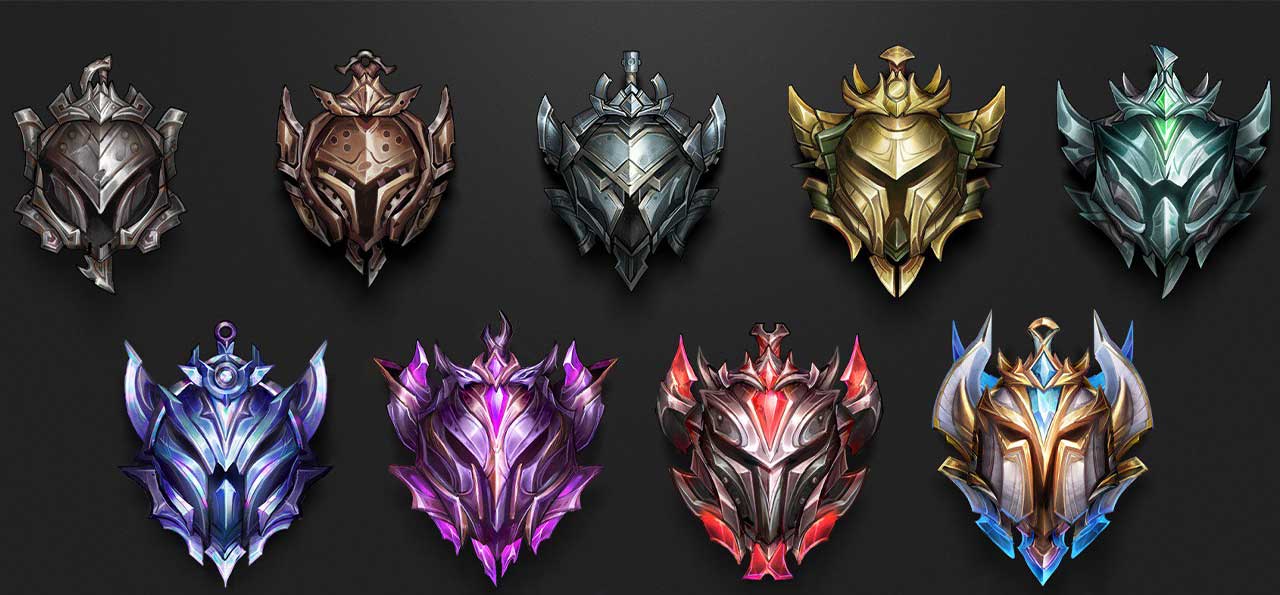
The best players are found in the Challenger ranks. The currently lowest ranking is in the Iron league. Since 2018, the Iron league has existed, and players have had to come up with new flames.
What are divisions?
The individual leagues are partially divided into divisions. A Gold player can be in Gold IV or Gold I. The fourth division is the lowest, while the first is the highest. By earning League Points (LP), which you receive from winning matches, you can advance in divisions and leagues. If you lose League Points, you can be demoted.
At the end of a season, your achieved ranking is recorded, and you receive rewards based on it.
All divisions of LoL:
- Iron IV, Iron III, Iron II, Iron I
- Bronze IV, Bronze III, Bronze II, Bronze I
- Silver IV, Silver III, Silver II, Silver I
- Gold IV, Gold III, Gold II, Gold I
- Platinum IV, Platinum III, Platinum II, Platinum I
- Diamond IV, Diamond III, Diamond II, Diamond I
- Master
- Grandmaster
- Challenger
Player Distributions in the Rankings – How many are Gold and above?
Ranks in the Solo Queue: We looked at the rank distributions of the solo queue of LoL. The data comes from February 2023 and is based on information from leagueofgraphs.com. Here, it is clearly visible how the rank ratio of solo players currently looks:
- Challenger ~ 0.023 %
- Grandmaster ~ 0.065 %
- Master ~ 0.24 %
- Diamond ~ 2.1 %
- Platinum ~ 7.1 %
- Gold ~ 19 %
- Silver ~ 32 %
- Bronze ~ 28 %
- Iron ~ 9.4 %
What stands out? Most players participating in ranked games in the solo queue are between Bronze and Gold. These three ranks make up about 79 % of the player distribution.
It is also evident how thin the area above Diamond is. Only about 0.3 % of the players from the ranked solo queue are better than Diamond. For this reason, players in the higher tiers know each other well and encounter the same players more often, while there is more variety in the lower tiers.

Your opinion is important to us!
Do you like the article? Then let us know!