


On March 5, the Bundestag voted positively on an extension of youth protection in the internet and social media. Games with ‘gambling-like mechanisms’ are to be considered harmful to youth in the future.

What exactly is going on? With a reform of the Youth Protection Act, the government wants to ensure that children no longer come into contact with games that offer a high purchasing incentive.
Specifically, the paragraph concerning “developmentally harmful media” is to be expanded. This includes, for example, games with excessively frightening violence. A corresponding section should in the future be expanded to include this content, among other things:
This particularly includes risks from communication and contact functions, from purchasing functions, from gambling-like mechanisms, from mechanisms that encourage excessive media use, from the transfer of inventory and usage data without consent to third parties, and from age-inappropriate purchasing appeals, especially through advertising references to other media.
For the extension of the Youth Protection Act, the parties SPD and CDU voted in favor. The FDP and the Left voted against it, while the Greens and the AFD abstained. Thus, the adjustments were officially approved.
What could this mean? Games that currently offer loot boxes or comparable content could in the future only be approved for those aged 18 and over, as these contents could be classified as harmful to youth.
This was also stated by lawyer Julia Maris to the magazine Spiegel. It also states that Minister for Family Affairs Franziska Giffey wants clear symbols and signs of violence, but also traps for costs.
It is unclear how far the law will go and which games could be included. Because points like “communication and contact functions” or “purchasing functions” can be found in almost all online games. Also, there are significant differences regarding loot boxes depending on the game.
Loot boxes have been hotly debated in recent years
What are loot boxes? Loot boxes have been very popular in online games for several years and are used in many different games.
- Loot boxes are chests or other items that can be opened, yielding random rewards – the loot.
- Usually, loot boxes can also or even only be purchased for real money.
- They contain a range of items, with the best or prettiest ones usually being very rare.
- Often, there is no clear overview of what items are available and what chances one has to obtain them.
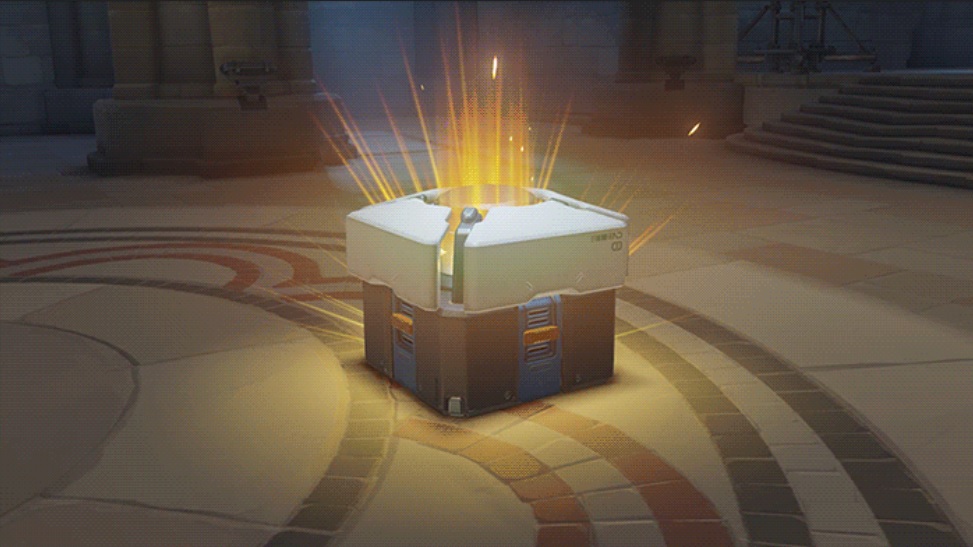
What is the problem with loot boxes? Many players view loot boxes critically. Players see them as money-making schemes. Instead of being able to buy an item directly, one only buys a chance to obtain it, which is often not even made transparent and can be very low.
Another problem is Pay2Win, meaning that players can buy an advantage for real money.
In 2017, there was a huge outcry over the release of Star Wars Battlefront 2. The loot crates there could be earned in-game as well as purchased for money. However, initially, Star Cards were included. With these, the characters could be improved.
The loot box was therefore not merely cosmetic but also provided a gameplay advantage, which fans of the series saw as a Pay2Win mechanism. This led to a great debate and calls for boycotts.
EA reacted and removed the loot box from the game for the time being. Later, it returned without the Pay2Win aspect.
For some, this starts already with boosters for additional gold or experience, allowing players to level up or upgrade faster than others. For others, Pay2Win is only evident when players get an advantage with real money that players without spending money cannot obtain regardless of how much time they invest.
What do supporters of loot boxes say? Fans of these chests enjoy the element of surprise. You open a chest and do not know what to expect.
However, for many, the fun only goes so far when cosmetic rewards are received. In Pay2Win situations like in Star Wars, many see a boundary being crossed.
The exception FIFA? The situation with the sports simulation FIFA is somewhat curious. Here, there is a mode called Ultimate Team, where packs for the best football players can be opened and bought. The strongest are also very rare here.
In FIFA’s packs, many see a definite Pay2Win, which is somewhat more accepted for some reason than in other games. It is similar to collectible card games – whether online or offline. They generally meet with greater acceptance among the masses.
Children repeatedly spend a lot of their parents’ money
On MeinMMO, we have reported multiple times that children handle money carelessly due to their lack of understanding:
- In 2017, there was a case where a Chinese boy spent 6,400 euros in just one day on mobile games. The money actually belonged to his grandfather.
- In 2019, children raided their parents’ accounts to buy packs in FIFA for 611 euros.
- In 2020, we reported on a 21-year-old who spent all his money intended for tuition on FIFA packs.
- Even in Fortnite, there are repeated reports claiming that children spend hundreds or even thousands of euros on computer games.
The satirist Jan Böhmermann targeted the game Coin Master in 2019. From his perspective, it was the perfect example of how children are taken advantage of.
The mobile game has no age restriction and relies on colorful and childlike graphics. However, players can invest money to progress faster. Moreover, the principle of Coin Master resembles that of slot machines. You can find the full story here:

Loot boxes are considered gambling in Belgium and the Netherlands
How do other countries deal with loot boxes? In Belgium and the Netherlands, loot boxes are already considered gambling. They may only be offered in games for players aged 18 and over. Game developers react differently to this:
- In the MMORPG Guild Wars 2, certain content from the shop is no longer offered in these two countries, including the Black Lion Chests.
- In CS:GO, players from these countries can no longer open loot boxes. However, trading them is still possible.
- EA and FIFA are currently engaged in a legal dispute in the Netherlands regarding this issue.
There has also been discussion about a ban on loot boxes in Germany. This came up in 2018 in connection with Star Wars Battlefront 2.
What is the future of the law? Although the Bundestag voted positively on the amendment, it does not mean it will come into force immediately. The Bundesrat can still impose a veto.
The law will only be officially enacted once the responsible minister or minister and the Federal Chancellor have signed it, it has been promulgated by the Federal President, and published in the Federal Law Gazette.

Your opinion is important to us!
Do you like the article? Then let us know!