

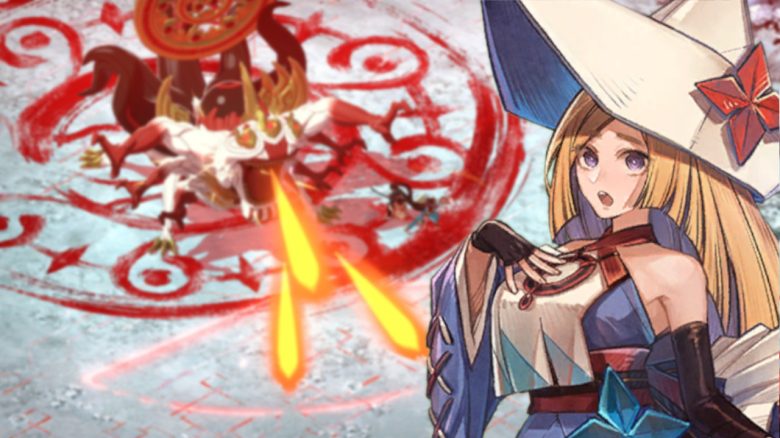
MeinMMO editor Lydia is used to suffering in her favorite genre. However, a new roguelite on Steam not only wiped the floor with her, but also gave her a stab in the heart.
Roguelites are my absolute passion. I love gnashing my teeth on a boss again and again, becoming stronger with each attempt until he finally falls – only to immediately start the next run with the newly unlocked abilities.
Accordingly, Towa and the Guardians of the Sacred Tree, which also impresses with its beautiful hand-drawn graphics, immediately caught my attention.
In the new action game, I take on the role of Towa, a priestess of the deity Shinju, who watches over a village of the same name. Along with her 8 allies, the Prayer Children, she sets out to fight against the demon king Magatsu. However, things go horribly wrong, and the Prayer Children are banished to another world, while time stands still in the village of Shinju.
The Prayer Children must now defeat the demon king’s minions, the 8 Magatsu-hi, and transport their mana back to Towa. For a run, we always take two characters: one character, the Tsuguri, we control actively, slashing through the enemies with his two swords. The Kagura, on the other hand, follows us as a supporter.
I have already played Towa in advance, and even in the first few hours, the game surprised me with a feature that I did not expect in an action-packed roguelite: emotional loss.
In Towa, you pay a price for victory
I initially went into the battles quite unreservedly and tried different combinations between the characters. The game encourages this, as the characters not only have gameplay synergies but also individual dialogues when you rest at the campfire between enemy hordes.
However, this changed dramatically when I managed to kill the boss in my third attempt, who had narrowly escaped me in the first two attempts. The victorious duo conducted a ritual, and suddenly my Kagura Shigin – my sweet, innocent Shigin – was simply gone.
I expected to find him in the village after his victory, but no. At least the mana gained from this allowed me to keep time moving in the village. Here Towa suddenly resembles Pyre, the underrated predecessor of Supergiant’s big hit, rather than Hades.
Even there, every victory meant parting with a beloved character. This requires not only an emotional component but also some planning because suddenly you have to think about who you take into battle.
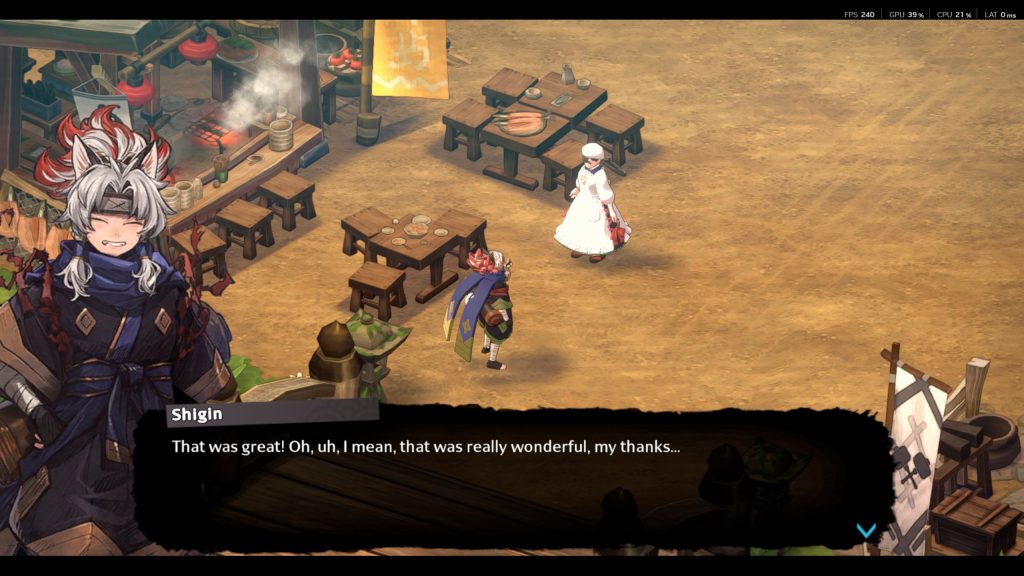
I do not want to rule out that the characters may return later in the story, but even then they will not find the village they left behind.
For every victory also means that time continues to pass without them: children grow up and follow in their parents’ or masters’ footsteps, and the young, pretty teacher suddenly has the first gray strands in her hair.
Normally, the bosses are my favorite part of such games. There is hardly a better feeling for me than finally defeating a mighty opponent after multiple failures with that magical run where everything just works.
The euphoria in Towa is also present, but everything comes with a bittersweet note. On the one hand, I am excited after each victory to explore what has changed in the village. On the other hand, I dread the moment when the friendly old lady no longer greets me with candy.
I almost don’t want to defeat the next boss to spend more time with the beloved characters – but only almost, because in the end I can’t help myself, and when I see a red health bar, it has to go down.
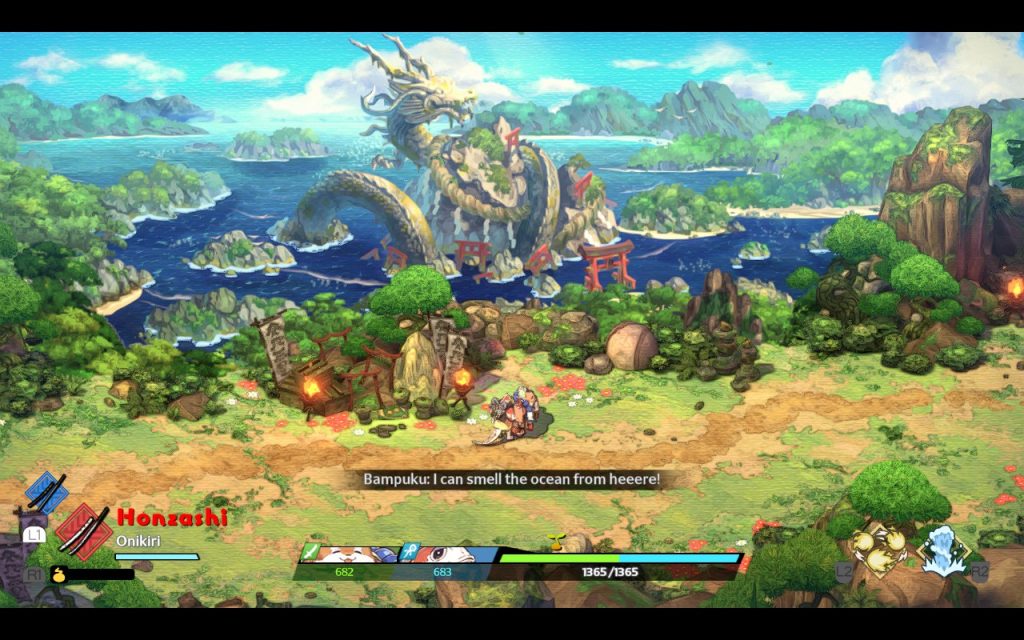
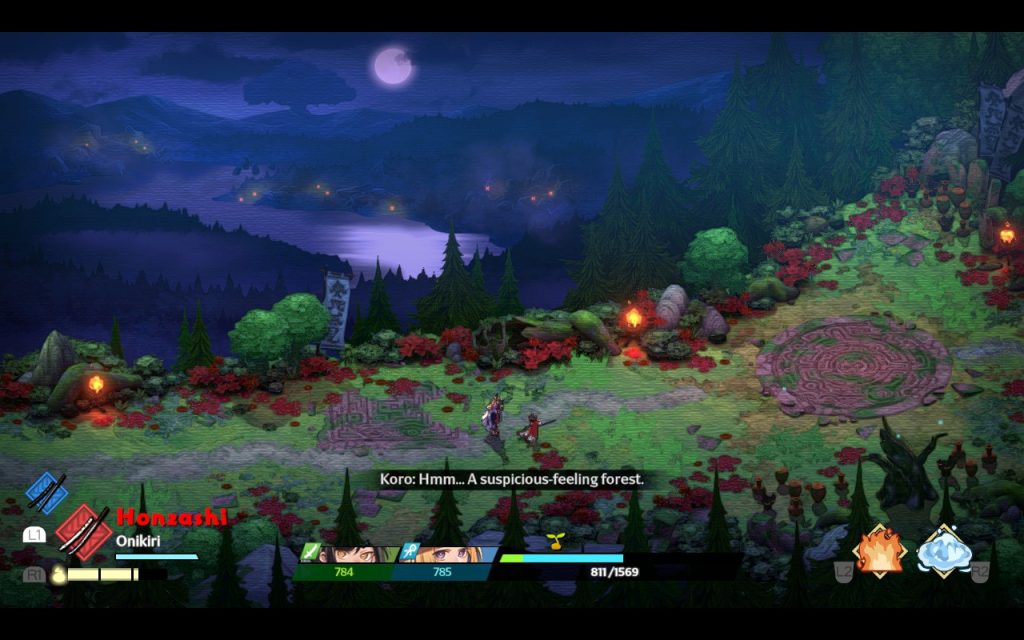
Whether you are truly standing correctly …
With the combat system, the enjoyment of the game rises and falls in every action roguelite, and luckily Towa has great strengths here. Enemies are tough and forgive only a few mistakes in their short counterattack windows. I often have to change swords, or they’ll simply break.
Moreover, I not only have to keep an eye on my character’s health bar, but also that of the Kagura, who far too often stands in the damage zone when I have already brought myself to safety.
Controlling both characters independently is not an option for me; I’m not ambidexterous enough. If you have a co-op partner, you can however leave them the control of the supporter.
The enemies are variably designed, and each type uses different attacks – however, to be honest, that doesn’t make a particularly big difference because they announce all their attacks with generous red areas on the ground. However, these can quickly get lost among the visual effects of your own attacks.
In fact, I haven’t found any of the enemies to be particularly mechanically challenging in my nearly 15 hours of play so far, which doesn’t mean they are easy to defeat. The bosses, in particular, deal a ton of damage, and if you’re not careful, your health bar can disappear faster than you can say “What’s an alien doing in feudal Japan?!”
Rather than memorizing boss mechanics, it is much more important to pay attention to your own positioning. My greatest successes came from waiting to see where the boss will strike, dashing behind him, dealing massive backstab damage, and quickly zapping out of the danger zone.
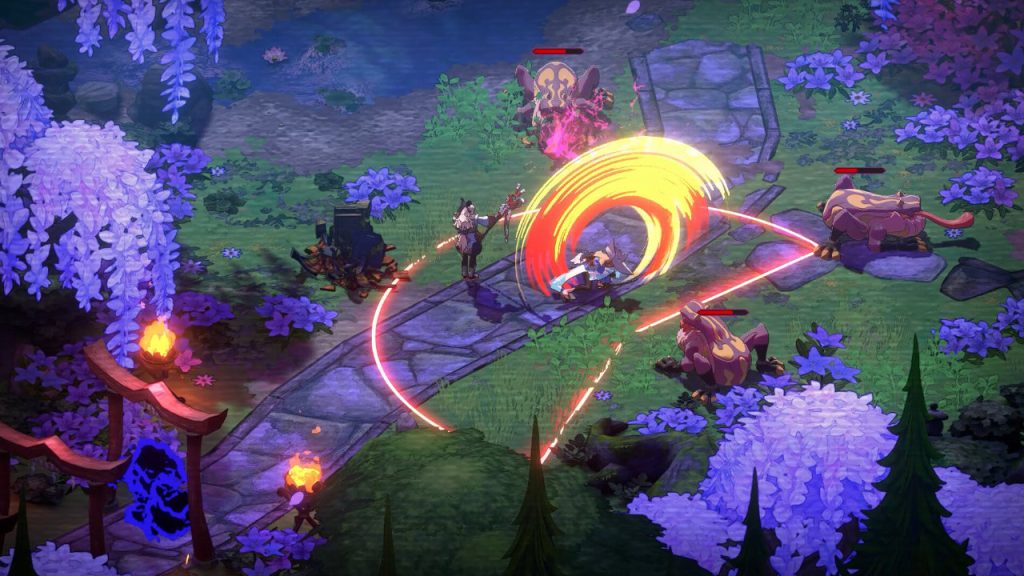
Fun combat system with a few weaknesses
Eating before a fight in the restaurant or resting in the onsen provides useful buffs and makes the tricky boss fights a little more bearable.
Then there’s the grace system. As a reward, you receive new abilities for the duration of the run after completing several rooms. These come in different rarities and generally mean “more damage plus something else,” such as elemental damage, crit chance, or health regeneration.
To deal with these enemies, various builds are possible, which play very differently. I can go for weapon power or dash through enemies with a dash build. The choice of swords additionally influences whether I chip away at enemies with many small cuts or rely on a devastating ultimate attack.
Especially with the elemental damages, I would have liked a bit more individuality because whether I set opponents on fire or rain lightning down on them didn’t make a notable difference for me in gameplay.
The controls could also have been a bit more precise. In action roguelites, I want to unleash devastating combos on the enemies and get to safety at the last moment. However, Towa requires me to think carefully beforehand if I can risk an attack, as the animation cannot simply be canceled.
Overall, I still found the battles to be very fun and surprisingly challenging.
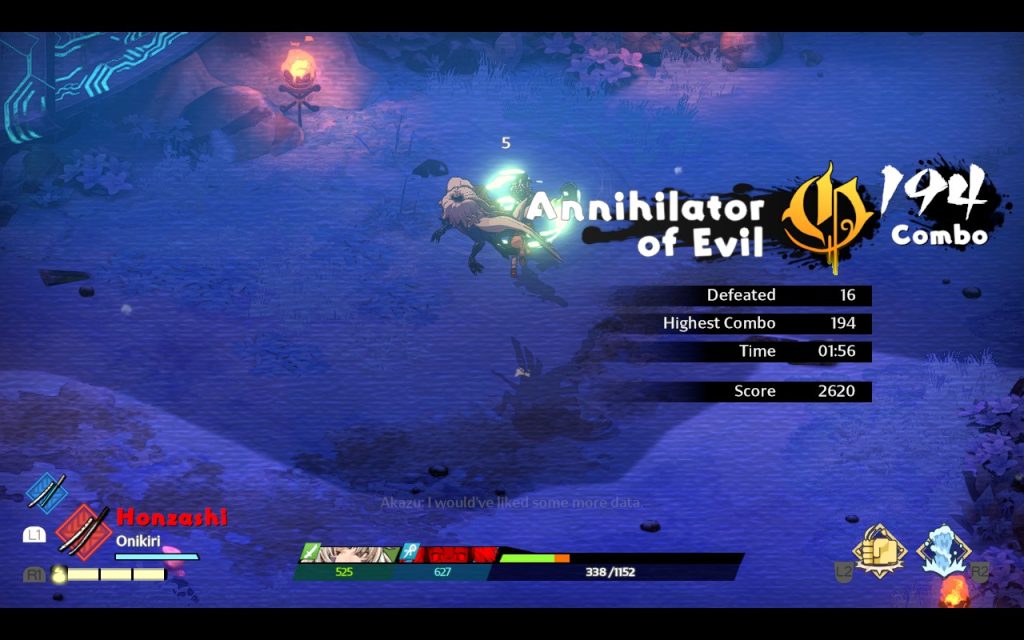
Fights are only half the battle
Between runs, I explore the village of Shinju as Towa, getting to know the residents and strengthening myself for the next run. Each visit to the village has some residents offering small cutscenes where I learn more about their stories and relationships with one another.
These scenes have a typical anime humor and sometimes drag on too long for my taste. After all, I’m here to beat up demons, not to chat.
Still, I have grown fond of some of the characters, and I loved observing their development over the years. The little screamer has suddenly turned into a moody teenager, and the capitalist cat actually has a heart.
Here, perhaps, dialogue options would have been nice, allowing me to have some influence rather than just listening.
I also spent way too much time in the village with the mini-games, which are actually useful in Towa.
You can exchange caught fish for the different in-game currencies, buffs for your Kagura’s staff, or materials. With those, I can forge, including a crash course in traditional Japanese blacksmithing, where the process is explained step by step. This way, I craft my own sword according to my ideas with bonuses and appearance.
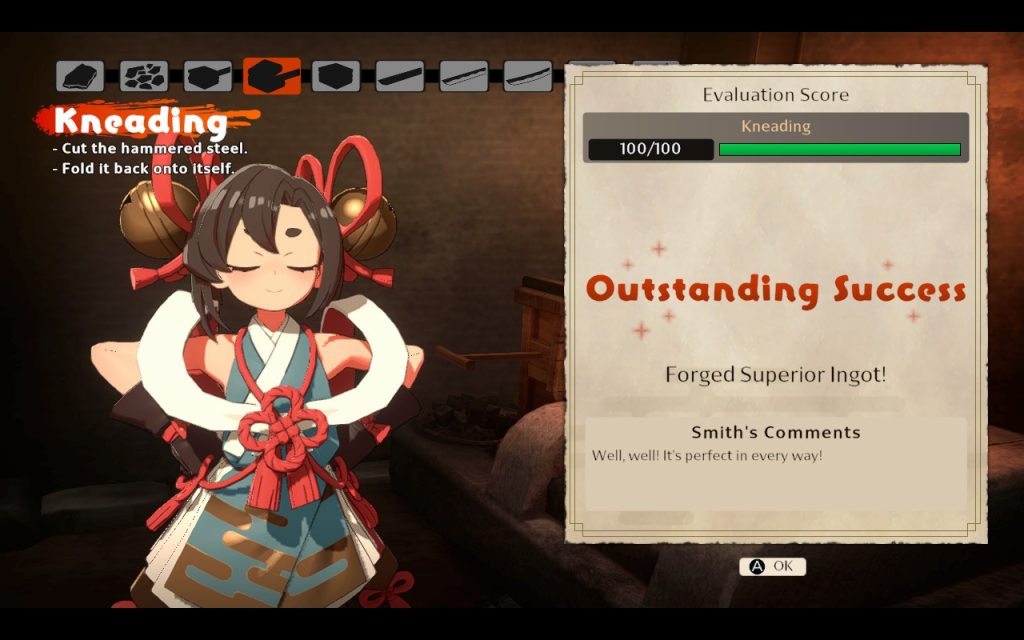
In the dojo, I prepare my characters for the next journey. Each of the Prayer Children can be used as either a Tsurugi or a Kagura, so you should really reskill regularly if you want to switch a character’s role.
Since the Kagura, as mentioned, often takes a hit, you should prioritize health here. If you’re confident in maneuvering the Tsurugi out of the enemy attacks, you can fully focus on offense here. Additionally, you equip swords for the Tsurugi and magical abilities for the Kagura.
As you progress, more and more systems come into play, so there’s really always something to do. When I defeated the third boss, I actually thought I had slowly seen it all and would now proceed according to the same scheme, but instead, the game really opens up at this point, and somehow I suddenly feel like it’s just beginning.


If you like games like Hades, are into Japanese mythology, or want to be confronted suddenly with the relentless passage of time and your own mortality in a seemingly cute game, you should definitely take a look at Towa and the Guardians of the Sacred Tree.
The roguelite is set to be released on September 19 on Steam, Xbox, PS5, and the Switch, and it already runs smoothly on the Steam Deck. At almost 30 euros, it is, however, a bit more expensive than other genre representatives, and I can’t really gauge yet if it truly brings their almost endless replay value.
As for me, I’ve just about recovered from the emotional damage of my last run and look forward to diving back into the fray. I’d also like to recommend the preview by my colleague Jasmin, who has also spent some hours with Towa: I thought I needed a doctorate for an action game on Steam, but after 5 hours, I was mowing down the enemies

Your opinion is important to us!
Do you like the article? Then let us know!