

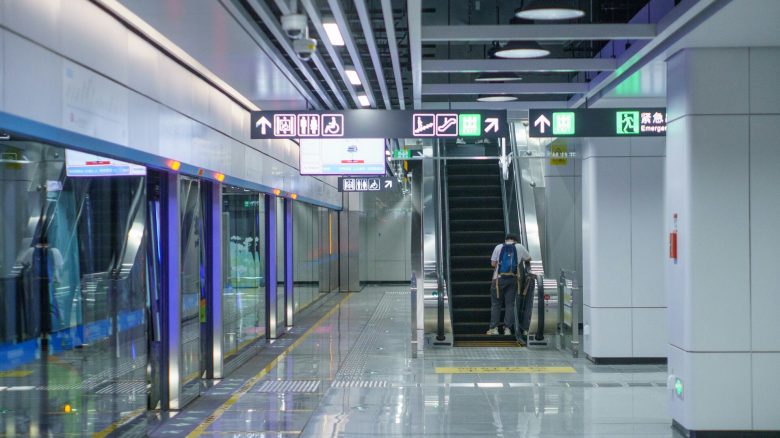
In China, metro stations are being built before the city is even constructed. Chinese urban planning began this process in 2008, effectively turning the usual urbanization process on its head.
What exactly is done differently in China? In many Western cities, there is a clear sequence: first the city grows, then it gets a subway. In China, however, the opposite has become the norm: infrastructure is built in advance – and the city follows in the years to come.
This approach has a system: According to Xataka, it is part of a long-term plan (10–20 years), where such apparent “voids” are not misplanning but rather a transitional state. Today, many of these areas are fully developed and urbanized.
The most famous example is Chongqing, a mega metropolis with over 30 million inhabitants. Ten years ago, users already photographed subway stations amidst empty landscapes, with no buildings in sight. The construction of the subway stations reportedly began on-site as early as 2008 (via unusualplaces).
Is China building its cities like in Cities: Skylines?
Why is China taking this approach? Chinese planning follows a simple principle: infrastructure creates cities, not the other way around. Instead of reacting to existing demand, this form of planning generates it through targeted criteria.
Current studies show that subway projects in China are intentionally used as tools for urban development – they not only direct traffic but also restructure entire neighborhoods and attract investments as well as population (via Frontiersin).
The great advantage of this approach lies in its predictability. Those who lay the infrastructure first can better control the growth of the city, arrange traffic flows early on, and minimize environmental impact from car traffic from the start. Additionally, this significantly increases the value of land – often even before construction has begun (via Xataka).
What does this mean for Germany or the EU? Compared to China, urban planning and strategic placement of subway stations in Europe is utopian. Here, infrastructure expansion is often seen as a reactive measure. In other words: action is taken only when commuters are stuck in traffic or bus lines are overcrowded. The Chinese approach turns this mindset on its head. Instead of waiting for problems, construction is proactively undertaken.
However, the fact that the model works in China does not mean that Europe should or even can adopt it one-to-one. As the French newspaper Le Monde reported in the summer, Chinese cities, due to their advance planning, face immense costs and debts (via lemonde).
This, along with the many historical structures of European cities, is one of the biggest obstacles to such advance planning.


China not only demonstrates how to build cities around metro stations but also how to make trains the number one mode of long-distance travel – with a rail network that sets new standards in speed and comfort: In a country, the train is currently outpacing the airplane: Flying is no longer worthwhile on a distance of 1,300 km

Your opinion is important to us!
Do you like the article? Then let us know!