

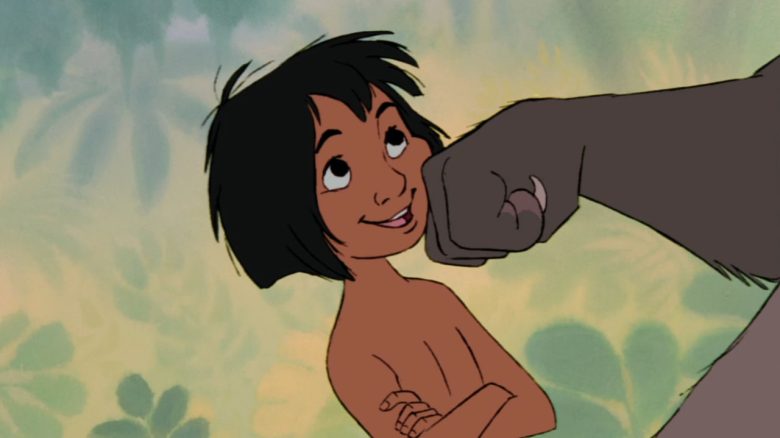
“The Jungle Book” is a popular story that gained additional popularity thanks to the Disney-adaptation. Mowgli is based on a real person whose story was far more tragic.
The story of the boy Mowgli, who grows up deep in the Indian jungle with wolves and other animals, is well known worldwide. It is part of a collection of stories by the writer Rudyard Kipling and was published in 1894, with a second volume following a year later.
In the story, Mowgli comes into contact with humans after his life in the jungle, learns to speak, and also how to behave like one of them. He even works as a shepherd before being labeled a sorcerer by humans after his victory over the tiger Shere Khan and is cast out. He then returns to the jungle.
Many of you may know this story from the Disney adaptation of 1967 – or the remake from 2016. What is less well known is that Mowgli likely had a real-life counterpart, even though Rudyard Kipling himself never commented on it. But the parallels between the fictional character and the boy Dina Sanichar are simply too great to be a coincidence.
A Child Who Lived with Wolves
Who was Dina Sanichar? Rudyard Kipling was likely aware of this boy’s story, as he lived in India in the 1880s, where the following events had occurred a few years prior.
In 1867, hunters discovered a wolf den, inside were several animals and a boy of about six years old, running on all fours and howling like a wolf. He fought against the hunters who wanted to capture him and displayed the behavior of an animal that feels cornered.
The boy was eventually captured and taken to an orphanage. As he arrived on a Saturday, he was given the name “Sanichar” – which means “Saturday” in Hindi. Even there, he still crawled on all fours, ate raw meat, and made sounds like a wolf.

In the following time, people tried to train Sanichar to exhibit human behaviors, such as walking on two legs, eating with utensils, and of course, speaking. At this point, the major difference between Sanichar and Mowgli becomes apparent: the real boy never learned to speak, as he was reportedly mentally impaired for unknown reasons.
He also struggled with walking on two legs, as his bones had been deformed from years of crawling. The clothing given to him was torn by him, and he rejected cooked meat until his death. In short, integrating Sanichar into human society failed. He did pick up one unhealthy habit: smoking.
He lived among people for over twenty years. Eventually, he fell ill with tuberculosis, which was exacerbated by his nicotine addiction. This led to Sanichar’s death in 1895 at the young age of 34.



Sanichar’s story is clearly different from that of Mowgli, who returns to his friends in the jungle at the end, and whose fate remains open. The reality, as is often the case in this story, is more complex and tragic than fiction. Did you already know of Sanichar? Feel free to let us know in the comments. A South Korean film also told a reality-inspired story a few years ago: Before Parasite, the director created a masterpiece about a true crime from South Korea

Your opinion is important to us!
Do you like the article? Then let us know!