

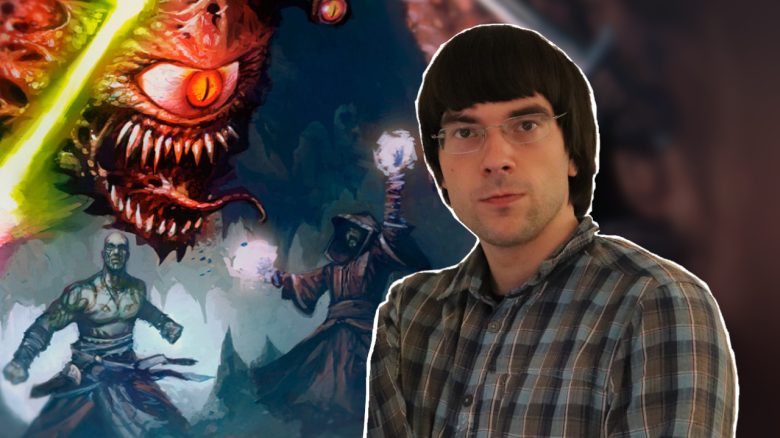
MeinMMO editor Benedikt Schlotmann has been playing almost exclusively the Paladin in Dungeons & Dragons or in Baldur’s Gate 1+2 for many years. Almost exclusively, because the only switch failed.
Baldur’s Gate 1 and 2 were released in 1998 and 2000. The two games are based on the rules of Dungeons & Dragons, specifically the 3.5 edition. However, I only got into it around 2010. Since then, I have played the game for dozens of hours every year because the old games were and still are a milestone for party-based RPGs and remain unsurpassed for me.
By now, it must be somewhere between 500 and 800 hours, counting all attempts. The time spent on the Switch version is not included.
In Baldur’s Gate and also in other D&D games like Solasta or Icewind Dale, I almost always choose the Paladin or he is always dutifully there when I have to create a full group of characters. The Paladin is definitely a class that has accompanied me throughout all rounds, sometimes more successfully than other times.
The Paladin is my class and has been for over 10 years
Why the Paladin? The Paladin in Dungeons & Dragons is a tough melee fighter who also has a few magical tricks up his sleeve. His many hit points and heavy armor make him a grateful class with little frustration potential, especially at the beginning.
When I first got into Dungeons & Dragons with Baldur’s Gate, the Paladin was the perfect class for me: The Paladin is robust and his abilities are manageable. This also makes group play easier compared to other classes: I stand in front and soak up damage while my team takes care of the rest.
Oftentimes, the Paladin also fits the characters I usually take along best: Typically in Baldur’s Gate, they are Imoen (Thief), Khalid (Fighter), Jaheira (Fighter/Druid), Minsk, and Dynaheir (Mage). Rarely, I also take the depressed Xan (Mage) or the cleric Branwen, if I have freed her from her petrification.

In part 2, my party shifts slightly but mostly remains good-aligned: I stay loyal to Imoen, Jaheira, and Minsk, and then Aerie (Mage) and Nalia (Mage/Thief) join. The 6th spot in my group varies depending on who I need at the moment.
Overall, I often play a good-aligned group, aside from the argumentative Viconia (Cleric) who occasionally has a guest appearance in both games. The Paladin fits perfectly without me having to break my oath.
Additionally, I believe the Paladin has the best class quest in part 2. The quests of the warrior and druid are nice, but do not have nearly as cool a final boss. What good is a druid grove or a castle of my own when I can defeat a huge dragon?

Once I played something else and instantly regretted it
Once, I actually wanted to play something else, namely a bard. But I couldn’t connect with him: I got to the Friendly Arm, an important tavern in Baldur’s Gate 1, and picked up Jaheira and Khalid for my group. And then I lost interest.
There were probably various reasons for this back then: The beginning of Baldur’s Gate 1 is slow and not quite easy, and a class like the bard, which is not necessarily suitable for beginners, didn’t make it any better. Especially when at the beginning you only have Imoen as your companion and she is fairly fragile. In the worst case, you can be torn apart by the first larger group of wolves right behind Candlekeep.
In the end, I ended up going back to the Paladin. A class that forgives errors a bit more and doesn’t confront me directly with the harsh reality of the Sword Coast.
The bard simply wasn’t beginner-friendly enough for me as a novice because I couldn’t endure much damage and had to rely on my party to utilize my skills effectively. This made the beginning quite tough, which I was not keen on.


If I’m not playing the Paladin in a D&D game, I also enjoy playing a strategy game. One that particularly fascinates me is Whiskerwood, a game featuring mice and cats. However, the cats are anything but harmless and have driven me crazy often enough: After 20 hours in a new building game on Steam, I would have loved to put my beloved cats out the door

Your opinion is important to us!
Do you like the article? Then let us know!