

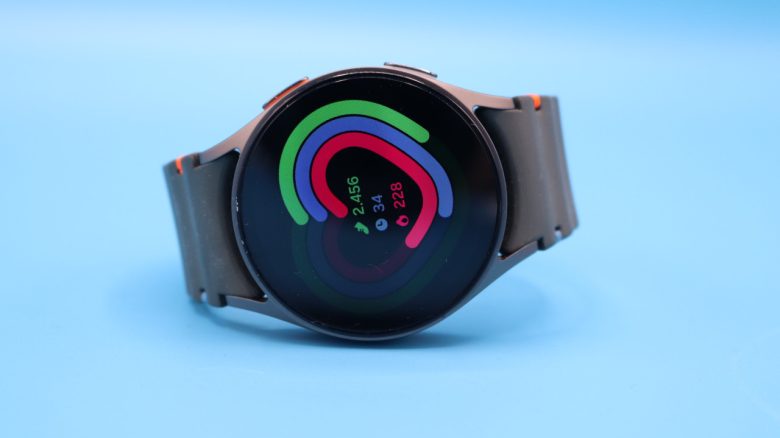
A smartwatch can make life easier. At least, MeinMMO editor Benedikt Schlotmann is thrilled with his device. But there are also people he cannot recommend such a smartwatch to.
“Move now to stay active!” This is how my smartwatch encourages me to move when I’ve been sitting at my desk nonstop for an hour or playing games at my PC in the evening.
Even though it annoys me sometimes, it has become a constant companion in my daily life that I simply cannot do without:
- Along with my fitness data, I get timely notifications when someone calls me on my phone, even if the phone is on silent or stuck at the other end of the apartment on the charger.
- If I’ve left my phone somewhere in the apartment, I can find it again thanks to my smartwatch in seconds.
- The stopwatch feature on the smartwatch is also very practical in daily life, and features like “paying with the watch” I also find great.
Moreover, for the past few months, the watch has been encouraging me to be significantly more active: For a while, I barely managed to get more than 3,000 steps a day. My watch has motivated me to move much more regularly. This is partly due to the fact that at some point I get a reminder that I’ve been sitting for too long. Along with my smartwatch, Ring Fit Adventure is also a constant companion for me.
The battery life of smartwatches is still way too short in 2025
Are there any downsides? Yes, the biggest disadvantage is the battery life. After at most 3 days, I have to plug my watch in to charge. Even my switch from the Galaxy Watch 4 to the newer model in the 7 series did not bring a noticeable improvement.
By the way, battery life is a problem that almost all smartwatches share. Even an Apple Watch hardly lasts 3 days. And this is also the main reason why my partner’s Apple Watch ended up in the drawer and not on her wrist.
Additionally, which especially applies to Samsung models, like my Galaxy Watch 7: Certain features can only be used with a Galaxy Watch if you use a smartphone from Samsung.
At the same time, such a watch doesn’t let you rest: “You only need to move for another 5 minutes to achieve your daily goal,” it says, or “if you want to reach your monthly goal, you need to make 3,551 more steps today.”
This can indeed be helpful if you want to move regularly, but it can also quickly become an obsession that some can hardly shake off. And this is something to keep in mind if you really want to start using smartwatches, fitness trackers, and similar devices.



News and the plethora of data can drive some users crazy
What’s the problem? Smartwatches and fitness trackers provide you with a massive amount of data and measurements: heart rate variability, stress levels, sleep phases, and how many kilograms you’ve gained or lost in recent days. And there’s even more data to access if you want.
What sounds very practical at first can also become a problem for some people. My colleague Alexander Köpf explained that his fitness tracker almost drove him insane. The sheer volume of data just wouldn’t let him rest:
My daily life didn’t bring me any peace either. Through constant monitoring, I began to put too much pressure on myself. I intensified my workouts, counted every calorie, and meticulously noted every milliliter of water consumed.
Another colleague of mine reports that with a smartwatch, you also receive all notifications from your phone directly on the watch, which is not better either. He said: “Having the push notifications constantly buzzing on my arm found extremely stressful, and I eventually let go of it.”
Other users also report how collecting and analyzing the data can become an obsessive habit (via npr.org). Fitness trackers ultimately represent yet another way to collect data about ourselves and make decisions. Or as one cartoon describes it (via zeitkunstgalerie.de):
Klaus couldn’t enjoy the beautiful view because he had forgotten his step counter at the hotel.
Can anything be done about it? Yes, in the end, you can turn off many features on a smartwatch selectively. But if you’ve turned everything off, why buy a smartwatch at all? Then a regular wristwatch and an occasional glance at the phone would suffice.
Another recommendation for daily life from me is, by the way, a seat cushion that I have been using in my home office for years. Since then, my butt and back have given me significantly less trouble than before: A cushion for 40 euros saves my butt in the home office and gaming

Your opinion is important to us!
Do you like the article? Then let us know!