


The new strategy game “Millennia” has been available on Steam since March 26. MeinMMO’s strategy expert, Schuhmann, says: “I can’t get away from it,” even though the game is anything but smooth.
What kind of game is Millennia? Millennia can be viewed in two ways:
- Either as a Civilization-type game, but without fixed nations; instead, you build your own nation throughout the game
- Or as a city-building simulation that has been scaled up to “Civilization” level out of necessity
Both views were represented in a talk by GameStar by content creators Writing Bull and Steinwallen. Both are true at the same time.
Every time I lose, I understand what I did wrong
What fascinates me about the game? The great thing about Millennia is that it is as understandable and logical as a game of “Nine Men’s Morris”.
Every time you encounter problems, you can trace the difficulties back to mistakes you made 10 or 20 moves ago.
The mechanics in the game are complex, but very clear. Everything has cause and effect. At the same time, you must consider different priorities:
- It is important that cities grow quickly, which requires you to utilize the available resources. Forests provide production, but little food. Resources like olives only become valuable through additional buildings like a press.
- However, you also need a large army, so that enemies don’t immediately invade or barbarians don’t bother you on the confined standard map (8 games share a medium-sized world).
- But you must also develop technology and ideally be a tech leader to determine which age you lead your people into. Otherwise, you suddenly find yourself with a plague on your hands and waste time and resources cleaning up outbreaks.
- However, if things go well, humanity enters a glorious “Age of Heroes” and the whole game becomes much easier and friendlier to navigate.

High replayability through building block principle
This is what makes it particularly appealing: Normally, 4X strategy games always follow the same pattern: You learn a formula and perfect it. Over time, you play through the first hours of a game as if in a trance. They no longer require decisions from the player, but rather a fixed play according to a blueprint.
Anyone who masters Stellaris could also play the first two or three hours of a game blindfolded. It’s like the openings in chess: Over time, you can memorize certain patterns.
However, in Millennia there are clever mechanics that ensure that the “basic rules” of the game keep changing. With four ages in the game, you have the opportunity to specialize your nation. The first decision comes early:
- If you want to play aggressively and conquer opponents early, you choose “Raider” or “Warrior” and get powerful units. That’s what I did at the beginning.
- However, nowadays, I like to play as a Hunter, as there are great bonuses hidden further down the tree that can significantly expand your territory.
- But now I’ve read on reddit that even the other options of the first eight, which I never considered, also work great. So I think, even when I’m not playing, I think about playing Millennia.
Just through the starting position of the first city and what resources you have available, the basic conditions change and how you must react to them.


The feeling of “I understood something” is addictive
This is what makes it addictive: Millennia has an incredibly satisfying learning curve because the game continually confronts you with puzzles that you solve, leading to the feeling: I understood something, I have really improved.
Thus, even the question “Where should I build my cities and how do I best expand them?” is a central gameplay decision where you understand something new every 10 hours and make a leap.
Here, you feel real progress.
Even those who find it stupid can still get hooked on Millennia
What do others say? I am not the only one who has already spent 40 hours on Millennia in just a few days:
On Steam, a user said after 36 hours: “Good game. Surprisingly many ideas for a Civ-like game. I love the extensive building part.”
Interestingly, there are several people who rate Millennia negatively on Steam after only a few hours, but simply cannot get away from it:
- A user wrote a negative review after 6 hours of play because Millennia is still so unpolished and has significant performance and AI issues. Despite the negative rating, the user continued to play and clocked in another 34 hours over the 4 days following the negative review.
- Another user criticized the game after 4 hours for “many small bugs and that it is not ready for release yet.” He also added 39 hours of play in 4 days after that.

Is the game fun? Yes, of course it is fun. However, you can also see at every corner how raw the game still is and that it needed a few more months in development.
Especially graphically, the game is weak, the battles are almost outrageous, and the user interface is so grainy that many important pieces of information are only recognizable once you know exactly where to look for the information: I puzzled over why my units simply disappeared in a military-oriented passage.
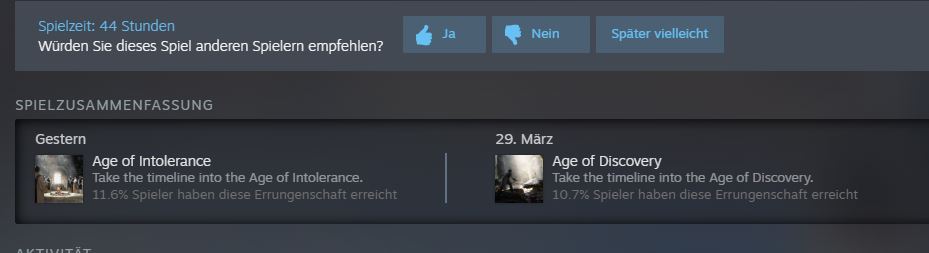
Only when I realized that my financial balance (a tiny display in the top right) was in the red did I solve the puzzle.
Nonetheless, Millennia has now captivated me like rarely a strategy game has in recent months. However, I would not recommend anyone to buy it right now for the €40 on Steam. It’s probably a game that will be significantly better in 6 or 12 months than it is now. Especially since the developers cheekily announced two expansion packs that are set to release in 2024.
Due to all the problems, Millennia has been penalized by testers and both user reviews on Steam:
Strategy geniuses fail again – New alternative to Civilization is pilloried in reviews on Steam

Your opinion is important to us!
Do you like the article? Then let us know!