

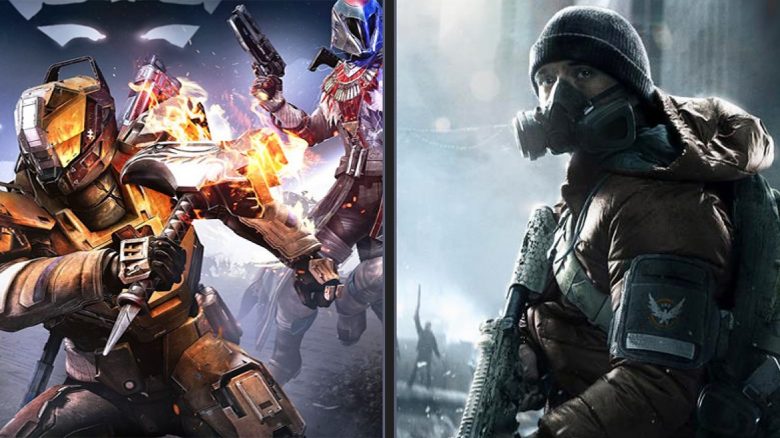
Since 2014, MMO shooters like Destiny or The Division have been one of the major hype genres. They took over the consoles PlayStation and Xbox and opened up new dimensions. Every company wanted to have one. But in 2019, this changed when EA’s “Iron Man” shooter, Anthem, crashed. Now, development of the new “The Division: Heartlands” has been halted. What’s going on?

This was the beginning of MMO shooters: In 2014, the legendary shooter developer Bungie launched their new project Destiny, introducing a new idea. To be more precise, they mixed three known ideas into a new one:
- They took the gameplay from shooters like Halo
- added the loot from Diablo
- and packed MMORPG mechanics from WoW like raids, traders, and reputation factions into the mix
Then they brought everything to PlayStation and Xbox, where there was nothing comparable and players did not know MMO mechanics. It was only the PS4 and Xbox One that were truly capable of online gaming to this extent. GTA 5 had initiated this console revolution a year prior, but Destiny followed through.
Admittedly, the mix was not entirely new. Even before Destiny, there had been forerunners like Defiance and Planetfall, but it was only with this trailer that the hype really started:
Destiny sets high expectations with 2 great expansions
This was the peak of MMO shooters: The golden age ran with some highs and lows approximately until 2018:
- The highlights were in 2015 when Destiny received the very good expansion “The Taken King”
- And in 2018, when “The Forsaken” was released for Destiny 2
The exciting thing about that time was that the expansions provided a glimpse of how great the genre was yet to become. There were epic campaigns, refined boss fights, and raids.
Ubisoft’s The Division demonstrated with exciting DLCs what new elements could be introduced into the shooter.
In Destiny, speculation arose: Players could race on their Sparrows, have a small apartment in the tower, or live in their spaceship.
Many had the expectation back then to never take the Destiny disc out of the PlayStation or Xbox again. They wanted to play the game with their friends forever, and there should always be something new, with new great expansions constantly being released.
2019 looked bright for the shooter world, then it fell apart
This was the break: 2019 ultimately became the decisive year for MMO shooters, for better or for worse.
That year saw the release of “Anthem” from Electronic Arts and “The Division 2” from Ubisoft. Moreover, Destiny announced an epic turnaround: They had separated from Activision Blizzard and planned to make the game that the players and the developers themselves wanted.
All three projects looked good at first glance:
- Anthem impressed with a strong gameplay loop and great graphics
- The Division 2 launched with a fantastic campaign that hooked players to the screen
- Destiny 2 was able to create a real sense of excitement with a stream back then
Destiny, Division, Anthem take the worst possible turn
But what went wrong? All three projects then went in completely the wrong direction and took the worst possible course:
Anthem utterly failed at the “MMO” aspect, had huge problems with game systems and updates. It crashed bitterly within months.
The Division 2 had simply nothing to offer after the campaign, was significantly worse in PvP and expansions than its predecessor, which had only improved over time.
In Destiny 2, the idea of “The game we always wanted to make” turned out to be an excuse for “Now, without Activision, we have fewer resources, can do fewer cool new things, so now we all grind much more.”


This was the aftermath: For fans of MMO shooters, five bitter years followed: While more content was released, the number of “highlights” was rather limited.
Alternatives to the games were not really developed. Individual attempts by publishers to somehow break into the Destiny niche ended in futility.
Yes, people played a few weeks of Outriders or Borderlands 3 – but it was not the same.
A Division 3 has been announced, but Ubisoft doesn’t seem to have much confidence in the franchise. Division developer Massive has been assigned to Avatar, a game that hardly seems to interest anyone. Recently, a Division spin-off was canceled.
Genre proves to be too costly and alternatives are easier
What is the problem? The loot shooter genre with Destiny and The Division has always had a content problem: Players constantly want new content: campaigns, raids, new enemies, new mechanics.
However, creating this content is labor-intensive and cannot be delivered as quickly as players want. Especially since the foundations for a game like Destiny were created back in 2012 and are apparently completely outdated.
Furthermore, the games prove to be prone to bugs and require a constant live service to handle bugs, exploits, and balance issues. The developers completely underestimated this.
Additionally, loot shooters have never really managed to establish new ideas and systems in the ten years they have existed to advance the genre. There is a lack of creativity and ideas. You can see this in how, in 2024, there will be a frenzied celebration that after six years, a new enemy is finally set to appear in Destiny.
Moreover, in the last ten years, other shooter genres have been in the hype, and the original “MMO shooter” trend has been flanked first by hero shooters (Overwatch), then by battle royale shooters (Fortnite), and finally by extraction shooters (“Escape from Tarkov”).
These games often seem easier to develop and update with new content. Fortnite, as is well known, was created in a matter of months.
Even the developers of MMO shooters want to do something different now
This, in turn, seems to be causing even the few companies that have experience with MMO shooters to prefer to exit the genre rather than continue working on the formula and improving it:
- Bungie is planning to create Marathon, also an extraction shooter.
- Ubisoft has canceled The Division Heartlands, to focus more on xDefiant and Rainbow Six Siege.
With Destiny 2, ‘The Final Shape’ a new expansion is set to be released in a few days. Whether this can give the genre an uptick seems questionable at the moment.
Overall, this is a very disappointing development over the past five years. Ultimately, the breaking point was reached a while ago when Bungie simply failed to implement Activision’s master plan, which was supposed to deliver us a great future: Destiny 2 and Activision’s grandiose master plan

Your opinion is important to us!
Do you like the article? Then let us know!