


For quite a while now, there have been attempts to revolutionize the clearly outdated education system, but particularly in Germany, politics struggles to let go of old ideas.
However, if you look a bit beyond the borders of the country, you can see some interesting approaches. In Austria, a teacher has introduced a completely new grading system: It is based on quests and experience points!
The Issue of Transparency
The developer of the new grading system is Christian Haschek, who is, of course, a teacher himself. He often reflects on his time as a student, during which he was unmotivated and hardly eager to prepare for an exam or seminar. He sees the root of this lack of motivation in the absence of transparency in grading.
A student or pupil never truly knows how their grade stands halfway through the semester, and often, teachers can only provide vague statements. This results in the perception that one is somewhat at the mercy of arbitrary decisions and cannot guarantee their influence on their success. And it is precisely this issue that Haschek’s system addresses.
Games + Grades = Full Motivation?
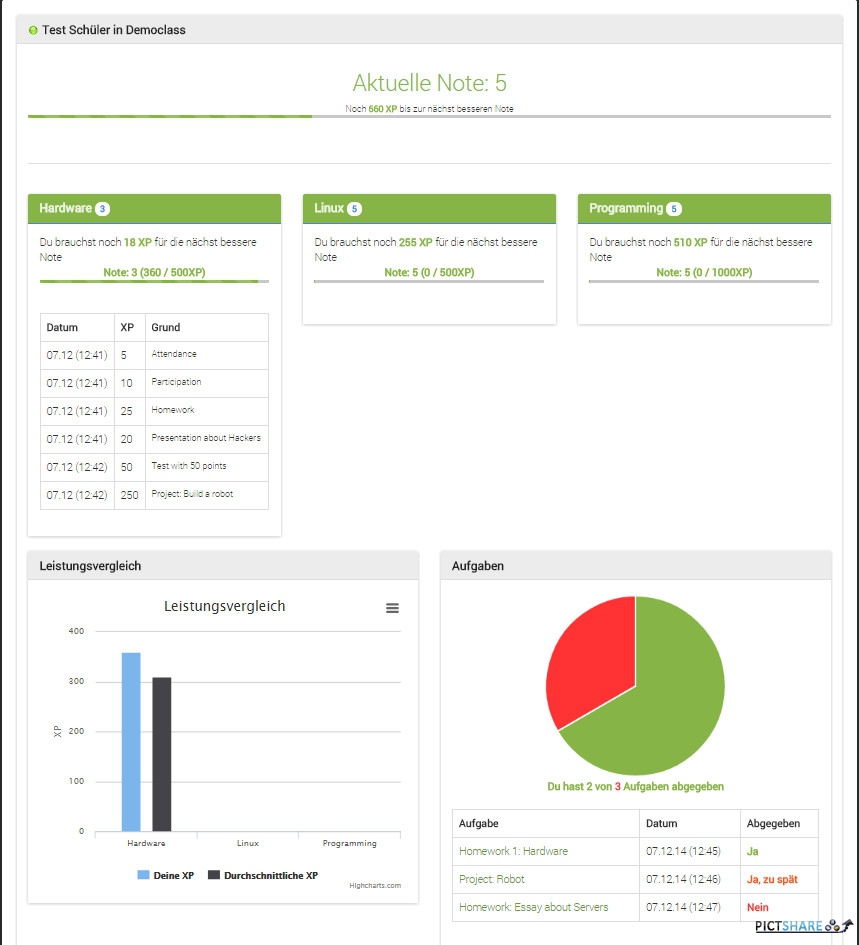
And here is what the solution looks like: At the beginning of the school year, all course content is divided into experience points, and thresholds are set that must be reached to obtain a corresponding grade. Of course, students can check at any time how they are currently doing and what they need to achieve to improve further. Haschek orientated himself on the leveling systems, as they appear in MMORPGs.
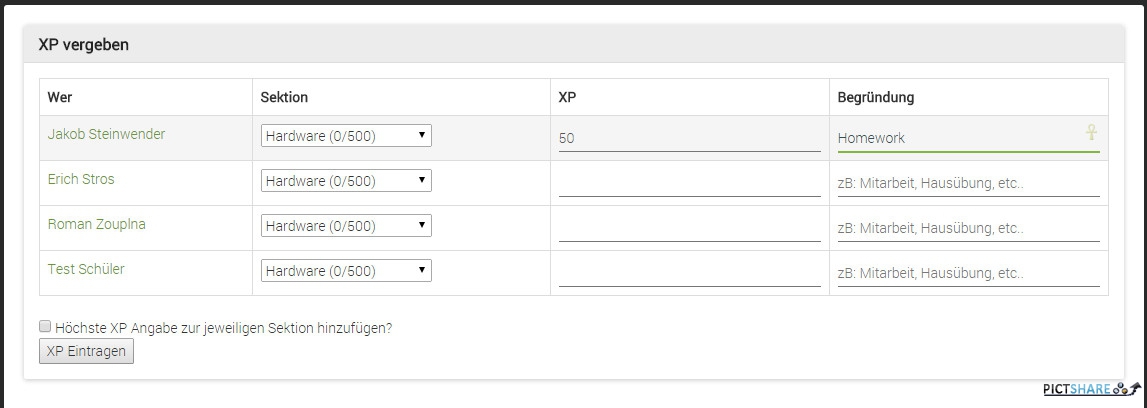
This way, once earned experience points (XP) cannot be lost again, as this would undermine one of the biggest motivators. A few simple examples to illustrate this: A constructive comment during class gives 5 XP, a particularly good homework assignment 20 XP, and a presentation maybe 35 XP. Those who do not complete their homework naturally miss out on some points.
Problems and Concerns
A considerable number of older teachers criticize this approach, and a few negative aspects are quite hard to overlook. Such an extensive system, of course, requires knowledge of new media, and a classroom without comprehensive computer equipment will hardly have a chance – not to mention that many teachers still dread using computers.

A second point of criticism is that students would have no incentive to put in effort if they had already earned the required experience points for a grade. However, Haschek reports the opposite: especially teenagers who find themselves “secure” with a good grade tend to help their classmates more actively; he has termed this phenomenon the “High-Level Syndrome.” Those who no longer need to worry about their own grade are happy to help others – he also compares this to online games where high-level characters like to assist lower ones.
Personal Opinion
I believe it is high time for new systems in schools. In this example, one takes something that young people enjoy in their free time and applies it to an area that is generally less favored. As a student, it must be incredibly motivating to have your current performance in front of you at all times and to know exactly what you need to do to reach the next “level.”
[pullquote]If I received 5 XP for doing the laundry every time, I could certainly motivate myself to do it more often.[/pullquote]
Primarily, such a system offers significantly more transparency, and situations where one thinks “Oh, the teacher just doesn’t like me” – whether justified or unjustified – would surely be a thing of the past. The concept certainly has a few weaknesses and cannot be applied everywhere – Haschek himself acknowledges this. Nonetheless, it is time to say goodbye to old concepts and try new things. And this is a good first step.
If I received 5 XP for doing the laundry every time, I could certainly motivate myself to do it more often… it’s amazing how much these games shape us.

Your opinion is important to us!
Do you like the article? Then let us know!