

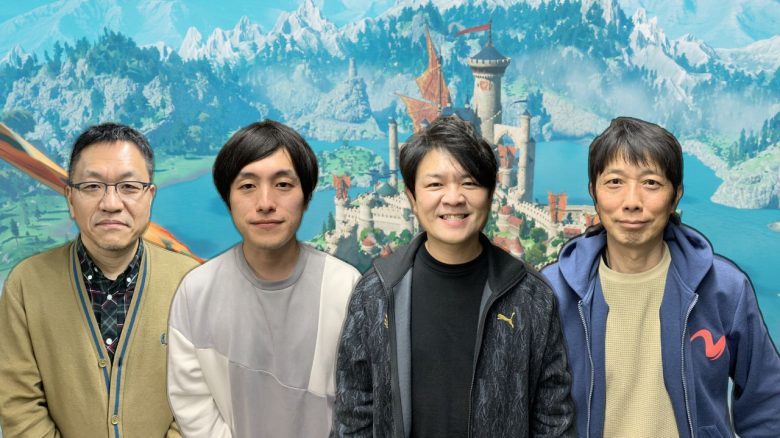
MeinMMO editor Nikolas Hernes was able to ask 4 developers behind the upcoming RPG Monster Hunter Stories 3: Twisted Reflection a few questions about the new size of the title, the habitat restoration, and the hardest monsters.
What is Monster Hunter Stories 3: Twisted Reflection? The RPG is the new installment in the Monster Hunter Stories series and will be released on March 13, 2026, on the Nintendo Switch 2, PS5, PC, and Xbox Series X|S.
Already in the preview, it shows that the title is a consistent continuation of the two predecessors. Notable are the new presentation of the characters, the habitat restoration, and the kinship attacks.
For the upcoming RPG, as well as for the series itself, I interviewed the lead developers of the game and spoke with:
- Ryozo Tsujimoto – Executive Producer
- Kenji Oguro – Director
- Takahiro Kawano – Art Director
- Daisuke Wakahara – Lead Game Designer
MeinMMO: Thank you for the opportunity. First of all: What stands out to me is the visual change from Stories 2 to Stories 3. Why did you decide to change the proportions of the monsters and characters in the new game?
Ryōzō Tsujimoto: Yes, when we started working on the third title of the series, I had the opportunity to think about the development of the first two games. And I think we did a great job bringing the Monster Hunter series into a new genre, namely that of turn-based RPGs.
I think the biggest part of our work was to transfer the gameplay of the series into this new format and ensure that it works. Players received this very well.
That was, so to speak, our starting point, where I thought that we had achieved everything we could achieve in this game so far in terms of gameplay. So where should we go with the next game, and were there new directions we wanted to take?
As we began thinking about the next direction at the start of this development, the RPG element was the main focus for me. I wanted to develop the next game, No. 3, even more towards JRPG.
This meant giving the story more maturity and depth. I think this has naturally been reflected in the visual style, because in the first two games, you accompanied these young riders on their journey to adulthood and saw how they became part of this world.
And that meant we wanted to show in part 3 that this development has already taken place and that you are now controlling a more realistic, mature character, which is also shown in the relationship between the riders and the rangers in the game and their interaction with the monsters. Ultimately, the visual style reflects a certain new maturity and depth in the narrative and RPG elements.
MeinMMO: You talked about maturity, and when I played the first few hours of the game, I noticed that there is a strong emphasis on the story between the two countries Vermeil and Azuria. Were there any inspirations in developing the story behind this impending war?
Kenji Oguro: There is no specific inspiration for this plot, but regarding the scope of the story, the previous games were based on villages and smaller settlements. When we started this project, I told the team that I wanted to expand the scope from the village or settlement level to the country level.
As an example, I cited Game of Thrones. I said it’s a story in which different factions operate on a much larger level. One gets a sense of a world whose countries are on the brink of war.
This does not mean that the story is directly inspired by it, but this is how I made it clear to the team that this is the scope I want to achieve for this plot.
MeinMMO: Speaking of the story, I’m particularly interested in the characters of the game. Compared to the two predecessors, I find that the characters have much more depth in terms of their personality, design, and their relationships with the kingdom.
Why did you decide to give the human characters in Stories 3 more space?
Kenji Oguro: The main feature of this series so far has been the connection between humans and the monsters they raise. And that continues to be an important part of the plot. But as mentioned before, one of the executive producer’s directives was that we should lean more towards JRPG than just RPG. That meant we had to ask ourselves what exactly JRPG means.
We concluded that it meant human dramas and relationships between the characters, including side quests and subplots that add more breadth and depth to the narrative.
Even though the main character is a sort of rider who dives into the world of rangers, and many elements of the plot revolve around monsters and how to deal with them in different ways, and the fateful monsters of the main plot.
But to give this central plot more breadth, there are new characters who become your friends, and you can explore their relationships with each other and dive into the humanity of the core group at various points in the storyline while still following the main story about monsters and various related things.
Ultimately, it’s really just about complementing the depth of this game with the breadth of a JRPG.
MeinMMO: Yes, now more about gameplay. I am really looking forward to learning more about habitat restoration in the game and the new mechanics. Because when you think about Monster Hunter’s past as a series, ecosystems have always been an important aspect.
But now you give us players the ability to help the monsters without killing them or other monsters. Now we can help them, for example, by strengthening their population. How did you come up with the idea of not being the enemy anymore but the one who helps the ecosystem continue to grow?
Ryōzō Tsujimoto: First of all, I would say that back when we developed Monster Hunter Stories, the original game, the key concept was to feel close to the monsters and build a bond with them, to bring them more into focus.
As you’ve already said, monsters are popular characters in the main series games, and players have their favorite monsters, but it was difficult to feel close to them since you could only interact with them in combat due to the action gameplay.
One of the main pillars of this series, and especially the first game, was therefore to change the context by interacting with monsters and giving the player the feeling that they can build a stronger bond with them as living beings.
Kenji Oguro: With this in mind, we wanted to find a way to reflect this relationship with the ecosystem not only as an element of the plot but also in gameplay. Specifically, it was about the idea of restoring an ecosystem that has fallen out of balance or needs to be restored to flourish again.
That was my starting point as a producer to consider the impact of this monster relationship, which was established in previous titles, in gameplay.
Restoring the habitat and the elements of the ecosystem really came from where, as [Ryozo] said, I want you to feel close to the monsters and build a bond with them.
We went beyond the dimension of individual monsters that were bred and ridden in the old games, as you know, and shifted this to the level of the entire ecosystem of this monster itself, which is achieved through the ranger characters.
I want players to feel that they have a relationship and responsibility regarding their influence on this ecosystem. It’s not about individual monsters that you breed, bond with, and respect in some way, but about the player character as a human having a respectful relationship with the entire ecosystem.
That was what I wanted to achieve and expand on.

MeinMMO: A feature that I have always wanted to talk about, also from the previous games, is the animations of tribal attacks. I always think of Brachydios, where there is this anime flashback and then this big hit.
Are there any limitations for you in creative development, or can you do whatever you want?
Takahiro Kawano: I would say it’s not so much about everything being allowed, but rather we want these attacks to be designed to make sense in the context of the relationship that you build with each individual monster.
I would say we know that you will see these animations many, many times over the course of a game, especially when players are really focused on the fight. Many players might want to start skipping the animations to progress faster.
For this reason, we hope to keep them relatively short. The maximum length is 10 to 15 seconds. But we also want to make them cool enough that you hopefully won’t want to skip them but will want to watch them every time.
You can watch a kinship attack from the predecessor here:
MeinMMO: If I imagine having to use one of these kinship moves in a main title in Monster Hunter, I would think I have no chance. Like, for example, the golden Rathian, which creates this black hole. I believe normal hunters would all lose.
[Developers laugh]
One more casual question for all of you. You all know these monsters. What do you think is the best monster to have as a pet in real life?
Takahiro Kawano: The first is Kulu-Ya-Ku. I think he has a really cute personality when you see him carrying eggs and other things around. I think he would be just charming as a real pet.
Kenji Oguro: I would like to have Paolumu as a pet. He’s fluffy and cute, and I believe I could even sleep on him like on a bed. I could maybe hold onto him and sleep on his fur, and he could fly into the sky, so I’d basically have my own floating hammock.
Daisuke Wakahara: I would like to have a real version of Palamute, the dog, the friendly, dog-like character. I think his size is well suited for a real home, and I believe he would be a very loyal companion.
Ryōzō Tsujimoto: As for gameplay, I would say that Brachydios is also my favorite, but when I think about a pet in the real world…
If I imagine going for a walk with my monster pet in the pet park, Rathalos would certainly be a very impressive animal to have with me, and it also sounds just very practical to be able to fly through the air with it.

MeinMMO: A question for the entire series, for you as developers and perhaps also for the players. I have nightmares about several monsters because I’m too bad at fighting against them, like Kirin or Rajang.
Are there monsters that you really hate fighting against, regardless of the game?
Takahiro Kawano: Nergigante was a very challenging monster for me.
Kenji Oguro: Given the monsters you mentioned, I suspect you have also played “Monster Hunter Stories 1”, but for me, even as someone who worked on the game, Yian Garuga in this game was such a sudden increase in difficulty that I, as a producer when I tested it, had to go to the team and say: “Hey guys, what’s going on? I find this monster really difficult.”
Ryōzō Tsujimoto: For me, Alatreon was a very challenging monster. As you know, I have only used the hammer in every single Monster Hunter game ever. And that is a pretty large monster to hit on the head with my hammer.
Daisuke Wakahara: And finally, I agree with you regarding Rajang, especially in the days of Monster Hunter 4 and Monster Hunter 4 Ultimate. I have never seen a monkey in my life that scared me as much as Rajang in Monster Hunter 4. It was just so intense.
MeinMMO: Thank you for the interview. I am looking forward to the complete game, and yes, have a nice day.

The Monster Hunter series not only lives off big monsters but also from many small successes that you can celebrate within the game. It can start small: 8-year-old proudly tells his father about his success in Monster Hunter, who thanks the community

Your opinion is important to us!
Do you like the article? Then let us know!