

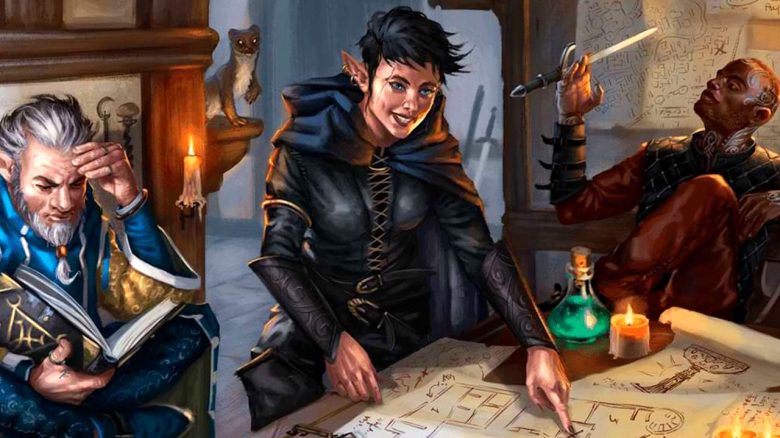
Finding the right balance is often not easy for Dungeon Masters in Dungeons & Dragons. A Dungeon Master explains why it is important for players to also be able to “win.”
What is the concern of the Dungeon Master? Reddit user 3-Possums-in-a-Coat reaches out to the community with his post on Reddit. He wants to demonstrate through his example that it is not only perfectly okay for players to sometimes “outsmart” the Dungeon Master, but it is also an aspect that should be aimed for.
He starts off by saying: “My players want to feel like ‘they caught me’ … and that’s fine with me.” From his perspective, this is precisely what is important and a point that makes Dungeons & Dragons special.
As an example, he mentions a situation where he had planned a room containing treasure. The group sent their barbarian ahead to secure the loot and act as a buffer for any potential traps. As intended, once the barbarian picked up the treasure, several skeletons sprang to life. The bard reacted and crushed the foes with a single spell, causing the barbarian to take no damage with his saving throw.
How did the players react to their solution? The players were excited about the cool solution and the relatively easy loot. “I bet you didn’t expect it to be that easy, DM,” one of the players reportedly said. But he probably did, as he had set up the encounter specifically so that the characters could have a shining moment. However, he didn’t tell them that and let them keep their belief and triumph.
It was not about challenging them or luring the players into a trap, but rather about giving them the opportunity for a cool moment that conveys that sense of superiority. And it is okay if the players think they have outsmarted their Dungeon Master – because such moments make Dungeons & Dragons so special.
Simple challenges like this are great because they provide characters with these opportunities and simply serve the fun of the game. According to the Reddit user, as a Dungeon Master, it is mainly about ensuring that everyone has a great time, and not about “playing against” the players.
“Players trying to break the game are as old as the game itself”
What is the community’s opinion on this? Many users in the comments can empathize with his feeling and would approach their games similarly.
It is important to know your own group and to realize that Dungeon Masters and players are not fighting against each other, and it is not about one side winning. Both sides must also be aware that they are playing together and jointly influencing whether everyone has a good time, even though the Dungeon Master ultimately has the final say.
Apart from Dungeon Masters who abuse their power and thus like to play “against” the players, there are just as many players who try to throw the DM off course and “break” the session. Both perspectives are seen as more than harmful by the community.
In the comments on Reddit, they share their experiences and offer tips on how to deal with this issue:
- [deleted] states: “Players trying to break the game are as old as the game itself. It is up to you as the DM to decide what is acceptable at your table and what is not.”
- 720eastbay shares: “My DM likes to end the session by asking what we want to do at the fork where we stopped, so that we have a mission set and then he has that and whatever else he wants to throw at us.”
- SecretDMAccount_Shh: “As long as the players are not trying to derail the game on purpose, I have no problem with the players celebrating if it happens unexpectedly, because it means the players have exceeded expectations.”
- Archwizard_Drake emphasizes: “It is not necessarily about derailing the campaign. It is just about players feeling clever when they can outsmart the DM, or powerful when the DM’s plans fail so easily.”
The art is primarily to maintain a balance and to get to know both players and Dungeon Masters well. The better this is achieved, the easier it will be for both sides to engage with each other and create a good gaming experience that everyone enjoys participating in.

In Dungeons & Dragons, it is essentially more about indirect “winning” and especially more about small intermediate victories and perhaps the end of a campaign. However, two players created an experience where it can definitely be said that they won Dungeons & Dragons: “I think you won D&D” – Players impress the community with their Dungeons & Dragons-themed wedding

Your opinion is important to us!
Do you like the article? Then let us know!