
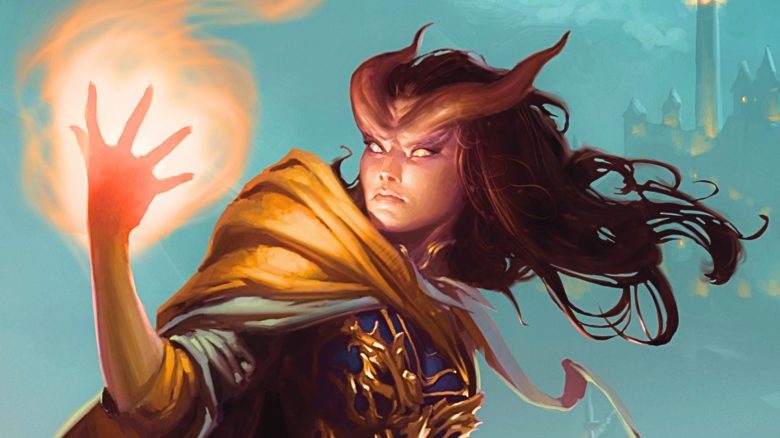
While they may outwardly resemble fiendish creatures or infernal demons, tieflings are not monstrosities. They are inhabitants of Faerûn, just like elves, dwarves, or humans, albeit a little rarer – and with many deep-seated prejudices that make tieflings one of the most despised races in Dungeons & Dragons and Baldur’s Gate 3.
What are tieflings? Tieflings are one of the many different races from Dungeons & Dragons that players can embody in the game. They are particularly noticeable due to their unique appearance and resemblance to hellish inhabitants, which give them a certain aura that can fascinate and unsettle others.
And that’s exactly the point. Despite all the different faces one can encounter in Dungeons & Dragons, tieflings are scrutinized especially closely – and usually not for a friendly reason.
Erin M. Evans captures the perception of tieflings very well in his book “Brimstone Angels” (published by Wizards of the Coast), which is why an excerpt from it serves as the introduction for tieflings in the fifth edition rulebook:
“But you see how they look at you, child of the devil.”
[…]
“What do they say?”, he asked, “One is a curiosity, two is a conspiracy…”
“Three is a curse,” she completed. “Don’t you think I haven’t heard this crap before?”
“Yeah, I know.” As she looked at him, he added: “It’s not like I want to tinker with the depths of your soul, girl. That’s the burden of every tiefling. Some collapse beneath it, some make it the millstone around their neck, others take joy in it.” He tilted his head and scrutinized her with that strange glow in his eyes. “You’re fighting it, aren’t you? Like a little wildcat, every bet. Every little jab, every comment only sharpens your claws.”
– Erin M. Evans, Brimstone Angels

In the eyes of many humans and other races, tieflings are viewed as shady and dark, often leading to their expulsion and ostracization. Whispering and looks, public violence and insults, distrust and fear characterize the daily life of a tiefling. But why is that the case?
Here you can see the trailer for the animated series “The Mighty Nein” on Amazon Prime, in which you can also meet two tieflings from the well-known campaign of Critical Role:
Where do tieflings come from, when they are so rare?
The rulebook refers to the infernal bloodline responsible for a tiefling’s appearance and nature as a “consequence of an ancient sin for which they, their children, and their grandchildren will be held accountable forever,” or summarized – as a punishment.
And there is some truth to that, only that the tiefling themselves is not guilty of this “punishment.” They really can do nothing about it.
The infernal bloodline can lie dormant for decades, with its legacy unexpectedly falling upon the child of a purely human parent couple in most cases. This can stem from a pact of a long-past generation, or a dark influence of a similar caliber.
The child itself rarely shares any guilt in this legacy but must carry the proof more or less unwillingly outward: Long horns in various shapes, sharp canine teeth, a long tail, differently shaped eyes, and an “unnatural” skin color for humans make tieflings stand out even in a diverse world like that of Dungeons & Dragons.

Tieflings cannot help their bloodline – why are they so hated then?
The fact that tieflings are despised by other races is not just a free choice of a DM (Dungeon Master), the mistrust that has now been reciprocal for generations is also made clear in the rulebook:
People tend to be suspicious of tieflings, as they assume that their infernal descent has not only left marks on their appearance but also on their personality and moral standards. […] In truth, a tiefling’s bloodline only influences their personality very little. Rather, the many years of mistrust leave their marks, and most tieflings respond to this in different ways.
Dungeons & Dragons Player’s Handbook (5e)
Thus, the hatred towards tieflings is an almost superstitious misunderstanding that has persisted for decades and centuries, making false assumptions and prejudices seem factual enough for many to accept them as their own reality.
Rumors, narratives, and prejudices are responsible for the exclusion of tieflings, who can react to these reactions to their kind in different ways. Because they are very aware of how people react to them.
Tieflings typically receive a +2 bonus to their Charisma attribute, which is indeed justifiable through their handling of their identity:
“Some fulfill the stereotype of the wicked monstrosity, others behave virtuously. […] After encountering only mistrust throughout their youth, tieflings often develop the ability to overcome prejudices through charm or intimidation.” (Source: Player’s Handbook 5e)
Tieflings do not have to conform to the stereotypes of the “evil, cunning creature”; they are extremely diverse, making them a popular choice when creating characters.
Hated by many, yet just as beloved
Why do so many players choose a tiefling as the race of their DnD character? Tieflings are extremely versatile and offer great potential for character and story development that many players yearn for.
They can embrace their infernal heritage and be tempted by dark powers, become charismatic leaders with social or creative talents, or break free from their shame and forge their own path.

In the Dungeons & Dragons community, some players describe why they love tieflings so much, after a player (EsperTheBard) asked this question on Reddit:
- cline_59: “They are Technicolor half-demons with built-in angst and story hooks due to their connection to the hells. They are different from conventional fantasy races to be interesting without being so different that they drive away newcomers. They practically sell themselves.”
- Aegillade: “I think the fact that they have incorporated alienation into their lore plays a significant role. Whether you are part of the LGBTQ community or just a nerd who was bullied in school often. Many people know what it’s like to be excluded just for being themselves – something that tieflings embody.”
Even MeinMMO editor Caro loves playing tieflings:
“I proudly refer to myself as an absolute tiefling ultra in Dungeons & Dragons and Baldur’s Gate 3, mostly due to their versatility. From the edgy warlock to the super extroverted and charismatic bard. They offer so many possibilities, not just regarding their design and personality but also in how to interact with other players and NPCs.
You could argue that this applies to almost every other race in a game like Dungeons & Dragons, yes, I get that too. However, tieflings, at least for me personally, bring that sweet flavor of satanic panic, of liberation from shame and disgrace, as well as the overcoming or playing into prejudices however you want – not for others. Besides, horns just look damn cool.”
Tieflings are a race that draws attention. In Dungeons & Dragons as well as Baldur’s Gate 3, there are many examples of the versatility of these characters, including the barbarian Karlach. If you’ve already met Karlach and want to know exactly how to win her burning heart, you can learn how to charm her on MeinMMO here: Baldur’s Gate 3: Karlach Romance Guide – How to Find and Woo the Hot Tiefling Friend

Your opinion is important to us!
Do you like the article? Then let us know!