

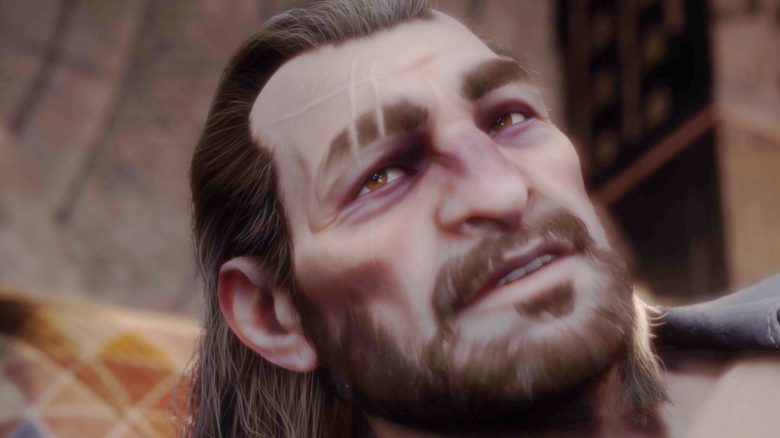
The head of Electronic Arts, Andrew Wilson, commented during a call with investors about the role-playing game Dragon Age: The Veilguard. He sees the reasons for its failure in missing features that are typical for live-service games. The previous game by BioWare, Anthem, was planned as such a service game.

This is what Andrew Wilson said about Dragon Age: The Veilguard: In an investor call on February 4, 2025, the CEO of EA said:
Q3 did not bring the financial performance we wanted or expected. As a leading company in the global entertainment sector, we know that great titles can sometimes fall short of our financial expectations, even when they are developed and delivered with refined execution.
To grow beyond the core audience, games must directly address the evolving demands of players, who in this popular category are increasingly looking for shared-world features and deeper engagement alongside high-quality storytelling.
Dragon Age had a high-quality launch and received positive reviews from critics and players, but did not find sufficient resonance with a broad audience in this fiercely competitive market.
Even before the call, it had become known that the sales figures for Dragon Age: The Veilguard were about 50% below EA’s expectations. Consequently, the developer studio BioWare was gutted and hollowed out.
Wilson says that Dragon Age lacked “Shared World” features
What does he mean by that? “Shared World features” and “deeper engagement” are ultimately terms that describe an MMO experience: here players share a world.
Wilson essentially says:
- The role-playing game itself was good and was well received by players and critics.
- But it only reached the core player base, and that is no longer enough today.
- For a game to be truly successful and a hit that everyone talks about, it needs more MMO elements or at least a strong evolution.
Perhaps the phrase “fiercely competitive market” implies that EA wanted a success with Dragon Age akin to Baldur’s Gate 3. While it does not offer a “Shared World,” it has built a strong community. Baldur’s Gate 3 remained relevant for years because it was continuously developed.
EA sounds completely different now than at the launch of Dragon Age
Why does he say that? What he actually means is: “Simply developing and selling a game is no longer making us the money we want to make.”
Wilson criticizes the direction of Dragon Age as a pure single-player title, without a roadmap or further development in line with a live-service game.
This is ironic because BioWare had developed Anthem as a similar game and such elements were consciously removed from the development of Dragon Age after Anthem flopped and was discontinued.
The last time EA commented on Dragon Age, in October 2024, it was repeatedly emphasized that Dragon Age is now “the return to form for BioWare” and Anthem was portrayed as a misstep with its live-service elements.
Now, however, they seem to view that very decision as a mistake.



EA believes: To make money, more service game elements are needed
How do you see the problem? The CFO of EA strikes the same chord. He says:
Historically, blockbuster storytelling has been the primary way our industry has brought beloved role-playing worlds to players. The financial performance of the game underlines the evolving landscape of the industry and reaffirms the importance of our actions to shift towards our most significant and potentially largest opportunities.
Translated, this means: Pure storytelling, for which BioWare is famous, is no longer enough today. People want MMO elements and we have to offer them if we want to make money.
EA has a completely different view than the rest of the world
This is what’s behind it: To put it delicately: This is quite an exclusive analysis of the situation. It completely overlooks the reaction of the players.
It has been noted more that Dragon Age did not allow players to be as bad as in previous installments, and that the game lacks a bit of depth.
Wilson does not even address the whole discussion about “excessive wokeness”. However, they overshadowed the discussion about the game in parts of the internet.
It is true that service elements – like an expansion pass, expansions, or a cash shop – are certainly good for EA’s balance sheet. But even such methods first need the foundation of a good game to stand on.
Baldur’s Gate 3 is so successful because the game is of such high quality that a huge community has formed around Baldur’s Gate 3, keeping the game relevant for a long time – but such a community cannot be conjured up with an expansion pass; it first needs the foundation of an excellent game to grow.
Anthem had a cash shop and a large roadmap. However, it lacked the foundation for people to want to play the game beyond a month.
To develop and sell a service game, it is necessary for customers to trust the publisher to actually continue developing the game. How EA handled the last service game from BioWare has shattered this trust: The decision by EA to let the MMO Anthem die looks even worse today than in 2021

Your opinion is important to us!
Do you like the article? Then let us know!