

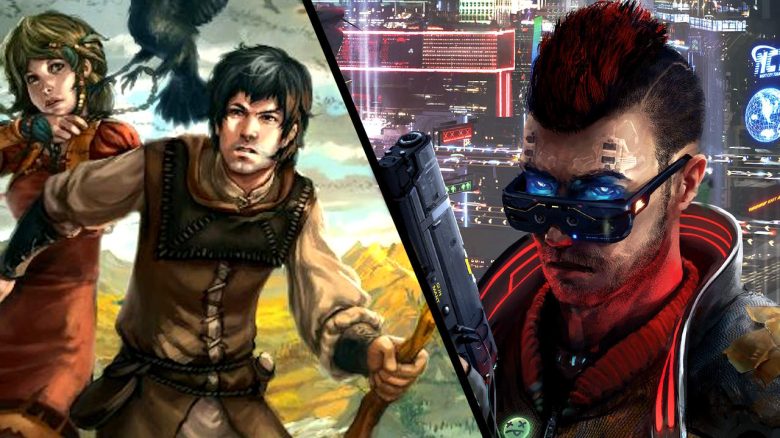
If you deal with tabletop role-playing games, you can hardly miss Dungeons & Dragons. However, there are some alternatives that are at least as good and have their advantages.

What were the alternatives chosen based on? Dungeons & Dragons is a relatively balanced system with the 5th Edition that somewhat evenly focuses on role-playing, story, and combat. Tactical combat and the power progression of characters are the focus.
Moreover, it offers a fairly accessible and not overly complex rules system that is especially suitable for newcomers to the world of tabletop and pen-and-paper role-playing games.
For this list, we have selected 8 other systems that differ significantly from the classic Dungeons & Dragons in several areas. We will present you with the rule systems and systems in a compact way and show you their significant differences compared to D&D.
In doing so, we tried to provide a broad image of as many different systems as possible. So if something bothers you about the system, hopefully you will find an exciting, suitable alternative here.
Of course, there are also many other exciting and good role-playing systems. So if you feel something is missing or would have included another system, feel free to let us know in the comments!
Daggerheart
- Genre: Fantasy
- Core focus: Character-driven storytelling, emotional story arcs
- Complexity: Moderate
- Languages: English, (German, French, Spanish, Italian planned)
Daggerheart is a new high-fantasy role-playing game from Darrington Press, the publisher of Critical Role. It was developed to shift the focus of the game from tactical combats and pure power progression, as is common in Dungeons & Dragons, to profound, character-driven, and emotional stories.
The core of the system aims to place the personal development of the heroes and their motivations at the center of each gaming session.
The biggest difference to D&D is the dice system. Instead of a single D20, Daggerheart uses two twelve-sided dice (2D12): one called “Hope Dice” for the character’s ability and one “Fear Dice” for the difficulty of the task.
This dual system creates nuanced results such as “success with a complication” or “failure with a small advantage,” making every roll an exciting, narrative moment instead of merely answering with a simple “success” or “failure.”
Additionally, both DM (the Dungeon Masters guiding you through a game) and players can gain resources of hope and fear through rolls and use them further along the way. Stress is also a resource to be monitored.

The character creation and progression also differ significantly from D&D. Abilities and spells are chosen from modular card sets based on so-called domains, which allows for more flexible customization than the fixed class structures of D&D.
Moreover, character advancement is directly linked to achieving personal, self-defined goals and experiences. The system specifically rewards playing out the character’s story and not just defeating monsters.
Daggerheart is therefore particularly suitable for players and groups who want a clear focus on the story and personal character development. The interplay between players and the game master is even more important here, making collaborative storytelling the focal point.

Your opinion is important to us!
Do you like the article? Then let us know!