

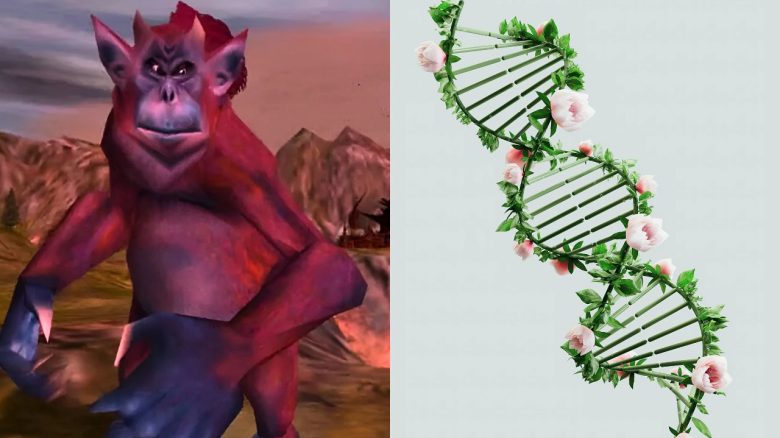
Anyone who was a gamer before 2001 probably knows the legendary Black & White. A clever mind behind it has now received a Nobel Prize, and his work on the video game is the foundation for that.
What kind of game is this? Black & White is a strategy game and a god simulation. In the game from 2001, you take on the role of a deity and can decide for yourself whether to treat your villagers kindly or cruelly. Your goal is to prevail against other gods.
The game also provides you with a servant. From a selection of creatures, you may choose the right servant who performs wonders for you and fights against other creatures. For this servant to act in your interest, you must train him.
If your servant does something you do not want, you can hit him for it; if he does something in your favor, you may give him affection. However, what is good and what is bad is solely determined by you.
From one AI to another
What does the game have to do with the Nobel Prize? Creating a servant according to your wishes requires machine learning from the game’s side. Demis Hassabis implemented this back in Black & White. These early approaches to AI shaped the developer, as his resume continued from Black & White into artificial intelligence.
In 2010, he became CEO and co-founder of DeepMind Technologies, which was acquired by Google in 2014 and is now known as Google DeepMind. While many significant works were done there, the work on AlphaFold2 is probably especially valuable for humanity.
AlphaFold2 is an AI tool that can predict protein structures. With artificial intelligence, this complex and time-consuming task can be completed much faster.
The tool is used worldwide by over two million researchers, for example, to understand how antibiotic resistance arises or to design enzymes that can break down plastic.
For what did he receive the Nobel Prize? Hassabis received the Nobel Prize in Chemistry along with two other scientists, Professor John Jumper and Professor David Baker. The latter focused, along with his team, on computer-aided protein design, which allows new proteins to be created.
Demis Hassabis and John Jumper share half of the prize for their predictions of protein structures using AI, while the other half was awarded to David Baker.



How does the former developer react to the prize? Even the CEO of a Google company is affected by a Nobel Prize. On the phone with the Nobel Prize team (via YouTube), he says:
“It is an incredible honor, you know, it is really a great honor. […] I am completely over the moon, it is so incredible, an incredible experience. I had an ordinary workday ahead of me, but I think that needs to change now.”
With his AI tool, he lays the foundation for many other scientists who can make scientific progress in many different fields thanks to his work. The players of the MMORPG EVE Online are also helping science: Players of the MMORPG EVE Online assist in important research – Professor explains why gamers are so useful

Your opinion is important to us!
Do you like the article? Then let us know!