

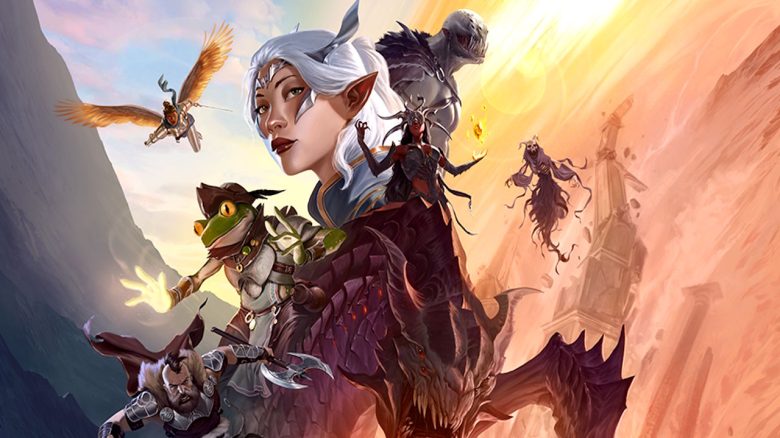
The streaming group Critical Role is mainly known for Dungeons & Dragons, but has now also developed its own system. What makes it special and what the main differences are, you can find out here.
What is Daggerheart exactly? Daggerheart is a modern pen & paper role-playing game from Darrington Press, the publisher behind Critical Role. It was first made publicly playable in 2024, initially in an open beta, so the community could actively provide feedback for further development.
Critical Role created the system because they wanted a role-playing game that better supports their play style than traditional rule sets that were already on the market. The focus is strongly on shared stories, emotional decisions, and relationships between characters, while maintaining clear, modern mechanics.
Moreover, Daggerheart places great importance on fast, cinematic actions instead of heavily rule-driven combat, unlike Dungeons & Dragons. It has also been made sure that it is easily accessible and provides a pleasant entry point for role-playing beginners.
The role-playing system primarily offers you a huge sandbox, like a toolbox, to create your own stories and experience cool moments. We will explain how this roughly works and what the biggest differences compared to Dungeons & Dragons are.
A rough summary of the rule system is provided by Matthew Mercer in this video:
Strong focus on collaborative storytelling and a quick entry
When playing Daggerheart, it quickly becomes apparent that creating an exciting story together is the top priority. There are significantly fewer stats to keep track of, and they are kept very open to accommodate a wide range of activities.
For example, you don’t have secondary stats and modifiers, such as perception that build on your primary stats, such as wisdom. Instead, you only have modifiers for agility, strength, finesse, instinct, presence, and knowledge, to which the game master can assign various skill rolls.
For instance, if you want to search for something specifically, you wouldn’t roll perception as you would in D&D, but it would depend on how and what you are looking for. The focus is primarily on the players explaining as precisely as possible how they want to approach and execute certain actions, while the game master responds and decides whether and with what modifier a roll should be made.
If you know the place or person you are searching for well, you would roll knowledge here. If you are new to the area and have to rely more on your own senses, you would roll instinct. Additionally, you have the option to attribute personal experiences or skills to your character, the modifier of which you can also use in appropriate situations.

Skills and spells are assembled through modular card sets from so-called domains, which offer significantly more freedom than the rigid class structures of D&D. Additionally, you can always carry a maximum of 5 spells or abilities actively. The maximum level is 10, keeping it manageable.
All classes can switch their abilities from their “pool” in certain situations, providing you flexibility without overwhelming you with the sheer number of options during gameplay. You can also choose races and ancestries from various cards and place them as help next to your character sheet.
Character progression is also tied to self-defined goals and personal experiences. Thus, the system primarily promotes role-playing and character development rather than solely combat successes.
The rules provide you with a lot of narrative freedom and opportunities to set nuances and shape situations in a way that serves the story as needed, without being overly restricted by rigid rules. This is also reflected in the other basic mechanics that Daggerheart brings.

Your opinion is important to us!
Do you like the article? Then let us know!