

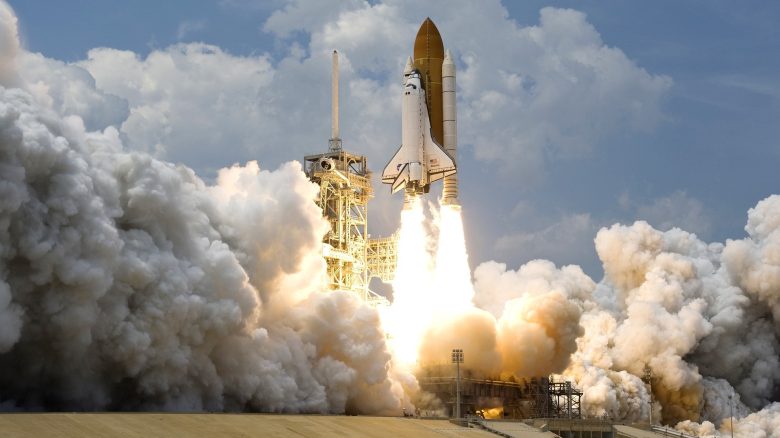
On Thursday, a Soyuz rocket launched on an eight-month mission to the International Space Station (ISS). Although the flight was successful, a gigantic service platform collapsed into the so-called “Flame Trench” at launch, crippling Russia’s only launch pad for manned missions.
What exactly happened? On November 27, 2025, the Soyuz MS-28 mission launched from the Baikonur Cosmodrome in Kazakhstan – with two Russian cosmonauts and one American astronaut on board. The launch proceeded technically flawlessly; the spacecraft reached the ISS, and the crew successfully docked (Reuters).
However, during the mandatory post-launch inspection of the launch pad, Roscosmos, the space organization of the Russian Federation, discovered severe damage. A service platform weighing around 20 tons, which assists in accessing the rocket and loading, reportedly detached and fell into the so-called “Flame Trench.” (via Reddit & ArsTechnica).
This “Flame Trench” is a device that specifically directs flames, heat, and exhaust from rocket or other engines away from the rocket itself to prevent damage. It is presumed that the ramp was not adequately secured and therefore fell into this trench, as seen on X.
Why can no astronauts be sent into space anymore? The damaged launch pad, known as Site 31 at Baikonur, a city in southern Kazakhstan, was Russia’s last functional facility for conducting manned missions to the ISS.
All other old launch pads — including the historic launch site from which the first human flew into space in 1961 — have long been decommissioned or are no longer used for manned flights (Spiegel & NYT). Thus, Russia has lost the ability to actively send humans into space for the first time in over half a century.
The current incident, which has temporarily brought the station to a standstill, could according to New York Times either be a result of misconduct or a technical defect.
In an interview with Anatoly Zak from RussianSpaceWeb.com, a platform closely monitoring Russia’s space activities, it was stated:
It is severely damaged […] and will therefore probably need to be rebuilt. Perhaps some of the hardware can be reused. But it has crashed and is destroyed.
via NYT
According to Zak, the service platform is typically brought to the rocket shortly before launch and secured there. This may have been forgotten.
How did the space agency react? In a brief statement issued on the evening of November 27, 2025, on the official Telegram channel, it commented relatively cautiously on the incident.
It was stated that the launch pad had been inspected – as is customary before any rocket launch. During this inspection, damage to several components was identified. Such damage can occur after a launch, which is why corresponding inspections are mandatory worldwide. The condition of the launch pad is currently being assessed.
International press releases and analysts assess the situation much more critically: The failure of Site 31 not only raises doubts about the reliability of Russian spaceflight – it also jeopardizes supply and orbital correction flights to the ISS and thus the long-term stability and collaboration of the partners on the space station (including: LiveScience, NYT, Spiegel, Newsweek)


If Russia has to pause its manned launches for the time being, another power in space is likely to come more into the spotlight: the American company SpaceX. Elon Musk said SpaceX needs no AI – now he pays $170,000 a year to get one

Your opinion is important to us!
Do you like the article? Then let us know!