


Getting a new level in Baldur’s Gate 3 is always a reason to celebrate. However, the many options can often be overwhelming for newcomers. MeinMMO helps you not to feel overwhelmed when leveling up.

Update from February 26, 2024: We have expanded the text with some useful links and a section on multiclassing.
What do I need to pay attention to when leveling up? It depends on which class you are playing and what level you have just reached. Each of the 12 classes in Baldur’s Gate 3 has different options and depending on your level, more features are available to you. Here are 5 important points to get you started:
- You’ll automatically receive more hit points.
- Every 4 levels, you get to choose a talent.
- Spell classes receive new spells at each level.
- In the first 3 levels, you usually choose a specialization.
- For some classes, nothing happens at certain levels.
You level up by gaining experience points from defeating enemies and completing quests. Keep in mind, that you can level up to a maximum of level 12 in Baldur’s Gate 3, and you cannot go beyond that. Additionally, it makes a difference whether you are leveling only one class or multiple classes.
If you choose “multiclassing”, the combination of multiple classes, you have more options, but they are less in-depth. With our expert knowledge from D&D and role-playing games, we will try to clarify some of the most important questions for you.
Here are tips for all classes directly from the developers:
I’ve leveled up – What do I need to do?
First of all: Congratulations! Leveling up is one of the best things that can happen to you in the game. You get to dive deeper into the incredibly cool classes and shape your character according to your own preferences.
The good news upfront: you usually don’t have to pay much attention to it. You automatically get hit points and most default settings are already made. If you don’t want to think too much, just choose something that appeals to you and click “next.”
However, at certain levels, you must make an important choice for the character that can have far-reaching implications for future development. Such choices include:
- Talents
- Attribute points
- Spells
- Class specializations
Talent or Attribute Points – What should I choose?
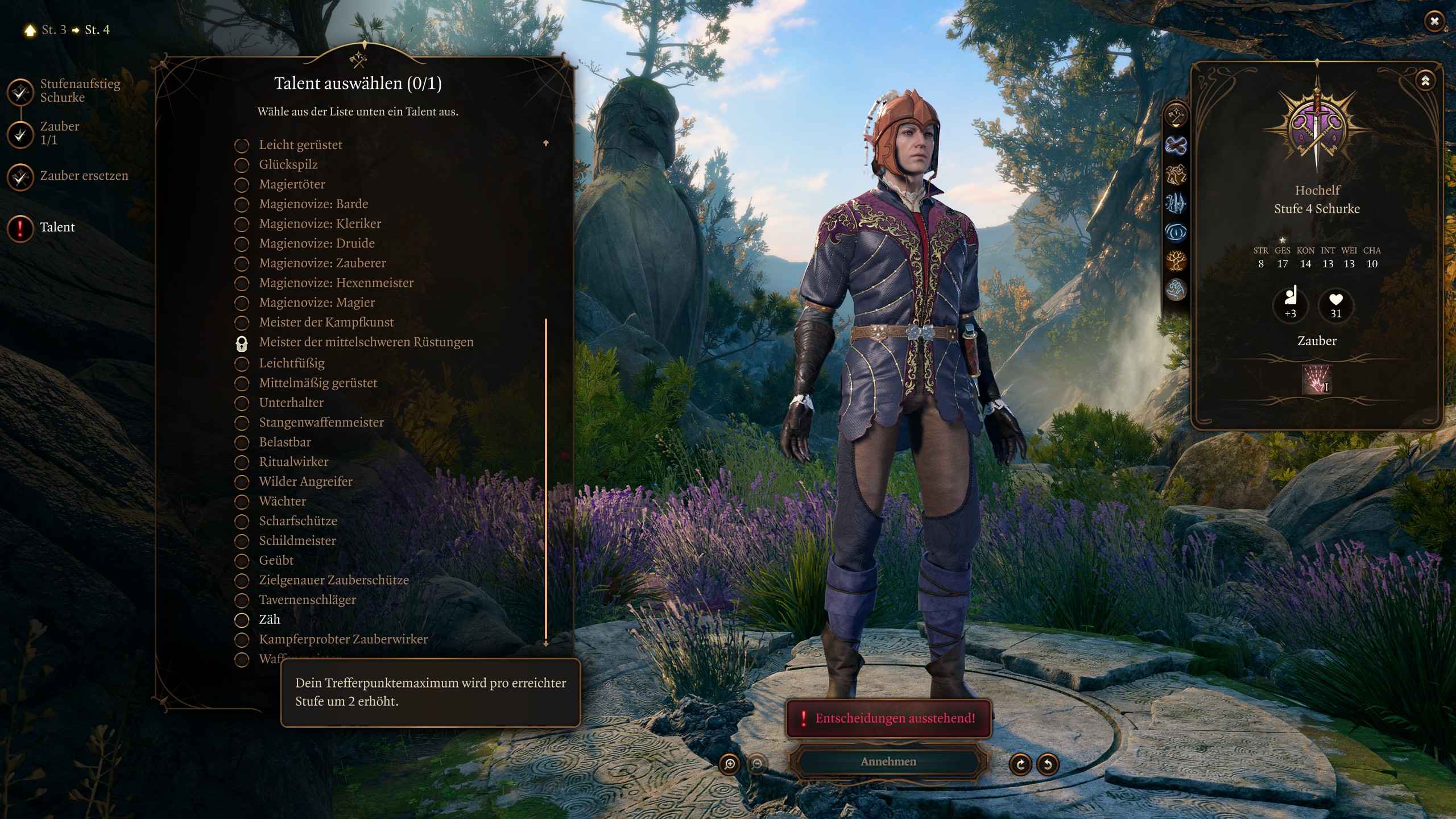
At levels 4, 8, and 12, you have the option to choose a talent with each class. Here, Baldur’s Gate 3 offers a bunch of options, although in some cases they deviate from templates in the book.
For beginners, the rule is: if you’re not sure, just choose the increase of the attributes (the top option). You will then receive 2 points that you can distribute freely. However, there are a few things to consider:
- The main attribute of your character is marked with a star.
- You can increase one attribute twice or two attributes once each.
- You only receive a bonus on rolls for even values! The bonuses are:
- Attribute 8 = -1 on the roll.
- Attribute 10 = +0 on the roll.
- Attribute 12 = +1 on the roll.
- Attribute 14 = +2 on the roll.
- Attribute 16 = +2 on the roll.
- Attribute 18 = +3 on the roll.
- Attribute 20 = +4 on the roll.
- (you can’t go further in a “natural” way)
The standard distribution of values assumes you start with one value of 17 and another of 13. It’s always a good idea for beginners to raise these to 18 and 14, and then always increase by 2. Remember: odd values give you nothing.
Talents are abilities that shape your character. There is no “template”: choose what appeals to you the most. However, talents like “Lucky” and “Tough” or “Resilient” are useful for all classes. You can find in our overview the best talents for all classes.
New Spells – What fits my class?
Most classes receive the option to learn new spells with each or almost every level up. Additionally, you will learn higher-ranked spells at certain levels, which are generally stronger.
No one can really take the selection away from you, but with a few key points, you can decide more easily which spells you want to learn:
- Does the spell fit my class and my specialization? Then take it.
- Does the spell fit into the “build” I have in mind? Try it out.
- Plan ahead: having the same spell multiple times in the group is often not sensible.
You can cast many spells with higher-level slots as well. This means: if there is no spell at spell rank 2 that you like, just take something else and instead cast stronger spells from rank 1.
Some classes, like the Warlock, can switch a spell at each level. If you find that you don’t like a spell or never use it, switch to a new one.
Remember that classes like Clerics and Wizards can change their prepared spells at every rest. You are not as bound to a choice as you are with Sorcerers and Bards.



Classes and Subclasses – What should I choose?
The possible variations for each class can differ significantly from the original class. For example, a Sword Bard hardly casts spells anymore, except to empower themselves. On the other hand, a Trickster Rogue suddenly casts constantly.
When selecting subclasses, schools, paths, and the like, make sure that you do not overly “block” your group. A healthy mix of melee and ranged fighters is usually best.
While you don’t necessarily need a “tank” and a “healer”, it’s advisable for beginners to create such roles. Make your fighter or barbarian as sturdy as possible and have your cleric prepare healing spells. If you are more experienced, you can experiment more.
Otherwise, it doesn’t really matter which subclass you choose. Take what you find the coolest – that’s what makes the game most fun. If you still want to “min-max”, you can find our Tier List with the best classes and subclasses in Baldur’s Gate 3.
Tip for beginners: try out the fighter.
Multiclassing – Is it worth it?
With each level up, you also have the option to choose an additional class. In theory, you can learn a new class per level – there’s even an achievement for that. However, this is not really wise.
Multiclassing, or using multiple classes, has advantages and disadvantages:
- You can potentially find really strong combinations.
- but you forfeit the opportunity to fully utilize one class’s potential.
For beginners, multiclassing is generally not recommended, as you can do more wrong than right here. However, if you are adventurous, this feature allows you to build cool builds. To start, you can find the 3 best multiclass options and what makes them powerful.
Help, I’ve messed up! What now?
Well, uninstall the game and cry in the shower. Just kidding, you won’t be punished in Baldur’s Gate for making a wrong decision once. In the camp, you can find the NPC “The Withered.” He can help you for a small fee of 100 gold.
You reset all your talents and set points there and can redistribute them from level 1. Essentially, you are starting the character creation process anew, and you can redistribute your class and attribute points from the start. You can find more details in our guide: Respec in Baldur’s Gate 3: How to reset your character and choose different classes
The experience points you accumulated will remain – only the points are refunded. So you will have the same level with the same progress as before afterward.
So don’t worry too much about what you should choose when leveling up. Instead, enjoy the enormous freedom Baldur’s Gate 3 offers and experiment. You can easily find 100 gold from the next goblin.
For more tips on group assembly and companions, check here:
Baldur’s Gate 3 Guide to Companions – How to create the best group

Your opinion is important to us!
Do you like the article? Then let us know!