

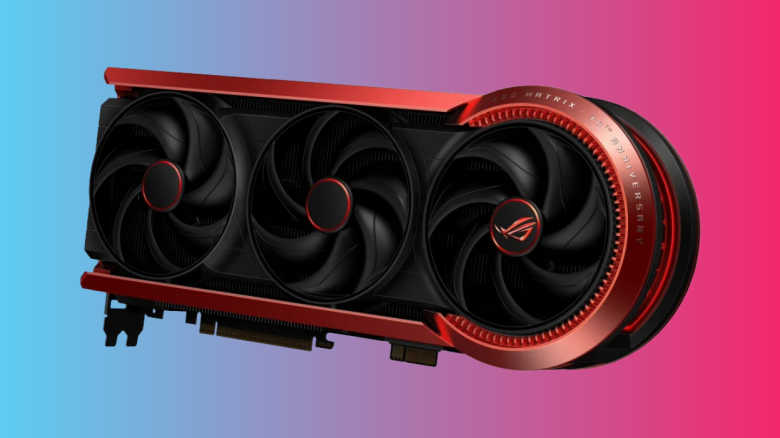
Asus announces a special variant of its high-end graphics card for its 30th anniversary – featuring numerous features for overclockers and enthusiasts. Consequently, the price is significantly higher than all other standard models.
What makes the graphics card so special? Asus already presented its ROG Matrix Platinum GeForce RTX 5090 at Gamescom. It comes with some special features:
- Increased power consumption up to 800 watts: This requires an additional power connector and a special BTF motherboard, which can achieve up to 10 percent performance increase.
- Copper vapor chamber: Represents a vacuum-packaged heat spreader, which is said to lower GPU temperatures by 5 percent.
- Power Detector Plus: Detects power fluctuations and anomalies.
- Memory de-icer for LN2: Ensures that memory chips do not freeze during the overclocking process, where liquid nitrogen is often used.
These additional features are sometimes reflected in the price, which is at $4,099. What exactly these features bring and why they drive the costs up, you can read here.
What Intel’s cheaper graphics cards can do, you can see here:
A 5090 for the price of two
Why does the card cost $4,000? The increased power potential, the larger cooler, and the special features mentioned above are possible indicators of the card’s price.
Gaming graphics cards usually do not have special features like a vapor chamber, memory de-icer for LN2, and Power Detector Plus. They represent functions for overclockers. These are people who try to extract the maximum performance from their cards with higher voltages and coolants – like cooling with liquid nitrogen. This range of special features may explain the card’s price.
The limited quantity of the card may also play a crucial role. Asus is only producing 1,000 units in celebration of the 30th anniversary, which likely also impacts the price of $4,099 MSRP, approximately €3,552 (exchange rate as of 07.11.2025). Special editions are usually a bit more expensive than standard versions.
The price corresponds to more than one monthly average income in Germany. Here the median is between €2,700 and €3,300 net per month (as of 07.11.2025 Federal Statistical Office).
In comparison, an AMD Radeon RX 9070 for around €600 costs just a fraction of the ROG Matrix and can still smoothly run all current games in WQHD. Colleague Benedikt Schlotmann explains why he does not regret buying the RX 9070.
Big card for a small target group
Who is the card worth looking at? With the high price and the low availability, the card is only truly accessible to a few groups of people. First and foremost, overclockers, enthusiasts, and collectors with deep pockets should take a look.
It is hardly recommendable for “regular” gamers as the price is not proportional to the performance and alternatives like the aforementioned RX 9070 offer a better price-to-performance ratio.



Additionally, it is highly likely that the card will be sold out immediately after its launch. We have already experienced similar situations with the launch of retail variants of the 4090 and 5090. All graphics cards were completely sold out seconds after launch by bots and scalpers. However, these events did not go without a fight: Players are currently selling pictures of a graphics card for €2,800 – Behind it lies a brilliant trick

Your opinion is important to us!
Do you like the article? Then let us know!