

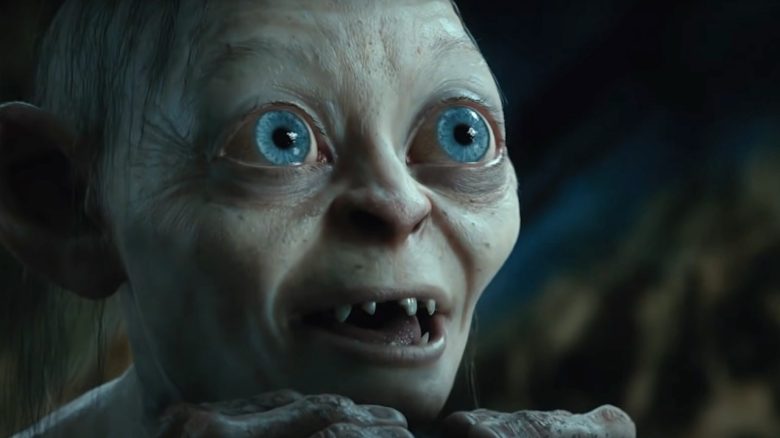
Anyone who knows The Lord of the Rings knows Gollum and probably his actor Andy Serkis. For him, the role was the big breakthrough, but it was also a risk. At one point, Serkis was even advised against participating in the film.
Gollum is undoubtedly one of the most famous characters from The Lord of the Rings and is also one of the Ring-bearers. Alongside heroes like Aragorn, Gandalf, or Frodo, the small, thin creature with its iconic voice has stuck in the minds of many viewers.
Gollum is played by British actor Andy Serkis. For him, the role was a breakthrough and made him famous worldwide. Besides Gollum, he also played the ape Caesar in Planet of the Apes, also thanks to motion capture technology. This means that a performance is recorded in a dedicated studio and with a specially designed suit by numerous cameras and subsequently digitized.
Thanks to his work on The Lord of the Rings, Serkis became one of the key actors for digital characters. And that, despite the fact that he was initially advised against taking on the role of Gollum.
“I wouldn’t touch it with a ten-foot pole”
How did Serkis fare? In the podcast “One Zoom to Rule Them All” by Josh Gad on YouTube, a number of actors from the trilogy gathered and talked about their work. Andy Serkis recalls how it all began with Gollum.
He received the offer to play the role. It sounded exciting at first: a film adaptation of The Lord of the Rings being shot in New Zealand. Serkis was to voice a digital character.
However, when he spoke to a colleague about it, the reaction was anything but positive:
I remember that I was in Prague, working on an adaptation of Oliver Twist, and I told another actor I was working with, “I think I’m going to New Zealand to voice this digital character.” He asked, “Will your face be seen on screen?” I replied, “No, it won’t.” He said, “Buddy, I wouldn’t touch that with a ten-foot pole.”
Andy Serkis
The problem was clear: the role would not show Serkis’s face. Many actors consider it important that their performance is visible on the screen. Simply lending a voice to a character and being replaced by a computer-generated 3D figure is not for everyone.


Gollum Was a Risk
Today, modern technology allows motion capture representations to correspond to the actor’s performance in the smallest detail. Facial expressions and movements are directly transferred. When Peter Jackson planned his film adaptation of The Lord of the Rings back in 1999, however, the technology was still in its infancy.
Serkis recalls a conversation he had:
Pete said, “I’m not exactly sure how this will work out, but we’re trying out this new method called motion capture. We want someone on set who can play Gollum, but no actor could portray him the way we envision him.”
Andy Serkis
The plan worked: Serkis embodied Gollum using motion capture, though his actual movements were not used 1:1. Rather, his performance served as reference material for the animators behind the scenes to know how Gollum moves.
Only the voice that Serkis lent to Gollum is truly authentic. And there is one moment when the actor is actually seen with his face: in the prologue of Part 3, he plays Sméagol, who later becomes Gollum.
Despite the later success, Gollum as a digital character was a significant risk. Two years earlier, George Lucas had already introduced a similar CGI character with Jar Jar Binks in Star Wars Episode I – with moderate success. Binks appeared comparatively less lifelike, and Peter Jackson wanted to surpass that with Gollum. It is also thanks to the outstanding performance of Andy Serkis that this endeavor succeeded. Soon, he will embody the role once again in his own film: Gollum movie release timeline, allowing appearances from all 9 companions

Your opinion is important to us!
Do you like the article? Then let us know!