

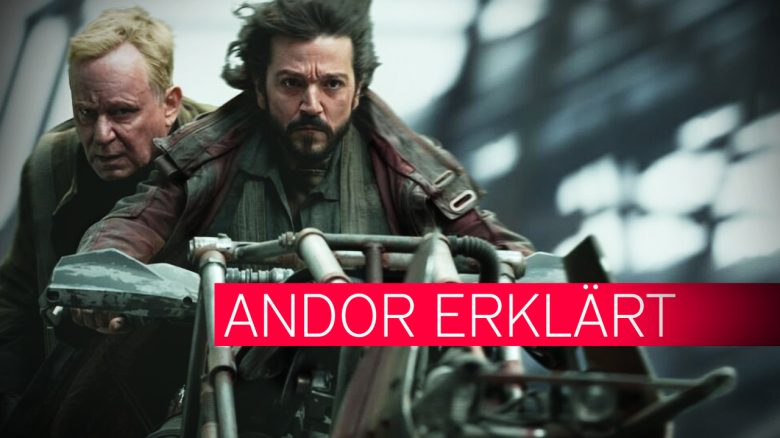
In a new video, Marco Risch from Nerdkultur discusses the beginning of the series Andor from the Star Wars universe and what makes it so special.
Who is Marco Risch? Since 2015, Marco Risch has been focusing on news, analyses, reviews, and interviews about current films and series on his YouTube channel Nerdkultur .
In addition, he meets weekly with his colleague Yves Arievich and chats on the Podcast Nerd & Kultur about pop culture film topics like Star Wars, Marvel, and DC.
Both the YouTube channel and the podcast are part of the Webedia network, which also includes MeinMMO.
In one of his latest videos, Marco discusses the Star Wars series Andor in light of the second season. He explains why the series is so good and so different from other series in the Star Wars universe.
Even the look is different from classic Star Wars
What makes Andor so different from other Star Wars projects? Right at the start of the video, Marco makes it clear that you can see immediately why Andor is different. It does not look like Star Wars, but like classic cyberpunk, as seen in Blade Runner (1982).
The first season of Andor does not show how the main character rebels, but how he got to that point. His original goal is to find his sister. Marco explains how the actor, Diego Luna, has a special connection to Cassian. Luna hails from Mexico and understands the feelings of Cassian, who embodies a typical migration story through his name change from Kassa
to Cassian
.
The inner conflict is also portrayed by the camera, which focuses solely on him. The inner conflict is also evident in one of the first scenes where we see how Cassian has no choice but to kill in this dystopian world
.
For the analysis of the first three episodes, Marco focuses on three points: the unique structure, the camera, and the parallels between characters.
Structure and Camera
What is special about the structure? Marco explains that the first season of Andor is structured into 12 episodes in the form of chapters. Tony Gilroy, the creator of the series, hired a different writer and director for each chapter (each consisting of 3 episodes). He wrote the first 3 episodes himself while Toby Haynes directed them. He is known for Sherlock, Doctor Who, and Black Mirror.
The first 3 episodes have 3 important locations. Marco compares the beginning to the cyberpunk genre, while the junk planet Ferrix resembles Wall-E. Alongside this is Kenari, which tells the backstory of Cassian and shows parallels to Lord of the Flies. To emphasize the previously mentioned focus on Cassian’s past, there is an unknown language and no subtitles on Kenari.
Ultimately, the past also reveals what is slowly happening on Ferrix.
How does the camera narrate? According to Marco, one of the most important aspects is also the camera. It shows the status of the characters. When the camera is with the authorities, it is wide and steady. It shows us order.
However, when we are with the oppressed
, the camera is more restless. It is close and shaky.
This represents the unrest. But there is also manipulation. When the authorities are in a chaotic situation, the camera is also shaky and restless with them. Marco compares the camera style to an indie film, thus moving further away from Hollywood and classic Star Wars.
Although Gilroy draws on the Western genre, according to Marco, he does not use its heyday but the nihilistic late western
.

The Character Syril Karn
In the last part of his analysis, Marco focuses on the character Syril Karn. Everything escalates because of him, stemming from the two employees of the security service. Unlike his superior, Hyne, Syril is principled. This is also shown through the staging, which often depicts him standing alone.
He meets Linus Mosk, who is more fanatical but equally enthusiastic. Together they want to capture Cassian, but there is resistance. Mosk, Syril, and their mercenaries are pushed back on Ferrix, using the simplest of means, fitting for a rebellion.
This is also represented by the bell ringer, who initially symbolizes routine and order, but later transforms into a signal for resistance and rebellion. You can find another analysis by Marco here: Disney can’t just copy this

Your opinion is important to us!
Do you like the article? Then let us know!