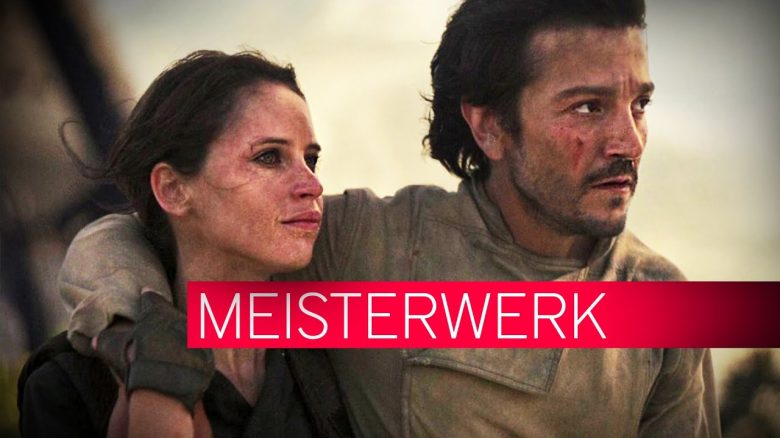
In his new video, Marco Risch from the Nerdkultur channel talks about Tony Gilroy’s work on Rogue One and the series Andor, and how it has changed Star Wars forever.
Who is Marco Risch? Since 2015, Marco Risch has regularly been uploading videos to his Nerdkultur channel on YouTube that cover news, reviews, analyses, and interviews on various films and series. Among other topics, he discusses Star Wars and Andor, for which there is already an analysis of the finale of Season 2.
In addition, he and his colleague Yves Arievich discuss various topics from pop culture weekly in the Nerd & Kultur podcast.
Both projects are part of the Webedia network, which also includes MeinMMO.
In his new video, Marco once again addresses the Star Wars film Rogue One and the series Andor. Their two seasons told the backstory to Rogue One, which in turn is the prequel to Episode 4. In the video, Marco highlights the significance of showrunner Tony Gilroy for the franchise and what makes his work on Star Wars so special.
Gilroy saved Rogue One from chaos
Why is Tony Gilroy so important? Right at the beginning of his video, Marco explains how Gilroy came to be involved with Star Wars. He was actually not a fan of the brand, unlike Gareth Edwards, the director of Rogue One.
However, Gilroy was supposed to help with advice after the shooting was completed. When he saw the first cut of the film, he reportedly labeled it a lost cause that could no longer be saved. Nevertheless, he did not want to give up, and many reshoots occurred, in which Gilroy’s ideas were incorporated. Among other things, Gilroy scripted the now-iconic appearance of Darth Vader at the end of Rogue One.
Because working with him had gone so well, Gilroy was able to submit his own pitch for a Star Wars project. He seized the opportunity and pitched the series Andor.
What makes Rogue One and Andor good? Marco emphasizes how differently the two projects feel compared to the rest of Star Wars. They are much more realistic, even in their presentation. Accordingly, Andor actor Diego Luna plays in a naturalistic way. The camera is especially hectic and excited with the rebels – with the Empire, it is much calmer and shows clear, clean images that at times remind one of Stanley Kubrick.
At the same time, Marco sees a clear visual language in the camera work: The camera often moves forward, showing a drive to move forward that perfectly fits the rise and strengthening of the rebellion.
The video also shows how much Rogue One and Andor reflect each other in some moments. For example, the introduction of Cassian Andor is presented quite similarly in both cases – only the character is much more experienced by the time of Rogue One.

Andor takes more time for the characters: While Gilroy had to deal with already shot material in Rogue One, he was able to work much more freely in Andor – together with his brother John Gilroy, who was responsible for the editing. This led to calmer moments where the characters come fully into their own and are not rushed in a cutting frenzy from one event to the next.
Supporting characters thus receive their well-deserved moments, even those who were not present during the filming of Andor: Gilroy used old, previously unused footage from Episode 4, explaining through the death of a pilot why Luke later receives a place in the flight squadron.
Real locations, such as in London, make the series tangible and authentic. The fascism from Star Wars is successfully depicted, showing that it also destroys those who have worked for it.
Thus, the overall package Rogue-One-Andor, according to Marco Risch, tells an exciting new trilogy that has been overlooked, in which it ultimately comes down to who lives for what – not for what one dies. MeinMMO editor Karsten has experienced Rogue One and Andor similarly: Star Wars has a new “best trilogy” with about 1,400 minutes of runtime