A YouTuber cools his graphics card with automotive oil to improve performance. While it’s a messy affair, performance increases by up to 16%.
It is not uncommon for gamers to try various techniques to cool their (gaming) hardware in order to improve performance. However, an enthusiast has come up with a particularly interesting idea:
The user submerged his graphics card, an Nvidia GTX 1060 Ti, in Automatic Transmission Fluid (ATF) and used a car transmission cooler as a radiator. ATF is typically used in the automotive industry, not in hardware. The experiment is reported by the English-language magazine Tom’s Hardware.
Graphics Card in Automotive Oil Yields Up to 16% More Performance
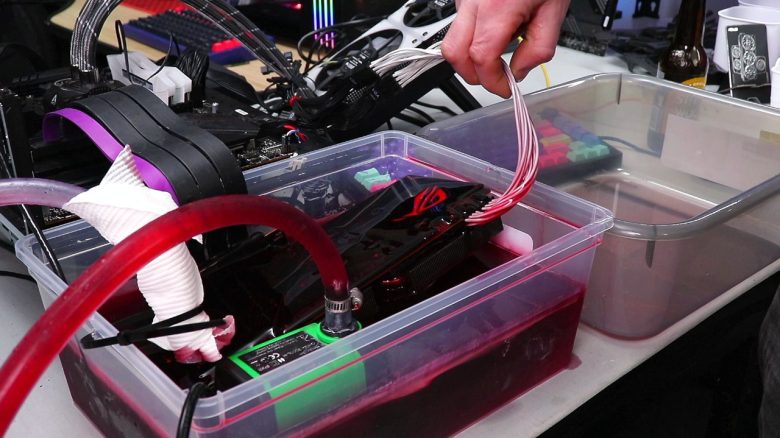
What exactly did the user do? The YouTuber took a large plastic container, into which he placed a ROG Strix GTX 1060 that had been reduced to its circuit board and heatsink, and connected it via a PCIe riser cable to a clean motherboard outside the container. He then poured ATF over it, filling the container about halfway.
He then installed a submersible pump in the container to circulate the liquid, which was connected to an external pump that allowed for the exchange of hot ATF for cold. The heated liquid was then routed through a car transmission cooler that he used as a radiator. The cooled liquid then flows back into the plastic container to cool the graphics card again. You can watch the entire experiment directly on YouTube:
What does it all bring? Surprisingly a lot. The user conducted some benchmarks with the modified graphics card.
In various gaming and synthetic tests, he observed a constant improvement of around 10%, with the benchmark program 3DMark showing an increase of up to 16%. This was achieved partly because the graphics card constantly ran at a boost clock of 2,160 MHz, which worked well due to the good cooling.
He conducted the same experiment with a 1080 Ti as well, but the results were somewhat weaker. Here, the performance gain was a maximum of 7%.



Nvidia’s current RTX 5000 generation has come under criticism as power cables are burning or becoming severely damaged. One user has developed a daring construction to prevent this. However, his method is not exactly space-saving: Hobby technician creates daring construction to prevent the cables of his RTX 5090 from melting