

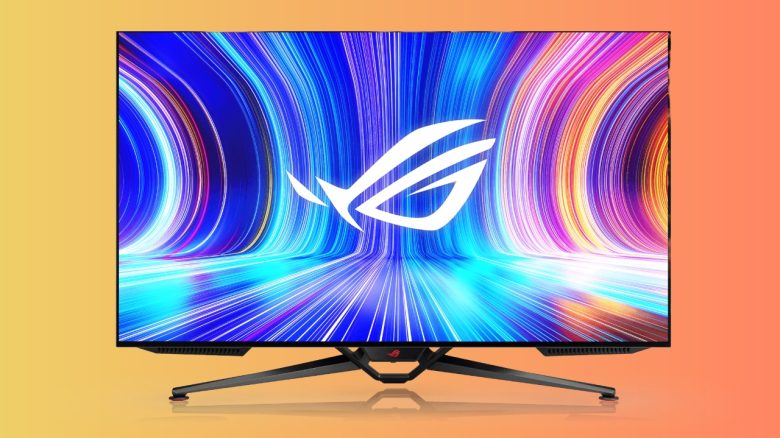
OLED monitors have been increasingly popular in recent years. A market research company now wants to demonstrate with a study why gamers have an advantage while playing with OLED.
What is reported in the study? Trend Force, a global research and consulting company, published a study stating that the sales of monitors have risen sharply and that gamers are the main buyers.
The company based in Taiwan states in the study from November 18, 2025 that 12 percent more OLED monitors were sold in the third quarter of 2025 than in the last quarter. Compared to the fourth quarter of 2024, it is even said to be 65 percent more.
In total, about 644,000 OLED monitors are said to have been sold in the third quarter of 2025.
Perfect contrast, deep black, and low response times are selling points
Why is OLED more popular among gamers? Trend Force writes in its study that the advantages of OLED, which include low response times, vivid colors, and high contrast values, are especially preferred in high-end gaming.
As each pixel lights up individually in an OLED display, there is no permanent backlighting, and black pixels turn completely off. This leads to significantly better contrast and deeper black compared to other displays.
Another advantage for gamers that Trend Force highlights is the low response time of the monitors. For comparison, an OLED display has an average response time of 0.03 milliseconds. A conventional IPS gaming monitor ranges between 1 – 8 milliseconds, depending on the display model (via newhavensdisplay).
Additionally, according to Trend Force, many models support high refresh rates of up to 240 Hertz or more, which in turn provides a clearer image in action-packed scenes. This is especially preferred by competitive players, as the higher the FPS rate, the more accurately you can aim and hit in a shooter, for example. Read more about it on MeinMMO.
Burn-in and high costs are counterarguments
What are the disadvantages of OLED? Displays with OLED technology can experience what’s known as burn-in, where static content is burned onto the monitor and remains visible even with changing images. However, there are now features like pixel-cleaning that are designed to minimize the burn-in risk.
Furthermore, the diodes in OLED displays degrade over time, leading to reduced brightness and luminosity. Thus, the device’s lifespan decreases faster than that of an LCD counterpart. Similarly, OLED monitors achieve lower peak brightness than IPS displays (via chip.de).



Nevertheless, a downward trend in the prices of OLED display technology is expected to become apparent. Therefore, it is probably only a matter of time before the technology becomes affordable for everyone. What happens to an OLED display if it is constantly on can be read on MeinMMO: Experts tested 100 OLED TVs for two years, and all devices had the same problem.

Your opinion is important to us!
Do you like the article? Then let us know!