

Godzilla has been terrorizing major cities and screens around the world for over 70 years. Over time, there have been many versions of the giant lizard, but one in particular stands out. In 2016, perhaps the scariest variant of the iconic film monster was released, which MeinMMO editor Nikolas Hernes analyzes.
Which version is it? In 2016, after 12 years, a new Godzilla movie from Japan was released again. For Shin Godzilla, the legendary director Hideaki Anno took the helm. He is best known for Neon Genesis Evangelion.
Although the film was inspired by the original from 1954, it presented Godzilla in a new, frightening light. This is due to several factors and a horrific event in Japan.
Shin Godzilla has several forms that become increasingly terrifying
What does Shin Godzilla look like? The monster from the film does not have just one form; throughout Shion Godzilla, it continuously evolves. Like the first Godzilla, the creature was an ancient sea creature that was polluted with nuclear waste 60 years before the events of the film.
Instead of dying, the creature adapted, fed off the nuclear remnants, and grew. It evolved to the point where it could come ashore. In the film, the second form is then shown. With large bulging eyes, Godzilla manages to come ashore and crawls through the streets, destroying everything and causing radioactive contamination.
However, the monster does not seem to destroy consciously. It appears as if it is in pain, gasping for air. This is further emphasized when it is learned that Godzilla must return to the sea to cool down. Afterwards, it returns even bigger and more dangerous. Its fourth form further develops this.
Close to the classic design, it now walks on two legs and looks significantly more sinister. It almost seems as if Godzilla now has a malicious consciousness. It does not have classic scales, but resembles techno-organic designs by H.R. Giger, which can also be found in the Xenomorph from Alien.

The red spots on its body appear like open wounds and are meant to cool it down. Its destructive power also increases with each form, and it seems unstoppable. It not only has the iconic atomic breath but also lasers that it can shoot from its tail and body.
Perhaps the strongest ability of Shin Godzilla is its rapid adaptation. It adapts to every situation and mutates simultaneously. This is also evident in its final form. People manage to defeat the monster by freezing it. But instead of a dead body, a fifth form is seen.
From its body, seemingly small creatures grow that resemble humanoid beings. Here, Godzilla almost looks like a being from cosmic horror works. While we do not know what happens next, these humanoid beings fit into the continual evolution of Shin Godzilla.

The human despair
Why is it so scary? Shin Godzilla represents, like few horror works, a special kind of despair. Like the first Godzilla, this monster was originally created because humans used nuclear weapons.
A monster has been created that can hardly die because it continuously evolves and seems to suffer in the process. In the film, Godzilla is also referred to as the incarnation of God
and could also be interpreted as punishment
that mimics human evolution. Its final form particularly fits this.
The despair of the people is also reflected in the soundtrack. Shiro Sagisu is responsible for it, whom fans of Neon Genesis Evangelion or Bleach might know. With pieces like Persecution of the Masses
or Who Will Know
, Sagisu opts for less epic sounds but instead for calmer operatic vocals.
In Persecution of the Masses
, innocent people are sung about, whom one should not blame. In Who Will Know
, the question is asked whether one will remember the person. This highlights the situation of ordinary citizens who are not responsible for the emergence of Godzilla but still suffer from it.
Hideaki Anno already dealt with the downfall of humanity in Neon Genesis Evangelion, which they themselves triggered. Godzilla transforms from a harmless creature into a diabolical object of destruction. The people of the destroyed cities cannot defend themselves and rely on the government. For this, Hideaki Anno draws on a tragic event as a source of inspiration.

Like the original, Shin Godzilla is based on a trauma
What is behind Shin Godzilla? Even in 1954, Godzilla was not just a film about a giant monster, it was the processing of a historical trauma. This also applies to Shin Godzilla, as the film is a metaphor for the Fukushima disaster that occurred in 2011 (via The Crescent Magazine).
On March 11, 2011, a massive earthquake struck Japan, causing damage at the Fukushima power plant. Radioactive materials were released into the atmosphere and water, contaminating everything around the area.
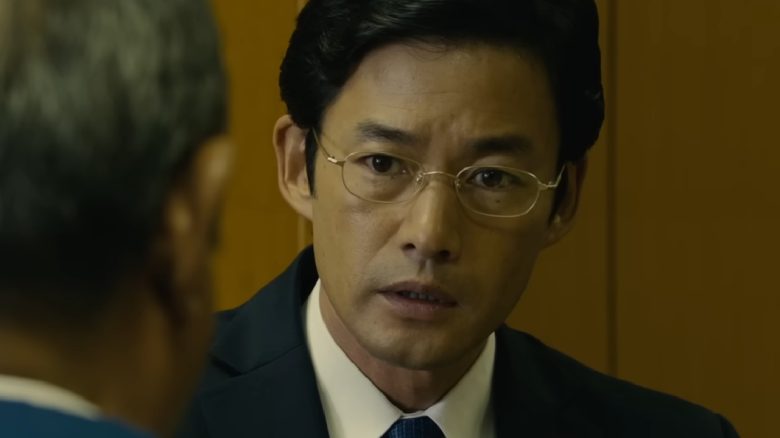
The metaphor for a societal catastrophe is also shown in an important aspect of the film: the politicians. In the film, much time is spent with politicians who discuss which ministry needs to take care of which problem during the destruction of Japan and what bureaucratic measures will be taken.
These are not action-packed scenes, but they also symbolize the criticism of the Fukushima incident. There was also criticism of the government, authorities, and disaster management during the Fukushima incident for acting too late (via nuklearforum.ch).

Why is Shin Godzilla scary? Shin Godzilla does not rely on jump scares, ghosts, or brutal kills. The film recalls cosmic horror. Godzilla is a force of nature created by humans. It shows that humans can create something that cannot be stopped and that could mean the end of humanity.
Just as helpless as one feels in many situations when watching the news, so do the people in Shin Godzilla. This has been represented by the monster since 1954 and also in its reinterpretation in 2016. I felt genuine chills in the cinema after a long time, and it’s Godzilla Minus One’s fault

Your opinion is important to us!
Do you like the article? Then let us know!