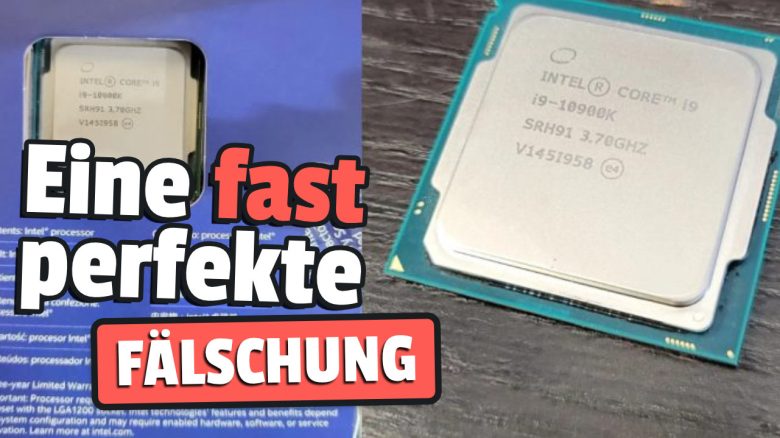
A player buys a new processor. But only Intel’s support can explain that it is a fake product. The user has purchased an almost perfect counterfeit.
A player reports on reddit that he has bought a new Intel processor. The Intel i9-10900K costs around 400 euros and is still an excellent CPU despite its age (released in 2020).
At first glance, the purchased processor looks like an official i9-10900K in the photo, which you can buy for around 400 euros on Amazon or from other retailers. In reality, however, it is just a cheap “Intel Pentium.”
The customer support from Intel explains this to the puzzled buyer. In the user’s email, you can also see that he bought the product on Amazon.
2D matrix on CPU indicates it is a counterfeit
How can you recognize the counterfeit? Intel processors have a so-called 2D matrix. This 2D matrix looks like an elongated QR code at first glance. However, it contains the serial number of the processor. With this, you can find out what processor you have and how long the warranty still runs. Intel also states this on its official website.
The customer support explains to the shocked player that the purchased processor is an “Intel Pentium.” These processors are significantly cheaper, usually available for under 100 euros. Typically, these are budget processors for low-cost office systems.
Can you check this yourself? Yes, you can. The easiest way is actually to download Intel’s official “Reverse Logistic Toolkit” software and use it to scan the 2D matrix on your processor. Theoretically, you could also download third-party apps that have the capability to decode 2D matrices.
Is this possible with AMD as well? Yes, with AMD you can also check your product, but there is no 2D matrix; instead, there is “only” a code that you can compare (via AMD.com). The code is located directly on the CPU and on the sales box.



How to protect yourself against fake products and strange offers
Check prices: In general, suspicious prices are always a good sign. If a product is being sold significantly below market value, you can be sure that something is not right.
Check reviews and sellers: Take a close look at who you are buying from. With “Sold and shipped by Amazon,” you rarely go wrong, but with other sellers, you should check who is selling. New sellers with few reviews are more questionable, but they may just be new merchants. If the sellers lack a proper imprint or if the information is incorrect or you end up nowhere, these are better indications.
Amazon sells the product itself: In some cases, you can also get a counterfeit when buying directly through Amazon. There are always users who report that other buyers purchase items on Amazon and then secretly swap the contents.
You can only partially protect yourself against this; after all, Amazon offers buyer protection. However, this doesn’t always help, as a family man recently found out. In this case, Amazon promptly denied the refund for the fake product: