

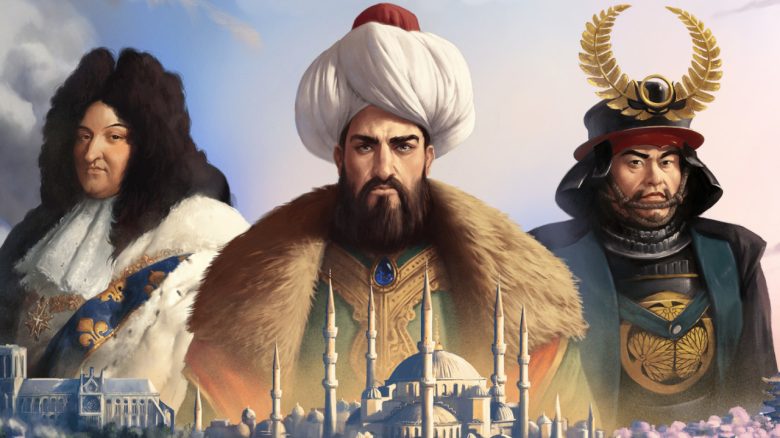
MeinMMO author Schuhmann has been playing strategy games for more than 20 years, but what fascinates him about Europa Universalis IV (Steam) from Paradox is how different the player experience is depending on which country you start with.
This game is about:
- Europa Universalis IV was released in 2013 and has since received 16 expansions. The entire bundle costs €370 on Steam.
- In Europa Universalis, you lead a nation from 1444 to 1821. You have the entire world at your disposal and can wage wars, conduct research, or develop your country.
- Over the years, the game has become extremely complex. Each expansion has customized and refined specific countries with ever-new mechanics to accurately reflect the history and characteristics of each nation.
The Turks are powerful, but break down from decadence
This is how I played Europa Universalis IV for a long time: I have spent hundreds of hours with the game and have almost always played as the Turks. The Turks, or “Ottomans”, are nominally the strongest nation at the beginning of Europa Universalis, but they have a “programmed disadvantage”: decadence.
Due to the inflated court and the intrigues in the harem, the empire becomes decadent over the centuries; the army weakens, the Turks become effete, and about 200 years after the game starts, around 8 to 12 hours in a game, various catastrophes hit that repeatedly throw me out of the game.
A game typically proceeds as follows:
- In the first 2 hours, you conquer Constantinople, present-day Istanbul, and Greece, establish a position of power, and can expand the empire in all directions.
- In the next 10 hours, I feel omnipotent and push Austria and the Mameluks in front of me; the world is a sandbox: I’m in control.
- But from hour 13 onwards, your own castles fall within seconds, while you have to besiege enemy fortresses for minutes. Your own armies crumble under the enemy’s fire. The empire falls apart.
Because in reality, one should play the Ottomans strictly according to the guide, flipping certain switches, granting and revoking privileges to reach tipping points and fulfill missions in the complex mission tree. But I don’t enjoy playing this way.
This was my alternative: So in recent days, I’ve tried to play other countries and noticed how much the player experience changes, even if you only stay in Europe and in the starting year of 1444:
- As Brandenburg, you form Prussia and become a military power, but constantly struggle with the small states of the empire forming a coalition against you.
- As Austria, you are the emperor of the Holy Roman Empire, conquer Italy, and are diplomatically involved. But it is surprisingly difficult to raise a reasonable army, and you have the damn powerful Turks at your door.
- As France, you first have to deal with the annoying duchies, fight the Hundred Years’ War with England, and if Burgundy forms an alliance with Austria, it causes headaches.
- Those playing with Castile will discover the New World and Christianize North Africa.
And these are just the major European nations; you can also play in Japan, India, or as the Incas, finding different conditions and situations from which you must make the best.
Events and history provide variety
This adds additional variety: The leader you play is extremely important. Each leader has specific values that significantly influence how quickly a nation develops. A ruler has points in administration, diplomacy, and warfare. The higher the ruler’s values, the faster the 3 most important resources in the game, which grow by a certain number each month and are constantly needed.
- Those burdened with a fool (0 /0/0) will lag decades behind in the struggle for power.
- A genius (6/6/6), on the other hand, is an advantage.
Events cause such figures to emerge. They also give countries additional advantages or disadvantages, often rooted in history. For instance, Brandenburg initially looks like it is stuck and can do nothing. But quickly an opportunity arises to buy 2 provinces from the Teutonic Order for 100 ducats; a mission is completed, and new claims on territory arise, allowing you to conquer Stettin, suddenly opening up new possibilities.

A strategy game like no other
This fascinates me: In normal strategy games, even complex ones like Stellaris or Civilization 6, the game is ultimately always the same and only changes in nuances. It usually revolves around the 4X: You explore the world around you, build cities in the best locations, and try early on to capture enemy cities to gain an advantage.
However, in Europa Universalis IV, the game changes completely through the individual mechanics that the 16 expansions have refined for different nations. The game delves extremely deep into mechanics to simulate the historical situation of various countries.
The great thing is: This is not just pretense; it is not just cosmetic like in many other games, but truly profound and in-depth. Europa Universalis IV in Ironman mode, needed for achievements on Steam, is often unfair and frustrating, but also wonderful.
It is certainly not a game for everyone, and many will spend days trying to understand what is happening and how to read the game, but if you really delve into Europa Universalis IV, it offers so much more than many other games: A strategy game on Steam costs €370 – I played it

Your opinion is important to us!
Do you like the article? Then let us know!