

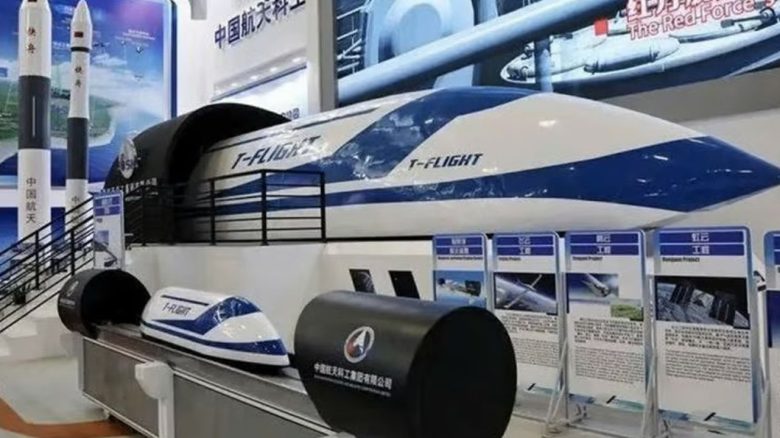
In 2008, a country lag behind the West in the widespread provision of high-speed rail. Today, it is working on maglev trains that could revolutionize the future of travel.
What kind of train is this? China is currently working on high-speed rail and a technology that aims to connect the entire country in record time, rendering air travel unnecessary. A new generation of maglev trains, which are expected to reach speeds of 1,000 km/h, is making this possible.
In the long term, the “T-Flight” model is set to follow, which is expected to achieve a speed of 4,000 km/h. Current maglev trains from China have already reached a speed of 431 km/h since 2021 and are considered the fastest in the world (Source: globaltimes.cn).
The Future of Travel
How are such speeds possible? Maglev trains levitate thanks to powerful magnets and electromagnetic fields on the tracks, without their wheels touching them. The new, significantly faster generation of trains is expected to operate in vacuum tubes to minimize factors like air pressure and resistance as much as possible.
The company behind the technology, the “China Aerospace Science and Industry Corporation,” also aims to use superconductors to enhance magnetic levitation and allow the train to hover up to 100 mm above the track. According to experts, this should keep the train stable even at extreme speeds.
What is the current status? Development on the “T-Flight” has been ongoing since 2017. Last year, as reported by fanaticalfuturist.com, they achieved initial successes, reaching a speed of 623 km/h in a test. In summer 2025, the next record was set at 650 km/h, as reported by cgtn.com.
This year, they aim to surpass the 800 km/h mark. Following that, they will move into the next phase to prepare for the “1,000 km/h” threshold. To achieve this, they want to extend the test track to 60 kilometers. Speeds of 2,000 and 4,000 km/h are next on the agenda.
China on the fast track: The enormous ambitions behind the maglev trains are even more remarkable considering that in 2008, China had just 120 kilometers of high-speed rail, specifically between Beijing and Tianjin.
Since then, a lot has changed. China is now by far the most advanced country in terms of the widespread deployment of high-speed rail.
According to data from worldpopulationreview.com, China has over 40,000 kilometers of high-speed tracks. An additional 12,800 kilometers are under construction and over 11,000 more are planned. In second place: India, with a total of 8,000 kilometers. Third place: the USA, with 6,100 kilometers.
Germany ranks 12th, with 2,000 kilometers of high-speed tracks, a large portion of which is already operational. Relatively few new tracks are currently in progress or planned.


Recently, China achieved another milestone: The maiden voyage of the “Istanbul Bridge” started a few weeks ago and took the Chinese container ship through a new northeastern passage across the Russian economic zone to Europe. Find out more here: A country masters the previously impossible sea route, enabling goods to be brought to Europe in half the time – Unfortunately, the reason is not so nice.

Your opinion is important to us!
Do you like the article? Then let us know!