

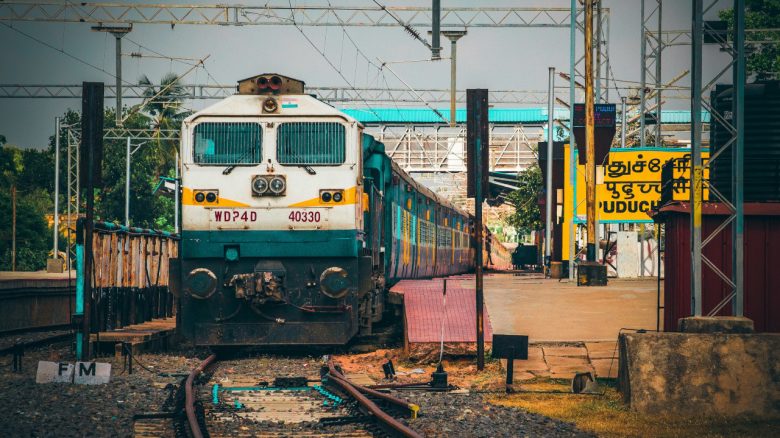
In India, millions of passengers are transported by train every day. However, according to the state railway, there are far too many fare evaders. Together with another company, they have now developed a clever idea to minimize the number of fare evaders. And this is reportedly supposed to work.
Which country is it about? The Indian Railway is the state railway of India and is responsible for the majority of nationwide rail traffic. Approximately 24 million passengers are transported daily. For comparison: The German Railways transport 7.3 million passengers daily (via germany.travel.de)
However, in India, there is a problem: The trains and stations are so overcrowded that the conductors have difficulty checking every single passenger. As a result, there is a large number of fare evaders who travel without tickets. This costs the railway millions in revenue every year.
But instead of responding with stricter enforcement of regulations, the Indian Railway in Mumbai has taken a more inventive approach to convince more people to purchase tickets.
Every train ticket in India is a potential lottery win
In India, luck, hope, and gambling play a significant role: Indians are said to spend more than the equivalent of $30 billion annually on gambling, which is why this inventive method of relying on a lottery was chosen:
What exactly has been done in India? The Indian State Railway has partnered with FCB India, the largest communication company in India, to develop a lottery called Lucky Yatra.
Every train ticket is now also a lottery ticket, giving travelers the chance to win cash prizes simply by purchasing a valid ticket. Instead of viewing the purchase of a ticket as a duty or obligation, Lucky Yatra turns it into a chance for a potential jackpot.
How does it work? Every train ticket issued by the Mumbai division of the Indian Railway now contains a unique identification number. With this number, the passenger participates in a daily lottery where winners can take home cash prizes. The more valid tickets passengers buy, the greater their chances of winning.
For comparison: A train ticket in Mumbai costs between 5 and 25 rupees. That is between 5 and 25 cents. 100 rupees are approximately 1 euro.
How is the system received? The approach of utilizing an existing need to solve a common problem in the public domain is well received in the community. As one user explains on Reddit, this solution-oriented approach is very good:
A very good approach to think about what the public is actually interested in, and then use that to solve the problem they had.
However, there is also legitimate criticism of the new system of the Indian State Railway. On the one hand, it encourages people literally to engage in gambling, which many consider not to be a good idea. On the other hand, the risk of being caught fare evading is so low that people continue not to buy tickets, argues another user on Reddit:
An interesting concept, but I am not sure if it is effective. At this point, it is more about marketing than politics. The person traveling without a ticket will continue to do so and will not buy a lottery ticket with a cash prize of 1 million. It’s not just about the prize, but also about the hassle of buying the ticket and the low risk of getting caught.



India has also relied on an inventive method in another area: India is placing solar panels over irrigation channels. And the idea is so well received that it is now being adopted by the USA because the benefits outweigh the downsides: The USA is adopting a strategy that India has been using for a long time, using solar panels against extreme heat

Your opinion is important to us!
Do you like the article? Then let us know!